Researchers have developed and characterized biodegradable composite filaments based on poly(3-hydroxybutyrate) and modified starch tailored for fused deposition modeling three-dimensional printing. Addressing the processing obstacles of poly(3-hydroxybutyrate), including its inherent brittleness and narrow thermal processing window, the investigation demonstrated that incorporating controlled proportions of modified starch produces flexible, homogeneous filaments using a custom single-screw extruder. Tested in additive manufacturing hardware, the formulated biopolymer blends exhibited consistent flow behavior and suitable printability, enabling direct fabrication of three-dimensional porous scaffolds. This strategy offers a practical route toward sustainable, bio-based filaments that preserve biocompatibility while expanding bacterial polyester utility in fused deposition modeling.
Additive manufacturing technologies, particularly fused deposition modeling, have transformed biomedical engineering by enabling layer-by-layer fabrication of patient-specific devices, surgical models, and tissue scaffolds from computer-aided design files. In bioprinting, biodegradable polyesters like polylactic acid and polycaprolactone are frequently employed to construct regenerative scaffolds that gradually resorb, eliminating secondary surgeries. Poly(3-hydroxybutyrate), a thermoplastic polyester synthesized through bacterial fermentation, has attracted biomedical interest due to its non-toxicity, biocompatibility, and support for cellular proliferation. However, adoption has been constrained by high production costs, low mechanical strength, thermal instability, and brittleness originating from high crystallinity. Blending poly(3-hydroxybutyrate) with natural starch, composed of linear amylose and branched amylopectin, provides an efficient strategy to reduce raw material costs, improve melt processability, and accelerate biodegradation.
To investigate this composite approach, the research team prepared polymeric blends utilizing commercial poly(3-hydroxybutyrate) donated by PHB Industrial and modified starch designated INDEPEL GUM 90, supplied by Indemil. The INDEPEL GUM 90 starch is engineered to improve compatibility with hydrophobic polymer matrices like poly(3-hydroxybutyrate), enhancing dispersion, reducing phase separation, and facilitating structural homogeneity. Formulations were prepared using one hundred grams of total polymeric mixture across varied poly(3-hydroxybutyrate) and starch weight ratios. Homogeneous dry mixing was achieved using a speed mixer, model DAC 150.1 from FUZK TEC, operated at 1500 revolutions per minute for thirty seconds, establishing uniform pre-extrusion distribution before thermal processing.
Thermal filament extrusion was performed using a custom-built single-screw extruder optimized for biopolymer processing. The experimental investigation evaluated three extrusion regimes to identify operating conditions capable of maintaining uniform filament geometry. Under the first configuration, utilizing a barrel temperature of 160 degrees Celsius and a screw speed of 20 revolutions per minute, the resulting filament demonstrated diameter linearity near 1.75 millimeters. In contrast, the second configuration, at 180 degrees Celsius and 35 revolutions per minute, caused excessive melt fluidity and low viscosity, preventing filament formation. The third configuration, operated at 170 degrees Celsius and 20 revolutions per minute, successfully generated mechanically robust, homogeneous composite filaments approximately five meters in length with a consistent diameter of 1.74 plus or minus 0.10 millimeters measured by digital caliper.
Thermal characterization of neat polymer and blended filaments was conducted using thermogravimetric analysis and differential scanning calorimetry under nitrogen atmospheres. Thermogravimetric measurements were gathered on a Shimadzu TGA-50 module utilizing a nitrogen purge stream at 5 milliliters per minute, calibrated against an indium standard, using sealed aluminum pans loaded with approximately 15 milligrams of material. Differential scanning calorimetry was executed on a Mettler Toledo DSC 1 system operated with a nitrogen purge of 10 milliliters per minute and calibrated with indium. Thermograms were recorded from minus 30 degrees Celsius up to 200 degrees Celsius at a heating rate of 10 degrees Celsius per minute, testing approximately 5 milligrams of sample encapsulated in aluminum pans.
Thermogravimetric profiles revealed distinct degradation behaviors across neat polymer controls and composite formulations. Unextruded 100 percent poly(3-hydroxybutyrate) exhibited an initial mass loss of 0.73 percent up to 258 degrees Celsius, absent in extruded neat filament. Thermal decomposition commenced at 268 degrees Celsius, with onset temperatures between 311 and 313 degrees Celsius and peak degradation at 333 degrees Celsius, yielding residues of 1.80 percent for raw polymer and 0.79 percent for extruded filament. Blends containing 1 weight percent starch showed 1.1 percent mass loss up to 273 degrees Celsius with an onset temperature of 317 degrees Celsius. Formulations with 5 and 10 weight percent starch exhibited similar decomposition with onset temperatures of 307 and 305 degrees Celsius. Blends with 20 and 50 weight percent starch displayed early mass losses of 5.6 and 10.9 percent up to 277 degrees Celsius, followed by decomposition from 256 degrees Celsius with onset temperatures near 313 degrees Celsius and residues of 5.60 and 10.90 percent. Differential thermogravimetry yielded a single peak at 334 degrees Celsius for the 20 percent blend and twin peaks at 323 and 340 degrees Celsius for the 50 percent blend, confirming extrusion preserved thermal stability.
Differential scanning calorimetry provided insights into polymer chain dynamics, crystalline morphology, and melting transitions. Unprocessed raw poly(3-hydroxybutyrate) exhibited a sharp melting endotherm at 177 degrees Celsius, reflecting high crystallinity corroborated by the absence of a glass transition near 5 degrees Celsius or cold crystallization near 50 degrees Celsius. Following filament extrusion, neat poly(3-hydroxybutyrate) melting decreased to 167 degrees Celsius due to chain scission from extrusion heating. Blends containing between 1 and 10 weight percent modified starch maintained this melting temperature of 167 degrees Celsius without substantial shifts, confirming favorable compatibility. At 20 and 50 weight percent starch, the apparent melting temperature shifted to 172 degrees Celsius, overlapping with partial starch mass loss visible in thermogravimetry curves. These calorimetric measurements established precise thermal processing thresholds, enabling researchers to adjust extrusion temperatures to avoid thermal degradation while securing adequate melt flow.
Attenuated total reflectance Fourier-transform infrared spectroscopy was utilized to interrogate intermolecular interactions and verify chemical stability following extrusion. Spectral data were acquired on a Nicolet Nexus Spectra spectrometer fitted with a Golden Gate diamond accessory, scanning from 4000 to 400 reciprocal centimeters at a resolution of 2 reciprocal centimeters. Neat poly(3-hydroxybutyrate) displayed characteristic absorption bands, including carbonyl stretching at 1720 reciprocal centimeters and ester stretching bands at 1275 and 1180 reciprocal centimeters. Incorporating modified starch introduced carbohydrate vibrational signatures, notably hydroxyl bending from water at 1640 reciprocal centimeters, stretching at 1458 reciprocal centimeters, and methylene vibrations at 1150 and 994 reciprocal centimeters. Crucially, diagnostic ester bands of poly(3-hydroxybutyrate) and carbohydrate bands of starch retained their positions and intensities without generating new covalent peaks. This spectroscopic persistence confirms extrusion did not trigger covalent reactions; rather, interfacial cohesion is governed by non-covalent Van der Waals interactions preserving the chemical integrity of both biopolymers.
The cross-sectional morphology of extruded filaments was examined using field-emission scanning electron microscopy. Cryofractured specimens mounted onto aluminum stubs were sputter-coated with carbon using an EMITECH K950X turbo evaporator operating with a single pulse, a 30-second outgassing cycle, and a 2-second evaporation pulse, followed by imaging on a JEOL JSM 7500F microscope equipped with an energy-dispersive X-ray spectroscopy detector. Micrographs of neat poly(3-hydroxybutyrate) filaments revealed internal spherical cavities, likely caused by air bubbles introduced during preparation, although higher magnification demonstrated a compact underlying matrix. Incorporating 1 weight percent modified starch eliminated these interior voids, yielding a dense, bubble-free cross-section. Filaments containing 5 and 20 weight percent starch similarly exhibited cohesive cross-sections, though high magnification revealed discrete micron-sized particulate domains corresponding to starch agglomerates dispersed throughout the continuous polyester matrix.
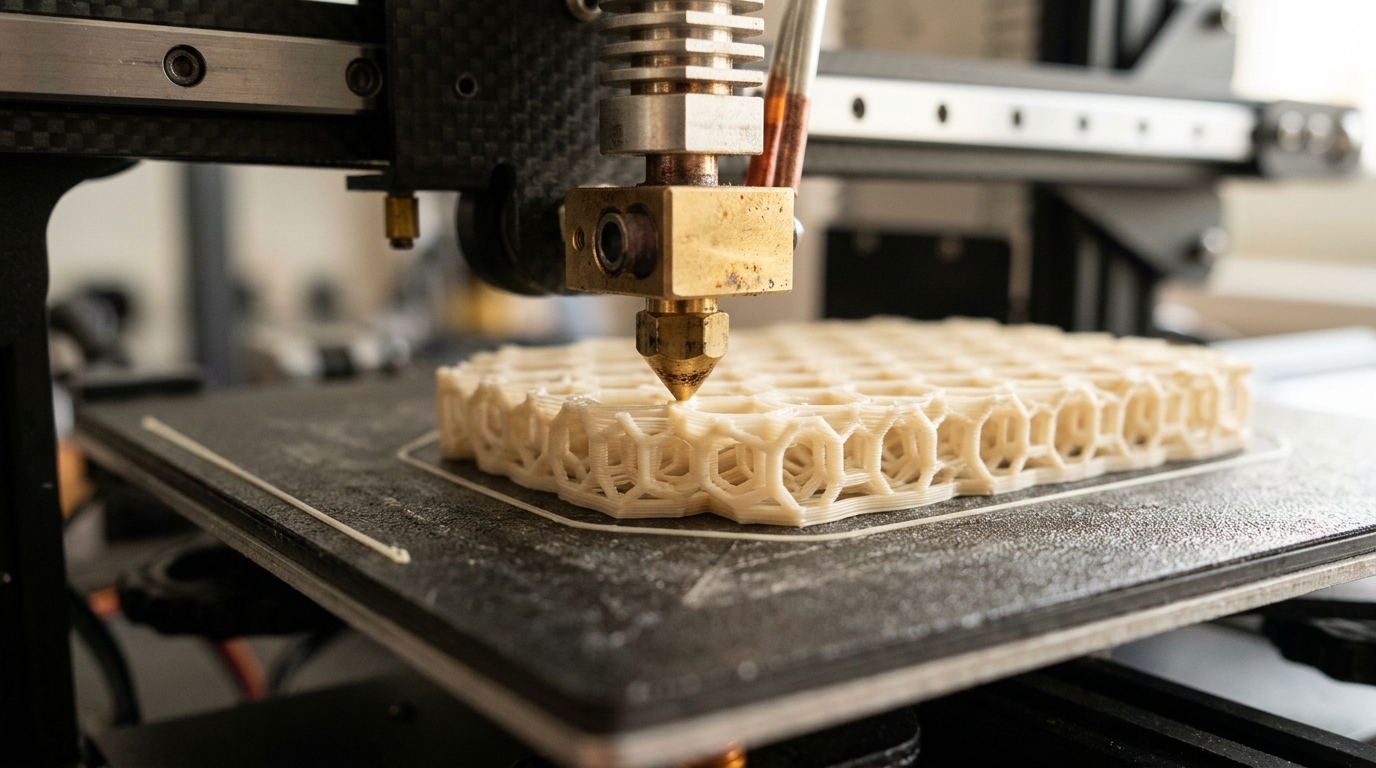
Additive manufacturing feasibility was assessed using a commercial Boa 3D Stella fused deposition modeling printer, with toolpaths programmed using Slic3r and Repetier Host software. Experimental printing parameters included an extrusion nozzle temperature of 170 degrees Celsius, a print speed of 15 millimeters per second, an internal infill density of 20 percent, and an unheated build platform held at 25 degrees Celsius. Prior to scaffold fabrication, preliminary extrusion trials monitored filament feeding consistency, nozzle drag, and melt flow stability across simple geometries such as single-layer lines and rectangular bars. Because the formulation containing 5 weight percent modified starch satisfied the required 1.75-millimeter diameter tolerance, exhibited no void bubbling during electron microscopy, and demonstrated continuous feeding without clogging, it was selected as the optimal composite for scaffold fabrication.
Using this selected 5 weight percent starch composite filament, the research team printed three-dimensional cylindrical scaffold prototypes modeled in computer-aided design software. The completed physical scaffolds possessed a diameter of 10.75 millimeters and a vertical thickness of 5.0 millimeters, reproducing the digital geometric specifications. Scanning electron microscopy of the printed scaffold revealed an open, interconnected lattice architecture with well-defined structural struts and clean layer-to-layer junction bonding, confirming robust inter-filament welding during fused deposition. Closer examination of individual deposited strands confirmed that the composite maintained geometric integrity without collapsing across unsupported spans. Furthermore, high-magnification micrographs revealed subtle surface micro-texturing and fine surface microporosity across extruded tracks. Within tissue engineering, such surface features are recognized as beneficial characteristics that can facilitate cellular attachment, promote mechanical interlocking, and enhance fluid permeability and nutrient transport through porous matrices.
Despite the successful demonstration of filament extrusion and scaffold fabrication, investigators highlighted practical limitations in testing protocols and formulation boundaries. A primary experimental constraint was the inability to perform standardized tensile and impact testing on fabricated filaments. Because the custom-designed single-screw extruder operated in small batch sizes producing approximately five meters of filament per run, the total volume of material was insufficient to print standardized test specimens. Although published studies frequently employ secondary compounding steps or dual extrusion cycles to produce test specimens, the authors emphasized that subjecting thermal-sensitive biopolymers to additional heat cycles would degrade polymer chains and alter blend formulation, invalidating mechanical measurements. Additionally, experimental findings revealed strict compositional boundaries for printability: composite blends containing 5 weight percent or less of modified starch processed smoothly through the nozzle, whereas higher starch loadings failed to feed consistently. Unmodified 100 percent poly(3-hydroxybutyrate) completely failed to print under identical conditions, underscoring the essential plasticizing contribution of low-concentration modified starch and the need for specialized characterization methodologies tailored to additive manufacturing.
Subject of Research: Biodegradable polyhydroxybutyrate and modified starch composite filaments for fused deposition modeling 3D printing
Article Title: Compatible composites filaments based on PHB/starch for 3d printing via fused deposition modeling
Article References: Esper, L. B., Batista, I. T. S., dos Santos, M. V., Ribeiro, C. A., Finocchio, H., Amaral, A. C., & da Silva Barud, H. (2025). Compatible composites filaments based on PHB/starch for 3d printing via fused deposition modeling. Biotechnology for Sustainable Materials, 2(1), Article 5. https://doi.org/10.1186/s44316-025-00026-1
Image Credits: AI Generated
DOI: 10.1186/s44316-025-00026-1
Keywords: Polyhydroxybutyrate, Modified Starch, 3D Printing, Fused Deposition Modeling, Biopolymer Composites, Tissue Engineering Scaffolds, Filament Extrusion, Thermal Degradation, Compatible, composites, filaments, based
News Source: Denise Maddox. (November 9, 2026). Modified Starch Blends Enable 3D Printing of Biodegradable Polyhydroxybutyrate Filaments. Scienmag.