Engineers analyzing prefabricated segmental lining options for underground construction have established how structural segmentation schemes and joint rotational stiffness govern deformation, cracking progression, and internal forces in super-large section tunnels. Using a coordinated framework combining scaled similitude physical model tests and finite element numerical simulations, investigators evaluated two predominant configuration geometries: an upper precast arch coupled with a cast-in-place inverted back-arch, alongside a three-part block precast assembly. Their findings reveal that the continuity of a cast-in-place lower invert provides robust lateral displacement constraints, whereas three-part block assemblies undergo pronounced joint rotations and dynamic internal stress redistributions under high surrounding rock loads.
The growth of urban centers and accompanying land scarcity have accelerated the excavation of large-span and super-large cross-section transportation tunnels. While traditional civil engineering relies heavily on cast-in-place concrete linings, environmental mandates and demands for accelerated construction timelines have prompted a shift toward prefabricated precast segments. However, decomposing a continuous tunnel ring into discrete prefabricated concrete components introduces mechanical discontinuities at connection interfaces. In service, these assembled joints often exhibit diminished structural rigidity, localized stress concentrations, uneven load distribution, and susceptibility to moisture ingress compared with monolithic cast linings.
To rigorously evaluate how different assembly methodologies withstand geostatic pressures, investigators fabricated physical similarity models at a 1:20 geometric scale and tested them under an acceleration ratio of 1:1. The prototype tunnel design, originally specified using C50 concrete, was reproduced in the scaled laboratory environment using M2.5-grade cement mortar reinforced with fine wire mesh to simulate internal steel reinforcement. Model segments were manufactured using custom-engineered three-component modular steel formwork systems comprising inner, outer, and invert assemblies. Alignment pins ensured joint placement, and cast specimens underwent standardized three-day demolding before undergoing a comprehensive 28-day moist curing regimen wrapped in plastic film.
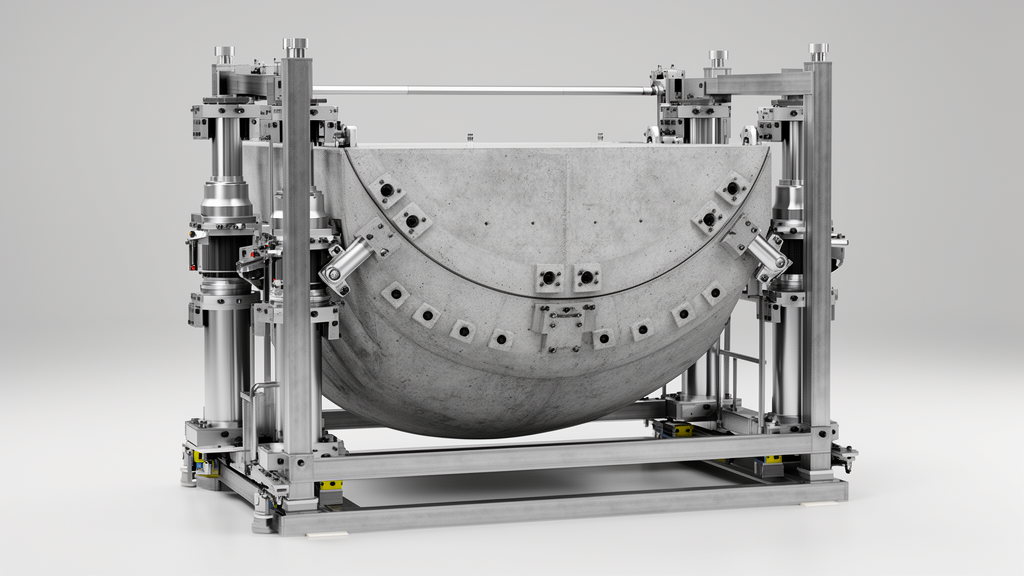
Laboratory evaluation was conducted using a high-precision biaxial synchronous loading test frame equipped with rigid distribution platens and hydraulic reaction systems to simulate surrounding rock and overburden pressures. Specimen blocks featured flat-faced concrete joints secured with through-bolts, replicating field connection details. Stepwise loading increased vertical compressive loads in increments of 50 kilopascals while symmetrically positioned lateral hydraulic jacks maintained a constant lateral pressure coefficient of 0.7. Following each incremental loading stage, researchers observed a stabilization period lasting between one and two minutes to monitor crack initiation, crack widening, joint opening, and overall structural deformation until complete failure occurred.
During experimental loading of the hybrid system combining an upper precast arch with a cast-in-place lower invert, specimens sustained initial loading cycles without measurable damage until external pressures reached sixty percent of the ultimate capacity. At this threshold, initial microcracks emerged across the inverted arch. As loading progressed to eighty percent of capacity, longitudinal fractures developed along the vault, reaching widths of approximately 0.1 millimeters alongside cracking in the spandrel zones. Continued loading generated through-going cracks at the right arch springing. Despite significant vertical displacement and opening at the crown joint, the monolithic invert provided enhanced bending resistance that delayed severe cracking in the spandrel regions.
In contrast, the three-segment precast assembly displayed an entirely different failure mechanism characterized by pronounced joint vulnerability and asymmetric instability. Microcracks initiated simultaneously at the left crown-foot joint, the crown connection, and the right haunch once vertical loading reached sixty percent of ultimate capacity. By the seventh stepwise loading cycle, corresponding to a model load of 340 kilopascals and an equivalent prototype engineering stress level of 6.8 megapascals, joints exhibited extensive crack propagation. When loading approached ultimate capacity, widespread concrete spalling developed at the crown, culminating in global leftward overturning and complete loss of structural load-bearing equilibrium.
Comparative inspections showed that while upper arch crack patterns shared visual similarities, structural damage diverged markedly across the two segmentation geometries. In the hybrid precast arch with a cast-in-place invert, fractures appeared as relatively straight, localized cracks confined largely to the spandrel, haunch, and central invert sections. In the three-segment design, cracks concentrated extensively along joint interfaces, exhibiting complex branching, interlocking networks, and extension into sidewall segments with average crack lengths of 120 millimeters and crack widths ranging between 0.3 and 0.5 millimeters. Shear displacements between adjacent segments concentrated internal stresses directly at joint seams, driving accelerated structural degradation.
To systematically verify the physical observations, researchers executed finite element numerical analyses modeling joint rotational stiffness values from zero to 50 meganewton-meters per radian under Grade V surrounding rock conditions. For the hybrid precast and cast-in-place scheme, decreasing joint stiffness toward zero produced minor increases in internal forces, elevating peak axial force to 1762.4 kilonewtons and peak bending moment to 358.5 kilonewton-meters, alongside vertical displacements of 18.03 millimeters and lateral displacements of 6.21 millimeters. The numerical simulation failure modes closely matched the experimental damage distributions, validating the accuracy of the computational framework.
For the three-segment configuration, numerical modeling demonstrated that joint flexibility fundamentally dictates the distribution of internal bending moments. When joint rotational stiffness decreased, axial forces rose by 7.4 percent to a maximum of 1878.6 kilonewtons at zero stiffness. Crucially, bending moments followed a non-linear path: moments initially decreased to a minimum of 220.5 kilonewton-meters at a joint stiffness of 30 meganewton-meters per radian before increasing sharply as joint stiffness exceeded 40 meganewton-meters per radian. Concurrently, zero stiffness yielded peak lateral displacements of 7.83 millimeters and maximum vertical deflections of 21.82 millimeters, representing substantial increases relative to initial baseline states.
These parametric comparisons indicate that maintaining joint rotational stiffness below 40 meganewton-meters per radian allows three-segment assemblies to undergo structural deformation that favorably redistributes internal moments, though at the expense of greater horizontal waist divergence. When stiffness exceeds this threshold, restrained deformation produces sharply elevated bending moments. Based on structural safety, deformation control, and fabrication considerations, the researchers concluded that tunnel designs should prioritize configurations with fewer segment interfaces paired with cast-in-place inverts, which preserve prefabrication efficiency while providing rigid lateral confinement against severe geostatic loads.
The selection of segment dimensions represents a primary trade-off in precast lining engineering, directly balancing manufacturing feasibility, installation speed, and joint performance. Within manufacturing and transport limits, precast elements should be designed as large as practical to minimize the total count of circumferential joints, thereby substantially curtailing joint seepage pathways. However, the longitudinal dimension must remain bounded within an optimal range to avoid the severe handling hurdles and structural vulnerabilities linked with excessively oversized or undersized components. Addressing these practical parameters, the investigative program implemented an optimized longitudinal segment length of 1.0 meter for both structural configuration schemes.
To simulate underground stresses under Class V surrounding rock conditions, the laboratory setup utilized rigid distribution platens for vertical loading alongside symmetrically positioned hydraulic jacks connected to high-strength load-transfer rods for horizontal confinement. The experimental team positioned each test ring relative to the geometric center of the loading frame using a laser positioning instrument to preserve an accurate load transmission path. Furthermore, the specimen preparation strictly adhered to a multistep casting sequence: formwork surfaces were uniformly coated with release agent, alignment pins maintained horizontal orientation via tensioning systems at joint locations, and concrete was slowly poured and consolidated with mechanical vibrators until free of entrapped air pockets before demolding.
The experimental observations also highlighted notable mechanical interactions within the joint connections themselves. In the three-segment configuration, pronounced joint cracking developed because the progressive opening of the haunch connections shifted substantial bending moments upward to the crown connection. Moreover, while cracks in the hybrid system were largely restricted to upper segments, invert, and footing areas, the three-segment assembly demonstrated systematic crack propagation without random branching. This progression is directly traceable to surrounding rock pressure triggering relative shear displacements at segment seams, focusing stresses at joint interfaces until macrocracks rapidly propagated across the concrete body.
Parametric numerical modeling also demonstrated contrasting sensitivities in displacement response as joint flexural stiffness varied between zero and 50 meganewton-meters per radian. For the hybrid precast and cast-in-place configuration, vertical displacement at the vault gradually decreased with increasing stiffness, whereas the three-segment design exhibited very minor vertical displacement changes up to 30 meganewton-meters per radian before experiencing an abrupt 35 percent reduction when joint stiffness reached 40 meganewton-meters per radian. This marked shift demonstrates that establishing a crown joint bending stiffness of at least 40 meganewton-meters per radian substantially elevates joint flexural capacity, improving the overarching load-transfer capability and system stability of multi-block assemblies.
Experimental conditions nonetheless introduced practical constraints during physical testing. Hydraulic jacks produced a slight deviation during the pressurization sequence, which caused crack locations in the hybrid lining model to shift slightly at the inverted arch, arch foot, and shoulder zones. In the three-segment specimen, initial eccentric loading intensified stress concentrations along the left flank, ultimately triggering the asymmetric leftward overturning failure. Despite these physical test deviations, the final vertical displacement response curves measured at the vault stabilized at 18 millimeters in both physical model experiments and numerical simulations, validating the computational predictions across both segmental designs.
Subject of Research: Mechanical behavior and segmentation design of prefabricated tunnel lining structures
Article Title: Similar Model Experimental Study on the Mechanical Behavior of Prefabricated Assembled Tunnel Lining Structures
Article References: Wang, Z., Huang, H., Li, H., Wu, L., Zhang, B., Luo, W., & Wang, Y. (2026). Similar Model Experimental Study on the Mechanical Behavior of Prefabricated Assembled Tunnel Lining Structures. International Journal of Concrete Structures and Materials, 20(1), Article 69. https://doi.org/10.1186/s40069-026-00937-x
Image Credits: AI Generated
DOI: 10.1186/s40069-026-00937-x
Keywords: tunnel engineering, prefabricated linings, segmental lining, similitude model, structural mechanics, joint stiffness, finite element analysis, geotechnical engineering, surrounding rock pressure, tunnel invert, concrete cracking, displacement response, bending moments, axial force, underground structures
News Source: Denise Maddox. (November 20, 2026). Tunnel Model Tests Reveal Structural Limits of Prefabricated Segment Lining Schemes. Scienmag.