Los Alamos National Laboratory researchers discover a new approach for capturing energy from light-generated, ‘hot’ electrons, avoiding wasteful heat loss
Credit: Los Alamos National Laboratory
LOS ALAMOS, N.M., October 7, 2019– Los Alamos National Laboratory scientists have synthesized magnetically-doped quantum dots that capture the kinetic energy of electrons created by ultraviolet light before it’s wasted as heat.
“This discovery can potentially enable novel, highly-efficient solar cells, light detectors, photocathodes and light-driven chemical reactions,” said Victor Klimov, lead researcher on the Laboratory’s quantum dot project.
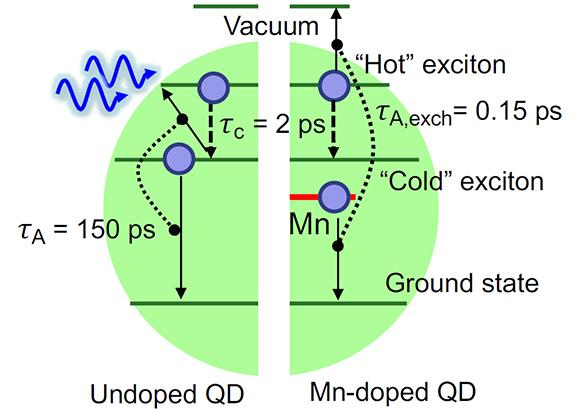
In standard solar cells, a large amount of sunlight energy is wasted as heat. This waste occurs due to the lack of effective approaches for capturing kinetic energy of ‘hot’ electrons generated by photons in the green to ultraviolet portion of the sun’s light spectrum. The problem is that hot electrons lose their energy very quickly due to interactions with crystal lattice that the devices are made of, leading to vibrations known as phonons. This process typically occurs in a few picoseconds (trillionths of a second).
Previous efforts to capture hot-carrier energy have exploited the transfer of kinetic energy from the energetic hot electron to an immobile, low-energy electron exciting it to a current-conducting state. This effect, known as carrier multiplication, doubles the number of electrons contributing to the photocurrent which can be used for boosting the performance of solar cells. In most conventional materials, however, the energy losses to phonons outpace the energy gains of carrier multiplication.
In their study published today in Nature Nanotechnology, researchers demonstrate that incorporating magnetic ions into quantum dots can greatly enhance useful, energy-producing interactions so as they become faster than wasteful phonon scattering.
To implement these ideas, the researchers prepared manganese-doped quantum dots based on cadmium selenide. “The photon absorbed by the cadmium selenide quantum dot creates an electron-hole pair, or an exciton,” said Klimov.”This exciton is quickly trapped by the dopant creating an excited state that stores energy much like a compressed spring. When the second photon is absorbed by the quantum dot, the stored energy is released and transferred to the newly created exciton promoting it to a higher-energy state. The energy release by the manganese ion is accompanied by the flip of its magnetic moment, known as spin. Hence this process is termed spin-exchange Auger energy transfer.”
An intriguing observation of LANL scientists was the extremely short time scale of the spin-exchange Auger interactions – around one tenth of a picosecond. To their surprise, these interactions were quicker than phonon emissions, which were generally believed to be the fastest process in semiconductor materials. To prove that the new effect could beat phonon-assisted cooling, Los Alamos researchers demonstrated that properly designed magnetically doped quantum dots allowed them to extract a hot electron created by an ultraviolet photon before it loses its energy to heating the crystal lattice.
These paradigm-shifting findings open exciting opportunities for exploiting spin-exchange Auger processes in advanced schemes for boosting the performance of solar cells or driving unusual photochemical reactions. Interesting opportunities are also envisioned in areas of high-sensitivity, high-speed light detection and new types of light-driven electron sources.
###
Publication: Hot-Electron Dynamics in Quantum Dots Manipulated by Spin-Exchange Auger Interactions, Nature Nanomaterials, DOI- For Klimov’s paper: https:/
Funding: This work was supported by the Solar Photochemistry Program of the Chemical Sciences, Biosciences and Geosciences Division, Office of Basic Energy Sciences, Office of Science, U.S. Department of Energy.
About Los Alamos National Laboratory
Los Alamos National Laboratory, a multidisciplinary research institution engaged in strategic science on behalf of national security, is operated by Triad, a public service oriented, national security science organization equally owned by its three founding members: Battelle Memorial Institute (Battelle), the Texas A&M University System (TAMUS), and the Regents of the University of California (UC) for the Department of Energy’s National Nuclear Security Administration.
Los Alamos enhances national security by ensuring the safety and reliability of the U.S. nuclear stockpile, developing technologies to reduce threats from weapons of mass destruction, and solving problems related to energy, environment, infrastructure, health, and global security concerns.
Media Contact
James Riordon
[email protected]
505-667-3272
Related Journal Article
http://dx.