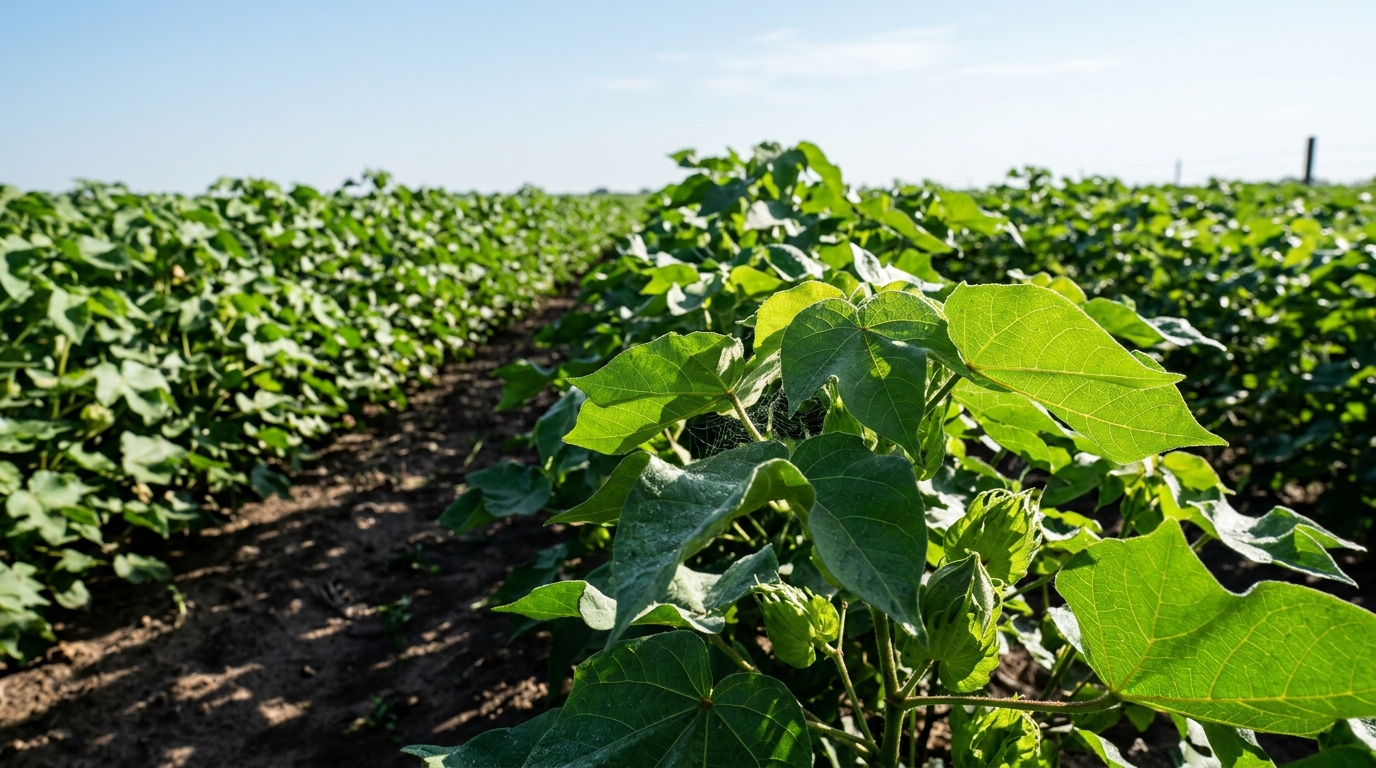
Agricultural scientists have developed an advanced remote sensing approach that significantly improves the accuracy of estimating vertical nitrogen distribution throughout the cotton canopy by modifying traditional attenuation models. Nitrogen plays an essential role in plant photosynthesis, vegetative growth, and overall crop yield formation, making precise canopy diagnostics critical for optimizing fertilizer management. In typical field settings, crops direct higher amounts of nitrogen toward sunlight-exposed upper foliage, creating a pronounced vertical gradient where younger leaves maintain higher photosynthetic efficiency while lower layers show earlier signs of deficiency under nutrient limitation. Standard remote sensing methods frequently struggle to characterize this stratified profile because upper foliage blocks lower canopy visibility and complex light scattering obscures spectral responses from shaded lower layers.
To overcome these remote sensing limitations, previous research introduced the vertical attenuation coefficient of nitrogen, designated as Kt, which describes nitrogen decline across cumulative leaf area index using an exponential function. However, traditional formulations of Kt were established almost entirely upon area-based total nitrogen content, which correlates tightly with leaf chlorophyll content and therefore only accounts for photosynthetic nitrogen pools. Photosynthetic nitrogen typically constitutes roughly 75 to 80 percent of total leaf nitrogen in crop canopies, leaving substantial non-photosynthetic nitrogen components unrepresented. These non-photosynthetic fractions reside within cell walls, cytoplasm, and peroxisomes, functioning primarily in structural integrity and antioxidant enzyme defense. Because standard Kt ignores the optical and physiological characteristics of non-photosynthetic nitrogen, conventional models often produce inaccurate or unstable estimations of canopy nitrogen dynamics.
Addressing this limitation, a research team conducted multi-year field experiments from 2021 through 2023 at Shihezi University in Xinjiang, China, examining the physiological and spectral heterogeneity of cotton canopies under five distinct nitrogen fertilizer treatments ranging from 0 to 450 kilograms per hectare. The researchers systematically divided the total nitrogen pool into photosynthetic nitrogen and non-photosynthetic nitrogen components. To accurately represent these physiological pools without destructive laboratory fractionation during remote sensing, the team established leaf chlorophyll content per unit area as a proxy for photosynthetic nitrogen and formulated an empirical index termed weighted antioxidant enzymes to represent non-photosynthetic nitrogen. This composite enzymatic index integrated measured activities of superoxide dismutase, peroxidase, catalase, and malondialdehyde concentrations using standardized multiple linear regression coefficients.
The structural modification of the vertical nitrogen attenuation coefficient required calibrating the specific proportionality coefficients linking leaf chlorophyll content and the weighted antioxidant enzyme index to their respective nitrogen fractions. Using comprehensive three-year datasets encompassing different cotton cultivars including Gengye 64 and Xinluzao 75, the researchers determined stable proportionality coefficients of 1.915 for photosynthetic nitrogen and negative 0.893 for non-photosynthetic nitrogen, achieving coefficient of determination values of 0.862 for area-based nitrogen and 0.820 for mass-based nitrogen. Incorporating these verified physiological relationships into canopy stratification equations allowed the team to derive a modified vertical nitrogen attenuation coefficient, denoted as K, which successfully couples the exponential decline of photosynthetic components with the linear vertical distribution pattern identified for antioxidant enzyme activity.
To connect the modified mathematical coefficient with canopy reflectance, the investigators employed the radiative transfer model PROSAIL-PRO, which couples the leaf-level PROSPECT-PRO model with the 4SAIL canopy structure framework. By entering measured ranges of biochemical and structural parameters—including leaf chlorophyll, protein content, carbon-based constituents, equivalent water thickness, dry matter, and leaf area index—the model generated a comprehensive synthetic spectral lookup table. Normalization using z-score transformations enabled balanced multi-band matching across visible, near-infrared, and shortwave-infrared spectra without allowing dominant high-reflectance regions to distort parameter inversion. Validation across field measurements confirmed that PROSAIL-PRO inverted leaf chlorophyll, leaf area index, soluble protein, and carbon-based components with coefficients of determination exceeding 0.804.
For extracting diagnostic spectral wavelengths from both simulated and field-measured hyperspectral imagery, the study compared a multi-feature ensemble algorithm combining partial least squares regression, random forest regression, and extreme gradient boosting against the standard successive projections algorithm. Following continuous wavelet transform preprocessing, where fourth-scale wavelet decomposition yielded optimal accuracy for nitrogen attenuation coefficients, the multi-feature ensemble successfully identified primary absorption features across visible, near-infrared, and shortwave-infrared regions. Notably, while traditional Kt features clustered narrowly within pigment absorption zones between 450 and 700 nanometers, features for the modified coefficient K extended into near-infrared and shortwave-infrared bands between 1150 and 1650 nanometers, reflecting chemical bonds associated with malondialdehyde and peroxidase enzymes.
The team subsequently constructed non-linear estimation models using machine learning architectures, specifically comparing random forest, artificial neural network, and extreme gradient boosting frameworks. The researchers introduced a feature fusion modeling strategy wherein the extracted spectral features of modified attenuation coefficients were combined with the distinct spectral features of key physiological parameters, notably leaf protein content, malondialdehyde, and peroxidase. In cross-validation evaluations, the random forest fusion model fusing mass-based modified coefficient Km with leaf protein, malondialdehyde, and peroxidase achieved a weighted coefficient of determination of 0.896, representing a 13.13 percent improvement over non-fusion configurations. Similarly, the area-based Ka model fused with protein and malondialdehyde features achieved a weighted coefficient of determination of 0.922, improving accuracy by 12.30 percent.
Validation on independent datasets collected in 2023 demonstrated that the modified attenuation coefficient consistently outperformed traditional Kt in predicting nitrogen levels across all vertical canopy strata. When inverting nitrogen content across individual vertical layers, the modified coefficient K maintained estimation accuracy above a weighted coefficient of determination of 0.698 across all growth stages. For upper canopy leaves during the full boll-forming stage, the mass-based coefficient model achieved a weighted coefficient of determination of 0.836 with a mean absolute error of 0.178, representing an 8.99 percent accuracy gain and a 15.64 percent error reduction relative to traditional approaches. Area-based estimations during the flowering stage similarly reached an accuracy of 0.811, reducing error by 25.98 percent compared to traditional Kt models.
To evaluate practical agricultural utility and spatial transferability, the investigators conducted independent field validation during 2025 across local commercial production farms encompassing seedling, budding, flowering, initial boll-forming, and peak boll-forming stages. Under diverse commercial soil and management regimes, models utilizing the modified coefficient demonstrated robust stability, yielding weighted coefficients of determination between 0.625 and 0.817 for upper canopy layers, 0.608 to 0.756 for middle layers, and 0.596 to 0.737 for lower layers. Area-based estimations exhibited even greater stability, maintaining validation coefficients between 0.634 and 0.819 across all canopy depths and crop growth phases, confirming that the physiological integration of non-photosynthetic nitrogen buffers against environmental variance.
The study highlights important operational benefits for precision farming, noting that because cotton exhibits nitrogen deficiency symptoms in lower canopy leaves well before upper leaves display detectable chlorosis, accurately retrieving lower-strata nitrogen enables timely diagnostic warnings prior to irreversible yield penalties. The authors identified specific operational boundaries, observing that their experimental setup relied upon near-surface ground-based hyperspectral instruments rather than airborne sensors or penetrating lidar platforms, and was calibrated using fixed three-layer vertical canopy divisions. Further multi-season investigations across diverse crop species, varied canopy geometries, and advanced canopy radiation models such as SCOPE will be necessary to establish broader regional calibration standards for automated precision fertilization systems.
Field measurements collected across multiple vegetative stages revealed marked differences in how fertilizer inputs shaped leaf physiology at contrasting canopy heights. Total leaf nitrogen content, chlorophyll density per unit area, and soluble leaf protein increased steadily alongside fertilizer application rates, reaching their highest concentrations in the sunlit upper canopy. Conversely, leaf mass per area and cumulative leaf area index exhibited opposite distributions, accumulating greater values toward the shaded lower foliage. In contrast to nitrogen and photosynthetic pigments, enzymatic activities governing antioxidant defense—including superoxide dismutase, peroxidase, and catalase, as well as malondialdehyde concentrations—declined as nitrogen availability increased. These antioxidant activities reached their peak levels within lower canopy foliage across nearly all developmental phases, reflecting heightened metabolic sensitivity and oxidative adjustments in older, nutrient-depleted leaves.
The experimental setup also clarified the environmental and technical boundaries that influenced canopy spectral reflectance under real-world conditions. Hyperspectral scans were collected using dual spectrometers fixed eighty centimeters above the canopy, capturing visible, near-infrared, and shortwave-infrared spectra across multiple viewing angles from zero to seventy-five degrees on clear days between noon and two in the afternoon. Radiative transfer simulations using the PROSAIL-PRO model demonstrated that spectral reconstruction was most reliable under lower nitrogen treatments, whereas high application rates yielded slightly lower accuracy. Furthermore, while the model accurately matched canopy reflectance during the flowering and initial boll-forming stages, performance declined slightly during the budding and full boll-forming periods, where strong moisture absorption across shortwave-infrared wavelengths partially masked the subtle spectral signatures of dry matter and nitrogen components.
To evaluate these attenuation models under controlled conditions, the researchers applied continuous wavelet transform analysis across ten decomposition scales. While fourth-scale wavelet decomposition provided the highest accuracy for estimating modified nitrogen attenuation coefficients, third-scale wavelet preprocessing proved optimal when directly inverting nitrogen content across individual vertical canopy layers. These findings demonstrate that tailored spectral preprocessing is essential for isolating subtle absorption features from complex vegetation backgrounds.
Subject of Research: Hyperspectral remote sensing and vertical nitrogen distribution modeling in cotton canopies
Article Title: Improving the accuracy of hyperspectral estimation of cotton canopy nitrogen content by modifying the vertical attenuation coefficient of nitrogen
Article References: Wang, J., Wang, H., Lv, X., Cui, J., Shi, X., Song, J., Li, W., & Zhang, W. (2026). Improving the accuracy of hyperspectral estimation of cotton canopy nitrogen content by modifying the vertical attenuation coefficient of nitrogen. Artificial Intelligence in Agriculture. https://doi.org/10.1016/j.aiia.2026.11.005
Image Credits: AI Generated
DOI: 10.1016/j.aiia.2026.11.005
Keywords: Cotton Canopy, Nitrogen Distribution, Hyperspectral Imaging, Vertical Attenuation Coefficient, PROSAIL-PRO, Photosynthetic Nitrogen, Non-Photosynthetic Nitrogen, Leaf Chlorophyll Content, Weighted Antioxidant Enzymes, Precision Agriculture, Crop Monitoring, Radiative Transfer Model, Remote Sensing, Machine Learning, Shihezi University, Agricultural Technology
News Source: Alan Morgan. (November 19, 2026). Modified Nitrogen Attenuation Models Enhance Cotton Canopy Hyperspectral Nitrogen Estimation Accuracy. Scienmag.