


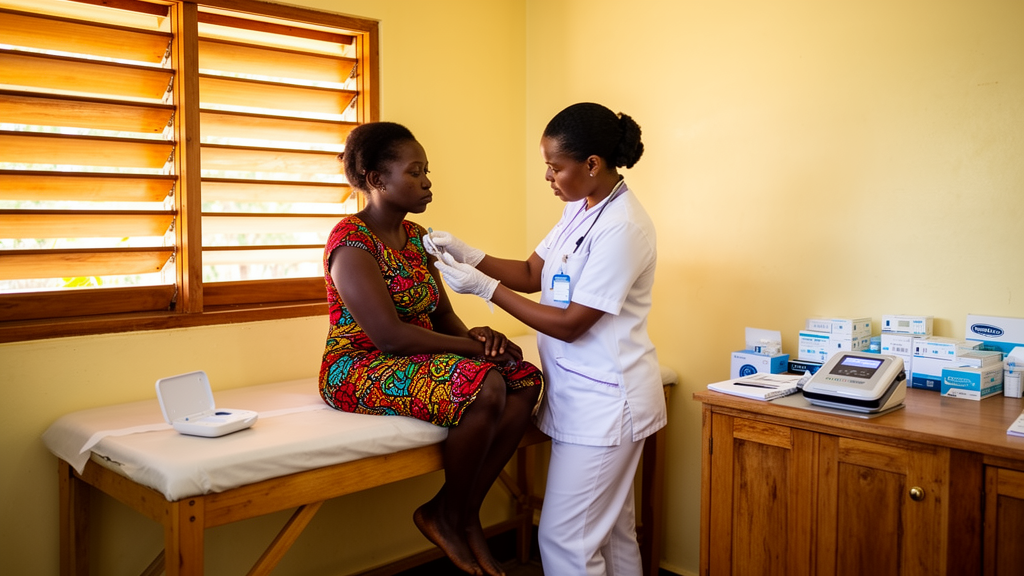
Point-of-care HPV DNA testing of self-collected vaginal specimens, refined with a simple restriction to eight HPV types and an adjusted cycle threshold cutoff, substantially improved the detection of cervical pre-cancer among women living with HIV in Papua New Guinea, according to a prospective clinical cohort study published in BMC Global and Public Health. The study, conducted at an HIV treatment and care service in the National Capital District, recruited 404 women aged 30 to 59 years between May 3 and December 12, 2024, and evaluated how alternative triage strategies performed when added to, or substituted for, standard HPV testing.
The research addressed a persistent problem in cervical cancer prevention. The World Health Organization recommends HPV testing with same-day treatment for cervical screening among women in the general population in low- and middle-income countries, but among women living with HIV it recommends an additional triage step, because HPV testing alone has lower specificity and predictive value in this group. Women living with HIV bear a disproportionate burden of cervical pre-cancer and cancer, with an estimated six-fold increased risk of invasive disease compared with women in the general population. In Papua New Guinea, where cervical cancer is the most common cancer among women and causes an estimated 1,200 to 1,500 preventable deaths every year, the stakes of getting the screening algorithm right are particularly high.
The setting itself carries weight. Papua New Guinea has among the highest estimated cervical cancer incidence and mortality rates globally, with incidence five times that of Australia and mortality fourteen times greater, and it has one of the fastest growing HIV epidemics in the Western Pacific. The country experienced a significant surge in HIV diagnoses in 2024 and 2025, with an estimated 30 new infections per day and over 11,000 new infections, prompting the government to declare a national HIV emergency in June 2025. Earlier field trials in Papua New Guinea were the first to demonstrate the clinical performance, safety, acceptability, scalability and cost-effectiveness of a fully integrated point-of-care HPV self-collect, test and treat strategy in a low- or middle-income country, and that approach has since been adopted across much of the Pacific region.
In the new study, eligible women self-collected a mid-cavity vaginal specimen that was tested on the GeneXpert platform using the WHO prequalified Xpert HPV Test, which detects 14 oncogenic HPV types in five fluorescent channels. All HPV-positive women, and a random systematic sample of HPV-negative women, underwent enhanced visual assessment of the cervix with a portable digital colposcope and provided a clinician-collected cervical specimen for off-site liquid-based cytology, which served as the reference standard. Of the 404 women recruited, 168, or 41.6 percent, tested positive for one or more of the 14 oncogenic HPV types. Cervical specimens were provided by 87.5 percent of HPV-positive women, and 24 of the 187 specimens collected were unsatisfactory for cytology, leaving 163 evaluable specimens.
Using manufacturer-defined cycle threshold cutoffs across all five channels, the estimated sensitivity and negative predictive value for detecting high-grade squamous intraepithelial lesion or worse both exceeded 99 percent, but specificity was a sub-optimal 63.3 percent and the positive predictive value just 18.6 percent. In practical terms, the researchers noted, with HPV positivity of 42 percent among women living with HIV, treating all HPV-positive women would mean around 81 percent of women were treated unnecessarily.
The most promising results came from broader type restriction. Defining clinically relevant positivity as any of HPV 16, 18, 45, 31, 33, 35, 52 or 58, the eight types of greatest oncogenic potential, corresponding to channels P1, P2 or P3 positive, raised estimated specificity to 70.2 percent and positive predictive value to 22.6 percent while preserving sensitivity and negative predictive value above 99 percent. Adding a more stringent assay cutoff, requiring a cycle threshold below 33.99, produced estimated sensitivity of 86.5 percent, specificity of 80.1 percent, positive predictive value of 30.7 percent and negative predictive value of 98.4 percent. Under this fifth algorithm, around 26 percent of women screened would be offered treatment, compared with roughly 35 percent under type restriction alone.
Enhanced visual assessment using the digital colposcope fared poorly. Among HPV-positive women later found to have high-grade lesions or worse, three of four squamous cell carcinoma cases and all 20 cases of high-grade squamous intraepithelial lesion had unremarkable pelvic examination and colposcopy findings, and the assessment detected only one of 24 cases of high-grade disease or worse among HPV-positive women. The visual assessments were carried out by experienced nursing staff who had completed nationally accredited training and clinical mentorship in HPV-based screening, yet the researchers concluded that enhanced visual assessment provided no additional benefit over HPV DNA testing alone and could not be meaningfully evaluated as a triage step in this setting.
The findings align with earlier work. A previous study among 535 women living with HIV in South Africa recommended HPV 8-type restriction combined with modified assay cutoffs, using cycle threshold values entered into a calculator programmed with logistic regression parameters. The Papua New Guinea team argued that their simpler approach, based on type restriction alone or type restriction plus a single cutoff value, would be more operationally feasible in resource-constrained health systems because it requires no additional equipment and only minimal extra staff training. Evidence from other settings reinforces concerns about visual triage: a randomised trial in India found that HPV screen-and-treat and HPV screen, triage and treat with visual inspection detected similar levels of cervical intraepithelial neoplasia grade 2 or worse, while a cohort study in Botswana found that visual triage after HPV 8-type restriction reduced sensitivity from 87.8 percent to 56.2 percent.
Implementation challenges emerged clearly in the study’s follow-up data. All 24 women with high-grade disease or worse were contacted by mobile phone or through community networks and asked to return for their cytology results and further treatment. Three of the four women with squamous cell carcinoma attended specialist gynaecology referral as recommended, and 14 of the 20 women with high-grade lesions completed a repeat pelvic examination and were treated by thermal ablation at the study clinic, with one woman relocating to another province but successfully treated at her local clinic. Multiple contact attempts and reminders were necessary to encourage completion of clinical follow-up, and the authors noted difficulties achieving optimal treatment completion and re-attendance with a multi-visit screening model, despite scheduling follow-up appointments to coincide with routine HIV care visits. No moderate or serious adverse events following thermal ablation were reported.
The researchers, who reported that this is the first such evaluation conducted in the Western Pacific, suggested that in the absence of a suitable triage step, policy makers and clinicians could consider a modified HPV screen-and-treat strategy based on HPV 8-type restriction with or without alternative assay cutoffs for women living with HIV. They recommended phased introduction and scale-up supported by rigorous clinical performance monitoring, including periodic evaluation of positive predictive value in practice. The study’s limitations include the use of liquid-based cytology rather than histology as the reference standard, which the authors justified on ethical and practical grounds, and the possibility that the systematic sampling of HPV-negative women may have introduced selection bias, a risk they judged to be low because the sociodemographic characteristics of sampled women were similar to those of all HPV-negative participants. Secondary outcomes on client and provider acceptability and health system implementation requirements will be reported in a separate manuscript.
Subject of Research: Clinical performance of HPV DNA testing and triage strategies for cervical pre-cancer detection among women living with HIV in Papua New Guinea
Article Title: HPV DNA testing and treatment strategies for cervical pre-cancer among women living with HIV in Papua New Guinea: a prospective clinical cohort study
Article References: Sauk, J., Riddell, M. A., Tongela, J., Koluk, F., Lialu, H., Tan, G., Jones, R., Elijah, A., Gabuzzi, J., Ripa, P., Toliman, P. J., Meke, H., Badman, S. G., Guy, R. J., Saville, M., Kelly-Hanku, A., & Vallely, A. J. (2026). HPV DNA testing and treatment strategies for cervical pre-cancer among women living with HIV in Papua New Guinea: a prospective clinical cohort study. BMC Global and Public Health, 4(1), Article 103. https://doi.org/10.1186/s44263-026-00336-0
Image Credits: AI Generated
DOI: 10.1186/s44263-026-00336-0
Keywords: HPV DNA testing, cervical pre-cancer, women living with HIV, Papua New Guinea, Xpert HPV, screen-and-treat, HPV 8-type restriction, cycle threshold cutoff, liquid-based cytology, thermal ablation, digital colposcopy, cervical cancer screening
News Source: Ophelia Keating. (October 28, 2026). Modified HPV Screen-and-Treat Strategy Shows Promise for Women Living with HIV in Papua New Guinea. Scienmag.



