


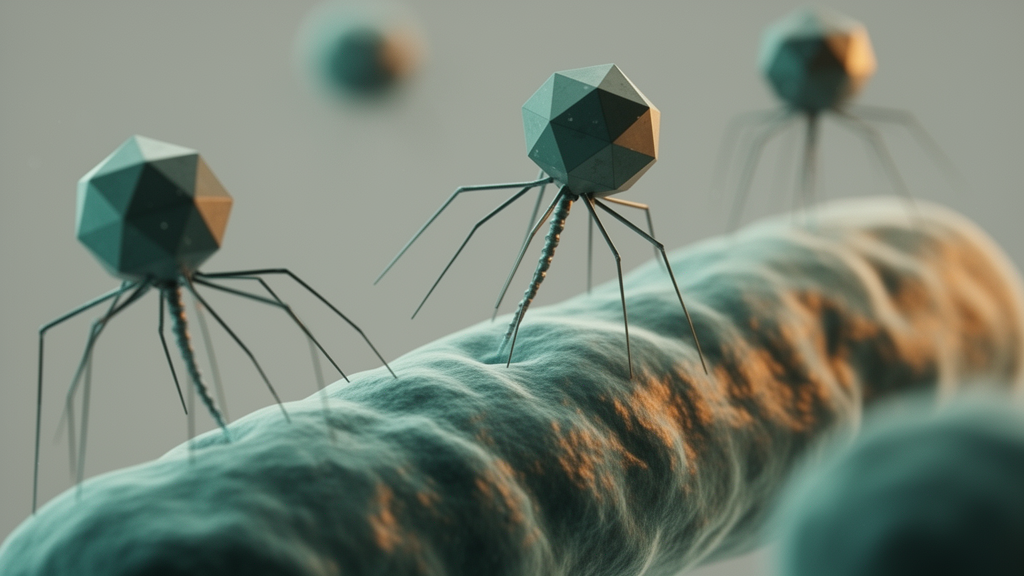
Bacteriophage therapy, the use of viruses that infect and kill bacteria to treat bacterial infections, is attracting renewed attention as multiresistant bacterial strains spread. Yet clinical outcomes have ranged from complete eradication of the infecting bacteria to no effect at all, or even adverse effects from the treatment itself. A new review published in the Springer Nature journal Discover Viruses argues that this wide variation stems from the enormous sources of variance inherent in phage therapy, and lays out ten concrete measures to improve it, grounded in phage and bacterial biology and supported by mathematical modelling.
The review’s author, Anders S. Nilsson, notes that phages are probably the most diverse biological entities on Earth, closely followed by bacteria, and both are involved in treating diverse infections in patients with different immune responses. This variation makes treatment design difficult to navigate. The key improvements, he argues, lie in the selection of phages, measures to avoid the emergence of phage resistance, reducing negative immunological reactions, and understanding treatment as a complex kinetic process.
Phages fare poorly against the checklist for an ideal antibiotic. They are large rather than small and easily diffusible, narrow in spectrum rather than broad, potentially immunogenic, and cumbersome to prepare to pharmacological standards. They also diffuse poorly, so they should preferably be applied directly to the site of infection; systemic delivery orally or intravenously is ineffective because phages are rapidly decomposed in the stomach or eliminated by macrophages of the mononuclear phagocyte system. Pharmacokinetics and pharmacodynamics are mainly based on in vitro experiments and remain virtually unknown in vivo. Low efficacy may arise from low actual doses reaching the bacteria, poor adsorption, low production of new phages, or inactivation by binding to bacterial cell debris or proteins on non-target human cells. Many bacteria also produce protective biofilm, develop resistance, and, upon repeated treatment, are neutralised by antibodies.
The first improvement concerns phage selection. Because phage therapy is more likely to be used for local, non-life-threatening chronic infections, the author recommends selecting durable and virulent phages. Durability matters because not all phage stocks maintain high titres: some are rapidly broken down and others clump together, reducing infectivity. Small phages also diffuse faster than large ones, so small, nearly tailless podophages are preferable to myophages with large capsids and protruding proteins that slow diffusion.
The second selection criterion is minimising the development of bacterial resistance. Phages are commonly isolated from microbiologically rich environments such as sewage or agricultural effluents, but this biases selection towards phages with high adsorption rates and short generation times. High adsorption can be associated with fast bacterial elimination but also with fast resistance development, because it often relies on abundant, non-essential cell surface receptors that bacteria can readily alter, for example by shedding their capsule or shifting phase. Phages that use scarce, evolutionarily conserved receptors essential to the cell are more likely to keep working even under poor nutrient conditions, as illustrated by the E. coli phage T1, whose infection rate drops when its host is less well nourished, and phage T4, which genetically reduces offspring production when bacteria are starving.
Characterising candidate phages should begin with quantitative in vitro assessment of virulence parameters: burst size, the number of offspring phages per bacterium; latent period, the time from infection to lysis; and the adsorption rate constant. Overnight plaque counting gives only a rough estimate, and efficiency of plating analyses are essential because phages can infect non-specifically at high titres and be misclassified as polyvalent. Laboratory conditions differ substantially from those in an infected body, and parameters vary with nutritional status, temperature, pH and shaking. Modelling with the Cocktail software can predict, for example, whether a slow adsorption rate can be compensated for by a short latent period or a large burst size. In one simulation, with phage and bacteria at 10^6 per millilitre, an adsorption rate constant of 10^-10 and a burst size of 100, bacteria fell to virtually nil in nine hours; with a hundredfold higher adsorption rate, each infection needed to produce only five new phages to achieve the same result.
Immunological problems form another cluster of recommendations. Severe immediate reactions are rare, but some phages are immunogenic and can trigger cytokine release. More importantly, from the start of treatment the innate and adaptive immune system begins eliminating phages within hours, defining a treatment time window bounded by immune clearance and the rise of resistant bacteria. Selecting less immunoactive phages, or training phages by repeatedly recovering survivors from treated animal infections, can help. A more common problem is contamination of phage suspensions with endotoxins or exotoxins released when bacteria are lysed. Propagating phages on toxin-free strains, purification by two-phase solvent extraction, ultrafiltration or chromatography, and, most promisingly, bacteria-free synthesis of phage particles in cell-free transcription-translation systems, which eliminates any risk of toxin contamination and allows deletion of unwanted genes, are proposed solutions.
Resistance, the review stresses, will always follow treatment; bacteria harbour more than 250 known phage resistance systems. Phage cocktails, in which phages infect via different surface receptors, can substantially extend the treatment window. Under modelling assumptions including a resistance mutation rate of 10^-7 per cell division, double-resistant bacteria appeared only after about 37 hours when two phages were applied at 5 × 10^5 per millilitre each, whereas single resistant bacteria emerged after roughly three hours and twenty minutes with one phage at 10^6 per millilitre. Adding a second phage later produced the same 37-hour delay. Cross-resistance must nevertheless be considered, and the titre of each phage in a cocktail is lower for technical reasons, since high-titre solutions rarely exceed 10^11 per millilitre.
Dosage modelling yields counterintuitive guidance. Because phages adsorb in a Poisson distribution, at a one-to-one ratio of phages to bacteria about 37 percent of bacteria escape infection, and phages must outnumber bacteria fivefold to infect more than 99 percent. High bacterial titres, as in wounds or the bladder, are actually an advantage because they support phage multiplication; with a burst size of only ten, an infection was cleared in 16 hours in simulation. Low bacterial titres are harder: with just ten bacteria per millilitre, the phage dose had to exceed 10^6 per millilitre and killing took almost 24 hours, with bacteria rising to about 10^7 cells per millilitre before phages caught up. Very high doses carry their own risks, including lysis from without, in which no phage offspring are produced, and depletion of cellular resources. Given typical infection titres of 10^5 to 10^8 CFU per millilitre, calculated doses fall between 10^8 and 10^9 PFU per millilitre, roughly ten times the highest bacterial concentration, delivered directly to the infected area in saline buffer rather than viscous formulations.
The review frames these ten measures as ways to navigate phage therapy’s inherent complexity rather than a guarantee of success. The modelling examples are illustrative, and small changes to parameters can produce different results; in vivo variance remains enormous and mostly unknown. Infrastructure, funding of clinical trials, education and regulatory issues are explicitly left out of scope. Even so, the author argues that careful phage selection, resistance-aware treatment design, reduced immunogenicity and kinetic modelling can at least partially avoid phage-related problems and improve clinical results.
Subject of Research: Strategies for improving bacteriophage therapy through phage selection, resistance management and mathematical modelling
Article Title: Top ten ways to improve phage therapy
Article References: Nilsson, A. S. (2026). Top ten ways to improve phage therapy. Discover Viruses, 3(1), Article 7. https://doi.org/10.1007/s44370-026-00042-3
Image Credits: AI Generated
DOI: 10.1007/s44370-026-00042-3
Keywords: phage therapy, bacteriophages, antibiotic resistance, phage cocktails, mathematical modelling, bacterial infections, immunogenicity, dosage, biofilm, virulence parameters, ways, improve
News Source: Kristina Jarvis. (October 29, 2026). Modelling Points to Ten Fixes for Better Phage Therapy. Scienmag.



