New method helps to ensure sustainable industries
Credit: Andrew Fox / Rodney Fox Shark Expeditions
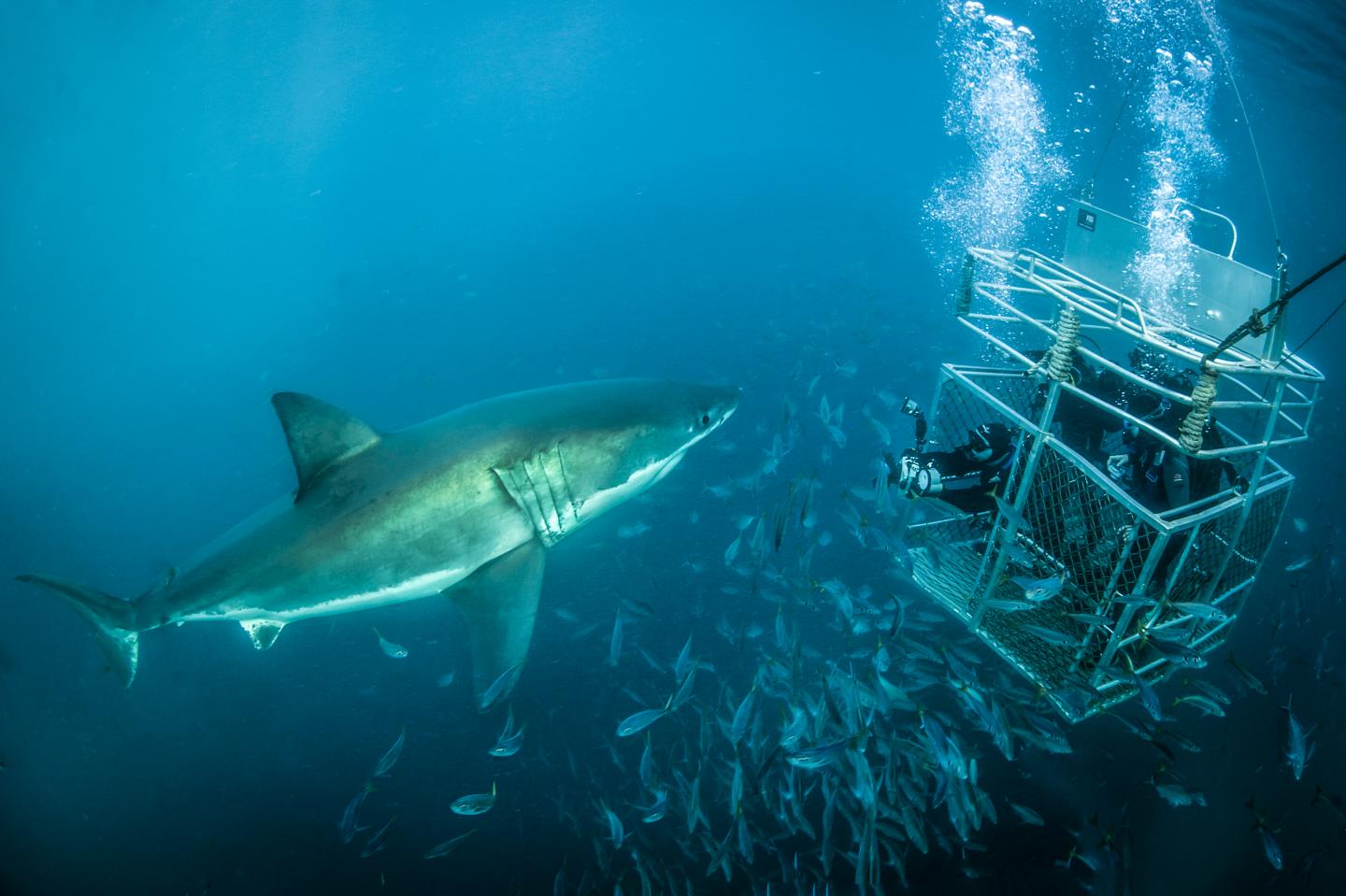
Wildlife tourism including white shark cage-diving is growing in popularity, but these industries remain highly contentious amongst tourists, conservationists, and scientists alike.
Many voice concerns about possible negative impacts – especially when it targets potentially dangerous animals – while proponents cite the socio-economic benefits to justify wildlife tourism activities.
In reality, wildlife tourism is complex, requiring managers to balance the benefits and drawbacks to determine what is acceptable for such industries.
To help solve this question of “is wildlife tourism good or bad?”, a tool to help managers assess these industries has been created by scientists from Flinders University, the Georgia Aquarium, and Southern Cross University with help from environmental, marine parks, and tourism managers from the South Australian Department for Environment and Water, and a veterinarian/university animal welfare officer.
The resulting framework, published in Conservation Letters, uses 26 factors to assess the industry’s tractability, socioeconomic values, and effects on conservation, animal welfare, and ecosystem impacts, says research leader Dr Lauren Meyer, from the Flinders University Southern Shark Ecology Group and Georgia Aquarium.
Bringing together these five distinct categories into one framework enables a more comprehensive assessment, combining the various pros and cons typical of wildlife tourism industries.
“The latest study provides an inventory of relevant factors incorporating a range of different industry sectors, current knowledge, and research needs,” says co-author and Flinders Associate Professor Charlie Huveneers.
To put the new framework to the test, the authors applied it to the white shark cage-diving industry on South Australia’s Eyre Peninsula. Here, three operators host up to 10,000 passengers and generate about $8 million a year.
The industry is well regulated with limits on the number of licences, days they can operate, and amount of attractant they can use.
Recent research from Dr Meyer found that while food-based attractant (bait and berley) had no impact on white shark diet (they still swim around eating their normal prey items), it can affect the diet of fish and rays that live at these offshore islands.
The framework also enabled the comparison of the costs and benefits to white sharks versus the other fish and rays, revealing the wholistic acceptability of the industry and identifying key areas for improvement.
The results show that while public opinion varies towards white shark cage-diving, the contribution to public education and awareness, and scientific research is high, Dr Meyer says.
“The conservation outcomes for target and non-target species is high, owing to the protected status of the Neptune Islands Group Marine Park Sanctuary Zone where the industry operates,” she says.
Unsurprisingly, the industry offers substantial regional economic benefits, but while the effects on white shark was well managed, the welfare of fishes and rays was identified as requiring further attention.
Associate Professor Charlie Huveneers, who has studied shark behaviour and ecology for more than 10 years, including white sharks, says the new framework shows how efficient collaboration between scientists, managers and the industry will help minimise negative effects on white sharks, but it also highlighted areas which could be further improved.
Specifically, the framework identified key priorities for future biological, socioeconomic, and cultural heritage research, ensuring comprehensive management of a divisive industry.
###
The article, ‘A multidisciplinary framework to assess the sustainability and acceptability of wildlife tourism operations’ (2021) by L Meyer, K Apps, S Bryars, T Clarke, B Hayden, G Pelton, B Simes, LM Vaughan, SK Whitmarsh and C Huveneers, has been published in Conversation Letters (Wiley) DOI: 10.1111/conl.12788 The Society for Conservation Biology (wiley.com)
Acknowledgements:
Researchers thank the cage-diving industry for ongoing assistance, support for industry management, and commitment to conversation.
Media Contact
Dr Lauren Meyer
[email protected]
Related Journal Article
http://dx.