


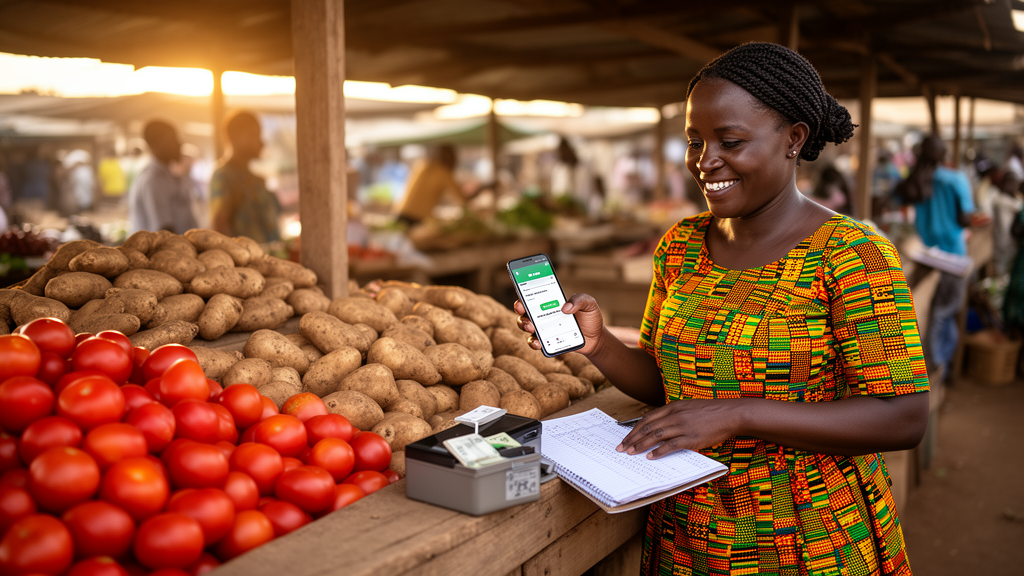
Ghana became the first country in the world to deploy a centralised, hub-based interoperability architecture connecting all of its mobile network operators and commercial banks, and a new mixed-methods study reports that the people who use it most appear to be saving more, paying less to move money, and borrowing more often through digital channels. The study, based on a survey of 350 adult mobile money users and 20 in-depth interviews across three regions, finds that mobile money interoperability, known as MMI, is associated with measurable improvements in everyday finances. But the same research shows the gains are unevenly distributed, concentrating among urban users and those with higher financial literacy, while rural participants and lower-literacy users capture far less of the benefit.
The scale of Ghana’s interoperability project explains why the individual-level question matters. Total interoperable transaction value grew from 26.4 billion cedis in 2022 to 32.8 billion cedis in 2023, while transaction volumes rose from 138.6 million to 171.4 million over the same period. Registered mobile money accounts climbed from 65.6 million in 2023 to 74.1 million by 2025. Yet aggregate figures of this kind say little about whether ordinary users are actually better off, and the study’s authors argue that previous research had focused on institutional impacts, transaction trends, and policy dynamics while leaving individual financial outcomes largely unexamined.
The research team, led by Kwadwo Kyeremeh, used a convergent mixed-methods design. A structured survey of 350 adults who had used mobile money within the previous six months was conducted through stratified random sampling across the Greater Accra, Ashanti, and Bono regions, chosen to represent urban, peri-urban, and rural conditions respectively. Greater Accra accounted for roughly 42 percent of the sample, Ashanti 35 percent, and Bono 23 percent. Respondents were recruited at registered mobile money agent points using systematic random selection, and the questionnaire was administered in English and Twi. The quantitative strand was complemented by semi-structured interviews with 20 purposively selected participants, analysed through reflexive thematic analysis.
The headline statistical result concerns savings. Using binary logistic regression, the study found that MMI usage intensity, measured as the frequency of cross-network transfers per month, was a significant positive predictor of self-reported increases in savings since interoperability was adopted, with an odds ratio of 1.74 and a 95 percent confidence interval of 1.31 to 2.31. Respondents in the highest usage quartile were approximately 74 percent more likely to report increased savings frequency than those in the lowest quartile, after controlling for age, income, gender, and mobile network operator affiliation. The savings association was markedly stronger among urban respondents, with an odds ratio of 2.12, than among peri-urban respondents at 1.58 or rural respondents at 1.19.
The qualitative interviews suggest a plausible mechanism behind this pattern. Participants described how, before full interoperability, they kept idle balances, or float, in multiple wallets across different networks as a hedge against failed transfers and slow reversals. One urban participant in Greater Accra explained that keeping money in MTN and Tigo separately had been necessary because it was never clear which network would work, whereas now everything sits in one place, leaving more available to save. Another participant from peri-urban Ashanti recalled losing almost 15 cedis on a 200-cedi transfer because of cash-out-and-re-deposit workarounds, money that now stays in the wallet and is being saved toward school fees. The researchers describe this as a trust-mediated savings pathway, in which reliable interoperability consolidates fragmented balances and makes residual funds visible enough to trigger deliberate saving decisions.
Transaction costs tell a more complicated story. In the survey, 63 percent of respondents reported a perceived reduction in effective transaction costs since full interoperability was introduced, and ordinal logistic regression confirmed that MMI usage intensity was significantly associated with perceived cost reduction, with an odds ratio of 1.52. However, interviews with mobile money agents and operator representatives revealed persistent interchange fee disputes at the provider level, which make operators reluctant to actively promote cross-network transfers. The authors conclude that while user-level cost savings are real, an unknown portion of the efficiency dividend appears to be absorbed within the provider ecosystem rather than passed through to end users as lower prices, a transmission gap that current policy frameworks have not closed.
Digital credit access showed the strongest association. Higher MMI usage intensity was significantly linked to having accessed digital credit in the past 12 months, with an odds ratio of 2.08 and a confidence interval of 1.54 to 2.80. The proposed mechanism operates through data: more active interoperable users generate richer transaction histories, which improve their eligibility scores on algorithmic lending platforms. This aligns with the documented experience of the lender JUMO in Ghana, which has used mobile wallet transaction data to serve roughly 9.6 million customers across more than 128 million loan disbursements. Interviewees who had borrowed described a pragmatic relationship with mobile credit, using loans mainly for business float, school fees, and medical emergencies rather than investment, suggesting that welfare effects depend heavily on loan terms and borrowers’ financial management capacity.
Financial literacy emerged as a decisive boundary condition. Ghana’s adult financial literacy rate hovers at approximately 32 percent, and the moderation analysis found that the interaction between MMI usage and literacy score significantly shaped savings behaviour and credit access. Users with above-median literacy scores showed substantially stronger associations between interoperability use and positive outcomes, while respondents below the median literacy threshold showed no statistically significant association between MMI usage and credit access at all. Lower-literacy interviewees described confusion about eligibility criteria and repayment schedules. Another peri-urban respondent had been declared ineligible without understanding why, despite using mobile money every week.
Geography compounded the literacy divide. The interaction between MMI usage and geographic location was significant across all four outcome regressions, and financial resilience, operationalised as the self-reported ability to cope with an unexpected shock equal to two weeks of household income, was positively associated with MMI usage with an odds ratio of 1.63. Interview accounts described how interoperability made it easier to receive emergency remittances from relatives on other networks without cash-out delays, or to access a loan on an alternative platform when a primary wallet was suspended. Yet rural users continue to face sparse agent networks and higher agent-to-agent travel costs, which partially erode the direct fee savings interoperability provides. The authors identify this urban-rural gradient, together with the literacy moderation, as the study’s key policy-relevant finding.
The authors are careful to note that, as a cross-sectional study, the findings describe associations rather than causal effects; the direction of causality cannot be established from the data alone, and reverse causality or confounding cannot be excluded without longitudinal or experimental designs. With that caveat, they propose four directions: an independent review of interchange fee pass-through rates by the Bank of Ghana and GhIPSS, co-investment in financial literacy programmes targeted at rural users, intensified efforts by the National Communications Authority to close rural agent network gaps, and future panel studies using administrative transaction data to establish causal estimates. Ghana’s interoperability framework, they conclude, has built something genuinely valuable; the challenge now is ensuring that value reaches the people it was built for.
Subject of Research: The association between mobile money interoperability and individual financial outcomes in Ghana
Article Title: Mobile money interoperability and individual financial outcomes in Ghana: evidence from a mixed-methods study
Article References: Kyeremeh, K. (2026). Mobile money interoperability and individual financial outcomes in Ghana: evidence from a mixed-methods study. Discover Analytics, 4(1), Article 32. https://doi.org/10.1007/s44257-026-00080-7
Image Credits: AI Generated
DOI: 10.1007/s44257-026-00080-7
Keywords: mobile money, interoperability, Ghana, financial inclusion, digital credit, financial literacy, savings behaviour, transaction costs, financial resilience, mixed methods, Sub-Saharan Africa, fintech policy
News Source: Denise Maddox. (October 29, 2026). Mobile Money Interoperability Linked to Savings and Credit Gains in Ghana. Scienmag.



