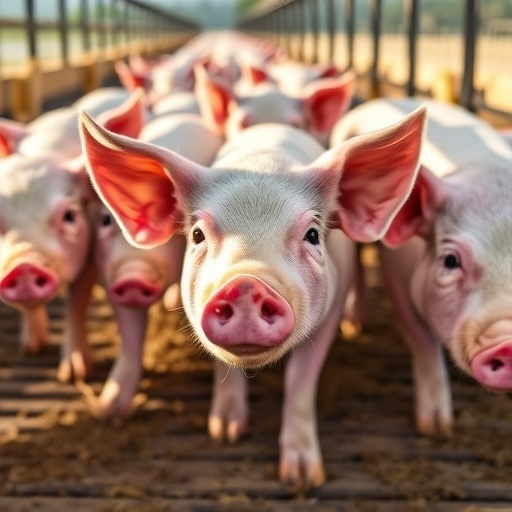
The warning signs of heat stress in pigs may soon appear on a smartphone before they become visible in the barn. Researchers at the University of Missouri are expanding HotHog, a research-based mobile application designed to help pork producers identify dangerous environmental conditions early enough to protect animal welfare, maintain productivity and reduce the risk of livestock losses. The project is supported by a $1.15 million grant from the U.S. Department of Agriculture and will extend the app’s predictive capabilities to pigs at several stages of production.
The project is led by Jay Johnson, an associate professor in the University of Missouri’s College of Agriculture, Food and Natural Resources. Johnson developed HotHog, which launched in 2023 and is now used by more than 2,000 people in more than 50 countries. The app combines location-specific weather forecasts with biological information about pigs to estimate when conditions are likely to become hazardous. Producers can enter multiple barn locations and receive alerts when heat-related risks are expected to reach specific levels.
The need for such a tool is rooted in pig biology. Unlike humans, pigs have very limited ability to cool themselves because they do not sweat effectively. Their primary methods of releasing heat include respiration and behavioral changes, such as seeking cooler surfaces or reducing activity. When environmental heat and humidity rise together, those mechanisms can become insufficient. The result may be panting, reduced feed intake, impaired growth, lower reproductive performance and, in severe cases, death.
By the time producers notice pigs panting heavily, the animals may already be experiencing physiological stress. HotHog is intended to shift heat management from a reactive process to a predictive one. Rather than relying only on air temperature, the app evaluates combinations of temperature and humidity, conditions that determine how effectively an animal can lose heat to its surroundings. This approach is particularly important in enclosed barns, where ventilation, stocking density, flooring, water availability and animal activity can influence the actual thermal burden.
The danger is not identical for every pig. A sow carrying a litter, a sow nursing piglets, a recently weaned pig and an animal approaching market weight can respond differently to the same weather conditions. Body size, metabolic rate, reproductive status and the energy demands of growth or milk production all affect susceptibility to heat stress. The current version of HotHog focuses primarily on sows that produce and nurse piglets, while the new USDA-funded work will expand the underlying models to recently weaned pigs, pigs nearing market weight and market-weight animals.
To improve those models, researchers will use the University of Missouri’s Animal Science Research Center and a new thermocline facility being constructed at South Farm. A thermocline system can create controlled temperature gradients, allowing researchers to expose animals to carefully defined environmental conditions rather than relying solely on naturally occurring weather. Video cameras will record behavior across those temperature ranges, providing data on activity, posture, feeding, water use and other changes that may emerge before obvious clinical signs of heat stress.
These observations will help researchers identify the earliest measurable responses to thermal challenge. The information can then be incorporated into algorithms that connect environmental data with the needs of particular classes of pigs. In practical terms, future versions of the app could distinguish between a forecast that is tolerable for one group of animals and potentially dangerous for another. The resulting alerts may give producers time to inspect ventilation systems, adjust cooling equipment, activate water sprinklers or reconsider transportation schedules.
The research also reflects the international nature of heat stress in livestock production. Johnson’s team will work with scientists at Purdue University, the University of Pretoria in South Africa and the University of Melbourne in Australia. These partnerships will allow the researchers to test how the app’s models perform under different climates, housing designs and production systems. A tool developed from data collected in one region cannot automatically be assumed to work everywhere, so international collaboration may help make the predictions more reliable across diverse pork-producing environments.
The grant includes an outreach effort intended to connect the technology with the people who will use it. Johnson and colleagues will work with University of Missouri Extension specialists to train producers throughout the state and collect feedback about how HotHog influences daily management decisions. The app remains free, a choice designed to maximize access for producers of different sizes. By combining real-time weather information, animal-specific algorithms and on-farm expertise, the researchers hope to make heat protection more precise while improving both welfare and the efficiency of pork production.
Subject of Research: Heat-stress prediction and management in pigs using a mobile application
Web References: https://cafnr.missouri.edu/ ; https://extension.missouri.edu/ ; https://mediasvc.eurekalert.org/Api/v1/Multimedia/0b11b54d-bc9c-4f71-8351-20782e7f5bfe/Rendition/low-res/Content/Public
Image Credits: University of Missouri
Keywords: pigs, swine, heat stress, HotHog, mobile app, pork production, animal welfare, agriculture, livestock technology, environmental monitoring, USDA, University of Missouri, precision agriculture, climate risk, veterinary science
Tags: early warning systems for livestock healthfarm technology for animal welfareheat stress prevention in swineHotHog application for pig temperature monitoringlivestock environmental condition alertsmobile app for livestock healthpig biology and thermoregulationpig welfare and heat stress detectionPork producer heat stress managementpredicting heat stress in pigsUniversity of Missouri livestock researchUSDA livestock research grants