• HOME
  • NEWS
  • EXPLORE
    • CAREER
      • Companies
      • Jobs
    • EVENTS
    • iGEM
      • News
      • Team
    • PHOTOS
    • VIDEO
    • WIKI
  • BLOG
  • COMMUNITY
    • FACEBOOK
    • INSTAGRAM
    • TWITTER
Wednesday, April 1, 2026
BIOENGINEER.ORG
No Result
View All Result
  • Login
  • HOME
  • NEWS
  • EXPLORE
    • CAREER
      • Companies
      • Jobs
        • Lecturer
        • PhD Studentship
        • Postdoc
        • Research Assistant
    • EVENTS
    • iGEM
      • News
      • Team
    • PHOTOS
    • VIDEO
    • WIKI
  • BLOG
  • COMMUNITY
    • FACEBOOK
    • INSTAGRAM
    • TWITTER
  • HOME
  • NEWS
  • EXPLORE
    • CAREER
      • Companies
      • Jobs
        • Lecturer
        • PhD Studentship
        • Postdoc
        • Research Assistant
    • EVENTS
    • iGEM
      • News
      • Team
    • PHOTOS
    • VIDEO
    • WIKI
  • BLOG
  • COMMUNITY
    • FACEBOOK
    • INSTAGRAM
    • TWITTER
No Result
View All Result
Bioengineer.org
No Result
View All Result
Home NEWS Science News

Mitochondrial DNA shows past climate change effects on gulls

Bioengineer by Bioengineer
January 18, 2017
in Science News
Reading Time: 2 mins read
0
Share on FacebookShare on TwitterShare on LinkedinShare on RedditShare on Telegram
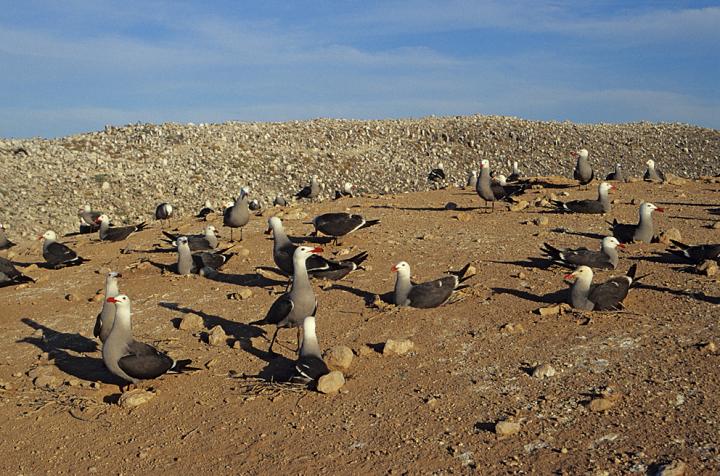
IMAGE

Credit: C. Contreras

To understand the present and future, we have to start with the past. A new study in The Auk: Ornithological Advances uses the mitochondrial DNA of Heermann's Gulls to draw conclusions about how their population has expanded in the Gulf of California since the time of the glaciers–and, by extension, how human-caused climate change may affect them in the future.

Enrico Ruiz of the University of California, Merced, and his colleagues sequenced the mitochondrial DNA of 286 Heermann's Gulls breeding in the Gulf of California in 2011 and 2012. Using a combination of statistical approaches, the researchers found that the pattern of genetic diversity among the birds suggests a period of population growth from roughly 100,000 years ago to 45,000 years ago, coinciding with the last glacial retreat in the region.

Ruiz and his colleagues believe that the gulls' population increase was the result of large-scale climatic shifts, which would have allowed the marine species on which the gulls rely for food to expand their ranges. Though this is one of the first studies to examine how regional climate change affected vertebrates such as seabirds, past analyses have found evidence of increases in fish, mollusk, and crustacean populations during the same period.

The Heermann's Gull population in the region has remained relatively stable since the end of this period of expansion, but Ruiz and his colleagues are concerned that this may change. "During the last 16 years, the warm oceanographic anomalies in the Gulf of California have increased in frequency from an average of one every six or seven years to six anomalies in the last 16 years," says Ruiz. "The consensus among researchers now is that there is a general productivity decline across the trophic web, including the availability of the small pelagic fish on which the seabirds feed." By learning how the ancient climates affected modern species' population sizes and distribution in the past, he hopes we may better understand present changes in their distribution and abundance.

###

"Demographic history of Heermann's Gull (Larus heermanni) from late Quaternary to present: Effects of past climate change in the Gulf of California" will be available January 18, 2017, at http://americanornithologypubs.org/doi/full/10.1642/AUK-16-57.1 (issue URL http://americanornithologypubs.org/toc/tauk/134/2).

About the journal: The Auk: Ornithological Advances is a peer-reviewed, international journal of ornithology that began in 1884 as the official publication of the American Ornithologists' Union, which merged with the Cooper Ornithological Society in 2016 to become the American Ornithological Society. In 2009, The Auk was honored as one of the 100 most influential journals of biology and medicine over the past 100 years.

Media Contact

Rebecca Heisman
[email protected]

http://www.aoucospubs.org

############

Story Source: Materials provided by Scienmag
Share12Tweet8Share2ShareShareShare2

Related Posts

KIST-IAE Collaborative Team Surpasses Performance Limits in Lithium-Air Batteries with Innovative Two-Dimensional Catalyst

KIST-IAE Collaborative Team Surpasses Performance Limits in Lithium-Air Batteries with Innovative Two-Dimensional Catalyst

April 1, 2026

Brain Metastases Show Unique Macrophage Spatial Patterns

April 1, 2026

PRSS56 Drives and Treats Human High Myopia

April 1, 2026

Early cfEBV DNA Guides Nasopharyngeal Cancer Treatment

April 1, 2026
Please login to join discussion

POPULAR NEWS

  • blank

    Revolutionary AI Model Enhances Precision in Detecting Food Contamination

    96 shares
    Share 38 Tweet 24
  • Imagine a Social Media Feed That Challenges Your Views Instead of Reinforcing Them

    1006 shares
    Share 398 Tweet 249
  • Promising Outcomes from First Clinical Trials of Gene Regulation in Epilepsy

    51 shares
    Share 20 Tweet 13
  • Popular Anti-Aging Compound Linked to Damage in Corpus Callosum, Study Finds

    43 shares
    Share 17 Tweet 11

About

We bring you the latest biotechnology news from best research centers and universities around the world. Check our website.

Follow us

Recent News

KIST-IAE Collaborative Team Surpasses Performance Limits in Lithium-Air Batteries with Innovative Two-Dimensional Catalyst

Brain Metastases Show Unique Macrophage Spatial Patterns

PRSS56 Drives and Treats Human High Myopia

Subscribe to Blog via Email

Enter your email address to subscribe to this blog and receive notifications of new posts by email.

Join 78 other subscribers
  • Contact Us

Bioengineer.org © Copyright 2023 All Rights Reserved.

Welcome Back!

Login to your account below

Forgotten Password?

Retrieve your password

Please enter your username or email address to reset your password.

Log In
No Result
View All Result
  • Homepages
    • Home Page 1
    • Home Page 2
  • News
  • National
  • Business
  • Health
  • Lifestyle
  • Science

Bioengineer.org © Copyright 2023 All Rights Reserved.