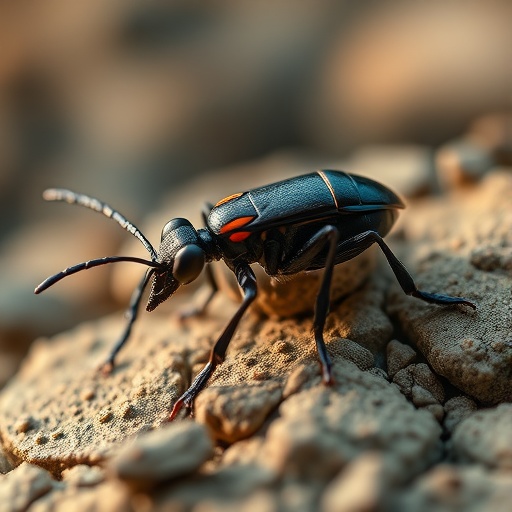
A revolutionary breakthrough in cyborg insect technology has emerged from Nanyang Technological University, where researchers led by Professor Hirotaka Sato have engineered a fully implanted miniature wireless controller that significantly enhances the mobility and navigational capabilities of cockroaches in complex environments. This innovative device is small enough to fit entirely inside the insect’s abdomen, preserving its natural biomechanics and enabling exceptional maneuverability, even in cluttered terrains where traditional backpack-style attachments fail.
The compact controller measures just 10 millimeters by 10 millimeters and has a height of 3 millimeters, weighing a mere 0.5 grams. Powered by a 9-mAh lithium-polymer battery also implanted within the cockroach, the system communicates via sub-1 GHz radio frequencies to deliver precise electrical stimuli. These pulses are biphasic in nature and are strategically applied to the cockroach’s antennae, which control turning, and cerci, which regulate forward walking. To ensure biocompatibility and safeguard the delicate electronics, the entire assembly is enclosed in a silicone elastomer coating, protecting it from bodily fluids and physical damage.
One of the most striking demonstrations of this technology involved a custom-built track featuring an 8-millimeter vertical gap—intentionally narrower than the natural height of the cockroach’s body. When unencumbered, intact cockroaches instinctively lower their heads to lift the shutter and push through with a success rate of 95%. However, when outfitted with a conventional backpack controller attached externally to the thorax, performance plummeted; the backpack snagged on the shutter, reducing success to just 15% and increasing traversal times dramatically. In stark contrast, cockroaches with the fully implanted controller mirrored intact behavior with a 90% success rate and slightly faster traversal times, confirming the implant’s unobtrusive nature.
Professor Sato emphasizes that this finding is pivotal: “The implant does not alter the body’s roundness or the natural tripod gait. The insect maintains its streamlined profile, reducing mechanical resistance and optimizing its ability to rotate and squeeze through confined gaps.” This preservation of natural morphology is crucial, as it allows the cyborg cockroach to exploit its evolutionary adaptations to navigate environments that would otherwise be impassable with cumbersome external equipment.
To validate the system’s practical autonomy, the team integrated an algorithm for automatic navigation within a virtual arena. The algorithm administered forward electrical stimuli to the cerci when the insect slowed below 5 mm/s and induced directional corrections by stimulating antennae whenever heading deviated by more than 45 degrees from the intended path. During 66 trials, this autonomous navigation system achieved a remarkable 90.9% success rate in reaching targets. Notably, the turning response varied between left and right stimuli, averaging 16.7°/s and 26.3°/s, respectively, while forward stimuli consistently reinitiated walking.
The advantages of full implantation became increasingly evident in a multi-stage obstacle course designed with stacked bricks, tangled cables, and a constricted slit. Cockroaches burdened with backpack controllers succeeded in 40%, 50%, and 0% of trials, respectively, often becoming entangled and unable to proceed. In sharp contrast, the implant-wearing insects achieved a 95% success rate for bricks, 89% for cables, and 63% for the narrow slit while traversing obstacles significantly faster. This performance disparity underlines the implant’s ability to preserve the insect’s natural behavioral repertoire—including rolling, side-stepping, and pushing—unlike external devices that interfere with such movements.
To streamline the implantation procedure and improve reliability, the researchers engineered a robotic arm equipped with a specialized parallel gripper and custom fingertip. This apparatus delicately pierces the intersegmental membrane of medium-sized cockroaches and inserts the controller within the body cavity in a rapid 25-second operation. Impressively, this method yields a 100% implantation success rate. Beyond locomotion, the team discovered that simultaneous stimulation of both antennae for 1.2 seconds reliably triggers backward walking behavior. This escape reflex could be instrumental for cyborg insects to retreat upon encountering impassable obstacles during missions.
Long-term survivorship also improved markedly after procedural refinements. Initially, only 43% of cockroaches survived one week post implantation. By employing a technique that uses a spatula to gently detach internal tissues before insertion, survival rates surged to 86%, extending the operational lifespan of cyborg insects sufficiently for practical deployment scenarios. Such durations are already suitable for critical applications in post-disaster structural inspection and pipeline monitoring where navigating confined, hazardous environments is paramount.
Looking forward, the researchers outline plans to miniaturize the electronic components further by developing flexible circuits, integrating biofuel cells or solar films to improve energy autonomy, and embedding advanced sensors such as infrared detectors, cameras, and inertial measurement units. These enhancements aim to empower the cyborg cockroach with full autonomy and multifunctional sensing capabilities, enabling it to operate effectively in real-world, unpredictable settings without human intervention.
Professor Sato concludes, “Our study reveals that the method of integrating electronics into an insect is not merely a technical detail; it is the key determinant of whether the cyborg can truly traverse the terrains it was designed for. Full implantation preserves the intricate, evolved body intelligence of the insect, making these cyborgs genuinely capable of maneuvering through cluttered, unpredictable environments where other robotic platforms fail.”
The pioneering work not only opens new frontiers for biohybrid robotics but also sets a benchmark for future research in the synthesis of biological and electronic systems, promising a new era of agile, adaptive, and resilient cyborg agents for complex field operations.
Authors credited for this groundbreaking research include Kazuki Kai, Le Duc Long, Qifeng Lin, and Hirotaka Sato. The project received funding support from the Japan Science and Technology Agency through the Moonshot R&D Program, grant numbers JPMJMS223A and JPMJMS2238, as well as the Singapore Ministry of Education under grant RG82/24. Their findings were published in the journal Cyborg and Bionic Systems on May 25, 2026, under the article titled “Fully Implanted Miniature Radio Controller Boosts Cyborg Insect Mobility in Challenging Terrains” (DOI: 10.34133/cbsystems.0589).
Subject of Research: Cyborg insect technology; miniature implanted wireless controllers for enhanced mobility.
Article Title: Fully Implanted Miniature Radio Controller Boosts Cyborg Insect Mobility in Challenging Terrains
News Publication Date: May 25, 2026
Web References: DOI: 10.34133/cbsystems.0589
Image Credits: Hirotaka Sato, School of Mechanical and Aerospace Engineering, Nanyang Technological University.
Keywords: cyborg insects, wireless implant, miniature controller, biohybrid robotics, insect locomotion, artificial stimulation, autonomous navigation, implantable electronics, robotic implantation, biocompatible coating, bio-robotics, obstacle traversal.
Tags: antennae and cerci neural controlbiocompatible implantable electronicsbiphasic electrical stimulation in insectsenhanced cockroach mobility technologyfully implanted cyborg insect technologylithium-polymer battery powered insect deviceminiature robotic implants for insectsminiature wireless insect controllernavigating cluttered terrains with cyborg insectsNTU cyborg insect research advancementssilicone elastomer coated electronicssub-1 GHz radio communication in insects