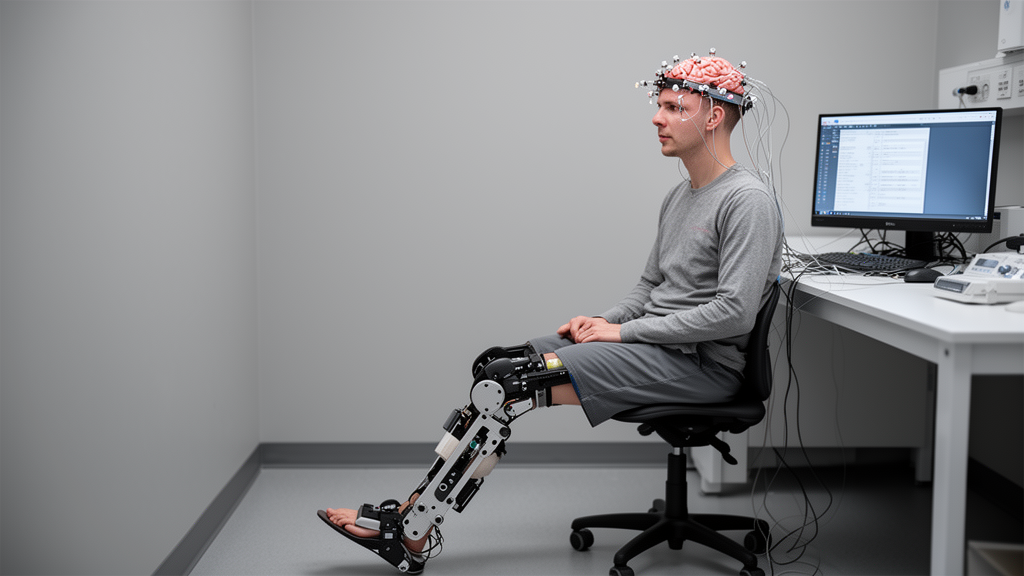
A team of researchers has taken a significant step toward hands-free control of robotic ankle devices by decoding brain signals associated with ankle movements. In a pilot study published in Frontiers in Neuroergonomics, scientists demonstrated that functional near-infrared spectroscopy (fNIRS), a non-invasive optical brain imaging technique, can distinguish between rest, dorsiflexion, and plantar flexion in both healthy adults and patients with ankle impairments. The work establishes a proof-of-concept framework that could eventually allow people with mobility deficits to command an exo-ankle device using thought alone.
The research addresses a substantial clinical need. Approximately one in four adults worldwide is affected by severe musculoskeletal disorders that often impair mobility, and ankle problems are particularly widespread. In the United States, roughly 25,000 people seek assistance every day for ankle-related issues, while a 2020 study found that about 20 percent of adults in Australia had ankle-related problems. Stroke survivors face even greater challenges: more than 63 percent experience motor and cognitive deficits ranging from mild to severe, and between 30 and 36 percent cannot walk without the assistance of a device. The loss of independence that follows can ripple into social withdrawal and mental health difficulties, making effective rehabilitation technologies a pressing priority.
Exoskeletons, wearable devices that augment or assist human movement, have evolved from passive mechanical supports to active, motor-driven systems. Early ankle-foot orthoses were later paired with electromyography (EMG) control, which reads electrical activity from muscles. But EMG and EEG, the two dominant signal sources for assistive devices, each carry limitations. This is where fNIRS enters the picture. The technique shines near-infrared light through the scalp and measures how much is absorbed by oxygenated hemoglobin (HbO) and deoxygenated hemoglobin (HbR) in the blood. Because neural activity drives local changes in these blood components, fNIRS can indirectly track brain activation. Compared with EEG, fNIRS is less vulnerable to electrical noise, safer, and more portable, making it attractive for wearable brain-computer interfaces (BCIs).
The research team, led by Naqash Ahmad, Hammad Nazeer, and Noman Naseer of Air University in Islamabad, along with collaborators at Riphah International University and The Chinese University of Hong Kong, recruited 20 healthy adults (10 male, 10 female, average age 23 ± 3 years) and seven patients with ankle motor impairment (four male, three female, average age 61 ± 12 years). The patient group included individuals with diabetic neuropathy, left hemiplegia, and ankle instability, all with Berg Balance Scores of at least 40 for safety. Using a NIRSport2 system sampling at 10.1725 Hz with two wavelengths (760 nm and 850 nm), the researchers recorded signals from a 20-channel montage over the primary motor cortex, with optodes placed according to the international 10-20 system.
The experimental paradigm, built in PsychoPy software, alternated between rest and movement blocks. Healthy participants performed 5-second ankle movements (dorsiflexion or plantar flexion) followed by 10-second rests, bookended by 45-second rest periods, for a total of 180 seconds. Patients followed a modified protocol with 15-second movement blocks to amplify the hemodynamic signal, and the exo-ankle device mechanically assisted their movements rather than requiring unassisted effort. The researchers applied the modified Beer-Lambert law to convert raw optical density into HbO and HbR concentration changes, then band-pass filtered the signals between 0.01 and 0.30 Hz using a zero-phase fourth-order Butterworth filter. Event labels were shifted forward by 3 seconds to account for the hemodynamic response delay.
For feature extraction, the team computed six statistical measures from each of the 20 HbO channels: mean, variance, skewness, kurtosis, peak, and slope. They then evaluated combinations of two through six features alongside four machine learning classifiers: linear discriminant analysis (LDA), quadratic discriminant analysis (QDA), support vector machine (SVM), and k-nearest neighbor (kNN). Critically, the researchers used leave-one-subject-out (LOSO) cross-validation, training on 19 participants and testing on the held-out 20th, rotating through all 20. This approach prevents the data leakage that can inflate accuracy when consecutive time points from the same movement block appear in both training and test sets. Under random 10-fold partitioning of individual observations, apparent accuracy reached 93.13 percent, but under LOSO it dropped to 72.50 percent, a 20.6 percentage point difference that underscores how much inflated results can mislead.
SVM emerged as the top performer with a mean offline accuracy of 72.50 ± 13.8 percent, followed by kNN (65.83 ± 13.5 percent), LDA (63.75 ± 16.1 percent), and QDA (60.42 ± 17.7 percent). A Friedman test confirmed a significant overall difference among classifiers (p = 0.0311), though no individual pairwise comparison survived Bonferroni correction. Permutation testing with 500 label shuffles confirmed that all four classifiers performed significantly above chance. The six-feature combination (mean, variance, skewness, kurtosis, peak, and slope) yielded the highest accuracy, and the slope feature was consistently associated with better performance across combinations.
For simulated-online decoding, which replays pre-recorded data through a sliding-window pipeline to mimic real-time command generation, the team used SVM with a 25-point (approximately 2.5-second) window advanced in steps of 0.5, 1.0, or 1.5 seconds. Accuracy increased slightly with larger step sizes, reaching 62.2 ± 14.1 percent at the 1.5-second step. The patient group, evaluated separately using leave-one-trial-out cross-validation, achieved a mean accuracy of 57.23 ± 5.0 percent. The researchers caution that the two cohorts differ systematically in age, movement-block duration, diagnosis, and device exposure, so the accuracy gap cannot be attributed to any single cause.
The study has important limitations that the authors acknowledge candidly. The 8 × 8 optode montage covers the major primary motor cortex but excludes the medial Cz and FCz regions where the lower-limb representation resides in the motor homunculus. This means the classified signal cannot be confirmed to originate specifically from lower-limb motor cortex activity and may reflect adjacent cortical regions or systemic physiological changes. The equipment also records offline data only, so real-time hardware-in-the-loop testing remains future work. The team recommends repositioning optodes for dedicated lower-limb coverage, expanding to more ankle states across the full gait cycle, and exploring deep learning algorithms or hybrid EEG-fNIRS-EMG systems to improve performance.
Despite these caveats, the findings represent a meaningful proof of concept for fNIRS-based exo-ankle control under rigorous participant-independent validation. By demonstrating that ankle movement states can be decoded from brain hemodynamics in both healthy and impaired populations, and by providing a conservative baseline against which future systems can be measured, the study lays groundwork for closed-loop rehabilitation devices that could one day restore mobility and independence to millions living with ankle and gait impairments.
Subject of Research: fNIRS-based brain-computer interface decoding of ankle movements for exo-ankle control
Article Title: Offline and simulated-online fNIRS decoding of ankle movements for prospective exo-ankle control: a pilot study in healthy adults and ankle-impaired patients
Article References: Ahmad, N., Nazeer, H., Naseer, N., Obaid Baig, M., Shakil, S., & Kai-yu Tong (2026). Offline and simulated-online fNIRS decoding of ankle movements for prospective exo-ankle control: a pilot study in healthy adults and ankle-impaired patients. Frontiers in Neuroergonomics, 7, Article 1726286. https://doi.org/10.3389/fnrgo.2026.1726286
Image Credits: AI Generated
DOI: 10.3389/fnrgo.2026.1726286
Keywords: fNIRS, brain-computer interface, exo-ankle, gait rehabilitation, SVM, machine learning, motor cortex, stroke rehabilitation, ankle impairment, hemodynamic response, LOSO cross-validation, exoskeleton
News Source: Cassandra Pierce. (October 17, 2026). Mind Over Ankle: fNIRS Brain Signals Drive Exo-Ankle Control in Proof-of-Concept Study. Scienmag.