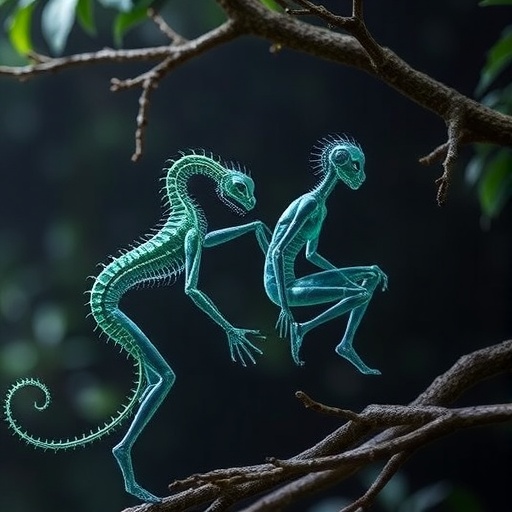
For millions of years, the evolutionary trajectory of Earth’s earliest animals was restrained by their mode of reproduction, a limitation that stifled biodiversity until the advent of sexual reproduction catalyzed a rapid acceleration in evolutionary complexity. New research from the University of Cambridge sheds light on why animal life remained relatively static for such an extended period, stagnating after its initial emergence before experiencing a dramatic surge in diversification.
The study focuses on fossils dating back approximately 574 million years, belonging to some of the oldest known animal communities from the Ediacaran period. These early animals predominantly reproduced asexually, a strategy that, while efficient in stable environments, inherently restricts genetic variation and competition—two fundamental drivers of evolutionary change. By scanning and analyzing these fossils with advanced laser scanning, spatial distribution methods, and artificial intelligence, researchers have reconstructed the ecological dynamics that contributed to this protracted evolutionary lull.
One of the most striking insights is that asexual reproduction via stolon-like runners—structures akin to those in modern strawberry plants—facilitated a communal sharing of resources among clusters of identical clones. This connectivity minimized intraspecific competition since neighboring individuals were genetically identical and effectively cooperated rather than competed. The consequence was an ecological stasis where evolutionary pressures to diversify or adapt were remarkably low.
These early Ediacaran animals, such as the genus Fractofusus, largely resembled stationary fern-like organisms rather than mobile animals recognizable today. With no apparent mouths, digestive organs, or locomotion mechanisms, they likely absorbed nutrients directly from surrounding waters. Fossil evidence from sites like Mistaken Point in Newfoundland, one of the richest sources of Ediacaran fossil records, reveals that such asexual reproductive strategies underpinned their persistence in the deep ocean for millions of years.
The research team constructed computational models incorporating Approximate Bayesian Computation, a statistical framework enabling reverse-engineering of evolutionary dynamics based on fossil data. By simulating thousands of reproductive scenarios, the models revealed that limited dispersal from asexual reproduction significantly restricted community diversity. This constraint explains why early animal populations maintained relatively homogeneous compositions with minimal species differentiation.
However, as the Ediacaran world changed—life expanded from deep abyssal zones to shallower, more turbulent waters—the environmental pressures intensified. Factors such as tidal fluctuations, storm events, temperature variability, and altered nutrient availability introduced new survival challenges. These stressors disrupted the equilibrium maintained by asexual cloning, fostering conditions where sexual reproduction became advantageous.
Sexual reproduction, with its promiscuous mixing of genetic material and broader offspring dispersal, emerged as an evolutionary response to escalating competition and environmental instability. This shift allowed early animals to colonize new habitats more effectively and rapidly, fostering genetic diversity and accelerating evolutionary innovation. Consequently, a “second wave” of diversification unfolded during the late Ediacaran, setting the stage for the Cambrian explosion of life forms.
The evolutionary implications are profound. Sexual reproduction fundamentally altered resource competition dynamics by increasing dispersal distances and decreasing genetic relatedness within groups, enhancing natural selection’s efficacy. This transition enabled the emergence of novel morphologies and ecological strategies, ultimately fostering the complex ecosystems flourishing in the Cambrian period.
Dr. Emily Mitchell, lead author from Cambridge’s Department of Zoology, emphasizes how these findings provide a fresh perspective on the evolutionary inertia witnessed across hundreds of millions of years. The research suggests that the initial absence of competitive stress in asexual Ediacaran communities slowed evolutionary progression significantly. It was the later ecological upheavals, compelling sexual reproduction, that unlocked the potential for explosive biodiversity.
Professor Andrea Manica, co-author and Fellow of Clare College, underscores the interdisciplinary approach uniting paleontology, computational modeling, and machine learning. Their integration allowed for a nuanced understanding of ancient ecosystems far beyond what traditional fossil observation could achieve, highlighting the role of reproduction modes as a critical evolutionary bottleneck.
This investigation into ancient reproductive ecology deepens our understanding of how evolutionary mechanisms interplay with environmental contexts to shape biodiversity patterns. It bridges a critical gap in the fossil record, revealing that life’s diversification was not merely a consequence of genetic innovation but also hinged on environmental pressures dictating reproductive strategies.
Moreover, the study adds to the growing appreciation that evolutionary transitions are often governed by subtle ecological factors rather than solely genetic mutations. By elucidating how reproductive mode influences resource competition and species diversity, the research opens new pathways for exploring evolutionary stasis and bursts of innovation across Earth’s history.
Overall, this work reframes our comprehension of early animal evolution and highlights the intricate balance between reproductive biology, environmental stress, and evolutionary trajectories. It exemplifies how cutting-edge technologies and theoretical frameworks can unravel ancient mysteries embedded in deep time, inspiring novel inquiries into our planet’s biological past.
Subject of Research: Early animal reproduction and its impact on evolutionary diversity during the Ediacaran period
Article Title: The influence of reproductive mode on resource competition and diversity patterns in Ediacaran early animal communities
News Publication Date: 9-Jun-2026
Web References: https://www.nature.com/articles/s41559-026-03094-2
References: DOI 10.1038/s41559-026-03094-2
Image Credits: Hugo Salais
Keywords: Paleontology, Fossils, Animal fossils, Paleoecology, Paleoenvironments, Evolution
Tags: artificial intelligence in paleontologyasexual reproduction in early animalsbiodiversity surge post-sexual reproductionearly animal community ecologyEdiacaran period animal fossilsevolutionary stasis in pre-sexual reproduction eraevolutionary trajectory of Earth’s earliest animalsfossil laser scanning analysisgenetic variation and biodiversity limitsintraspecific competition reductionsexual reproduction and evolutionary accelerationstolon-like runners in ancient species