


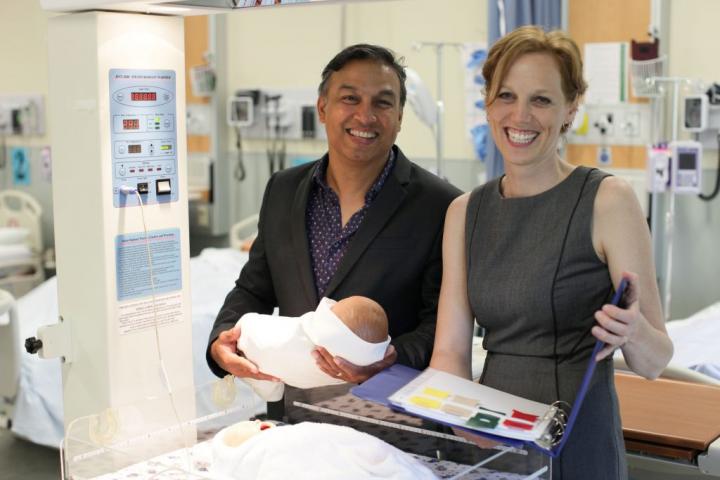
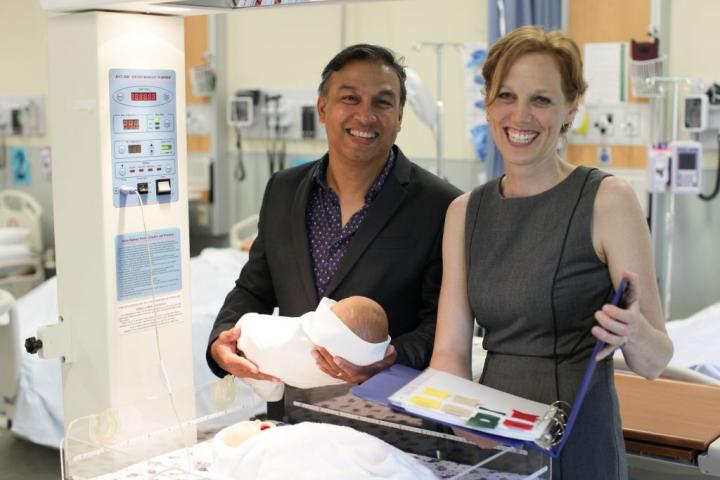
Credit: University of Saskatchewan
New research from the University of British Columbia and the University of Saskatchewan is adding new evidence in support of midwives as a safe option for prenatal care, especially for women who have low socioeconomic status.
The study, published today in the British Medical Journal Open, found that low-income pregnant women who receive care from a midwife compared to a physician are less likely to go into early labour, to have a baby with a low birth weight, or to have a small-for-gestational age birth, meaning a fetus or infant that is smaller or less developed than normal for the number of weeks in pregnancy.
Midwives, general practitioners (GPs) and obstetricians (OBs) are all qualified to provide safe prenatal care for women during their pregnancy, labour and birth, but each offer a different style of care that matches different women's preferences and needs. Midwives are experts in the care of women having healthy pregnancies, and tend to spend more time with their patients with a focus on the overall physical, emotional and psychological wellbeing of mothers and their newborns.
"Our findings show that women who are more vulnerable benefit from the care of a midwife, likely because they receive more time, counselling and education on how to care for themselves," said the study's lead author Daphne McRae, a post-doctoral research fellow at the UBC school of population and public health who conducted the study while she was a PhD student at the University of Saskatchewan.
For the study, the researchers followed 57,872 women in B.C. who carried a single baby, had low-to-moderate risk pregnancies, and received medical insurance premium assistance sometime between 2005 and 2012. They used maternity, medical billing and demographic data to investigate the odds of small-for-gestational age birth, pre-term birth and low birth weight for low-income women receiving care from a midwife, GP, or OB.
After controlling for differences such as age, previous pregnancies, where they lived and pre-existing medical conditions, the researchers found that low-income women who were receiving prenatal care from a midwife had 29 per cent lower odds of a small-for-gestational age birth compared to women who received care from a GP. Compared to those who received care from an OB, low-income women receiving midwifery care had a 41 per cent reduction in odds for small-for-gestational age birth, the researchers found.
McRae said the findings add new evidence in support of midwifery care, and support the development of policies to ensure midwives are available and accessible, especially for low-income women. Midwifery is not available in all parts of the country.
"Waitlists for midwives can be quite long, so women who are educated and health-conscious typically access midwives early on in their pregnancies," said McRae. "But more vulnerable women might not be as aware of the services available to them, so expanding midwifery to make it available for all women is important."
"Our research could help develop policies that make the service more accessible to low-income women," added senior author Nazeem Muhajarine, a professor in community health and epidemiology at the University of Saskatchewan and McRae's supervisor while she conducted the research.
###
The study was co-authored by Patricia Janssen, Saraswathi Vedam, Maureen Mayhew at the University of British Columbia, and Deborah Mpofu and Ulrich Teucher at the University of Saskatchewan.
Media Contact
Reyhana Heatherington
[email protected]
604-822-0116
@UBCnews
http://www.ubc.ca
Original Source
http://doi.org/10.1136/bmjopen-2018-022220 http://dx.doi.org/10.1136/bmjopen-2018-022220

