In recent years, the sustainable conversion of agricultural and forestry residues into high-value chemicals has garnered significant scientific attention. Among these biochemicals, furfural stands out as a pivotal platform molecule, essential for producing bio-based plastics, pharmaceuticals, and various industrial chemicals. The efficient and scalable production of furfural, however, remains a complex challenge that hinges critically on the choice of solvents and heating methodologies employed during its synthesis.
Traditionally, furfural production has been dominated by conventional heating approaches that rely on thermal conduction within high-pressure reactors or hydrothermal autoclaves. These methods, while effective to some extent, inherently produce non-uniform heating environments. Such thermal gradients lead to several complications, including uneven reaction zones and suboptimal interaction between the solvent and biomass substrates. Consequently, these conditions hinder the full exploitation of solvent properties, resulting in low reaction efficiencies and limited overall yields.
One of the most notable drawbacks of conventional heating is its lack of synchronization between the substrate characteristics and the heating mechanism. Monosaccharide conversion to furfural is manageable under these traditional conditions; however, efficiently depolymerizing hemicellulose—a major biomass component—proves significantly less effective. This inefficiency mandates longer reaction times and elevated temperatures, ultimately inflating operational costs and energy consumption.
Microwave-assisted heating technologies have emerged as a promising alternative, offering distinctive advantages rooted in selective and volumetric heating. Unlike conventional methods, microwaves can couple directly with the solvent and substrate dielectric properties, enabling rapid and uniform energy transfer at the molecular level. Leveraging this capability could revolutionize furfural synthesis by enhancing reaction rates and yields under milder conditions.
At the forefront of this innovation, Academician Jiang Jianchun and his research team at the Chinese Academy of Forestry have pioneered a method that combines microwave energy with tailored solvent systems. Central to their strategy is the understanding and manipulation of solvent dielectric properties, which dictate their interaction with microwave radiation. The team proposed definitive screening principles focused on selecting solvents that exhibit optimal compatibility with microwave fields to maximize reaction efficiency.
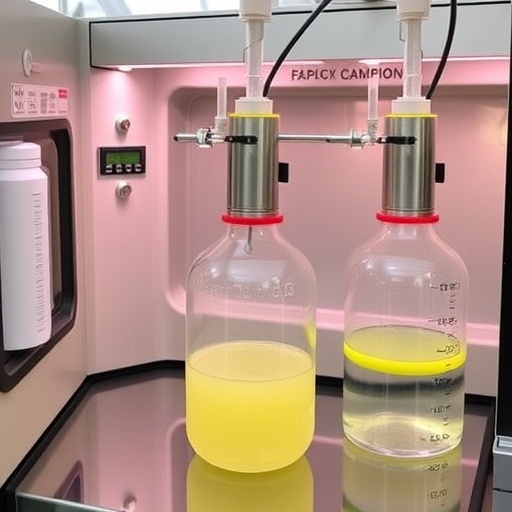
Building upon these principles, the researchers designed a biphasic solvent system employing γ-valerolactone (GVL) combined with an aqueous saline solution containing sodium chloride. This configuration facilitates both the directed liquefaction of pentoses derived from biomass and the stepwise isolation of furfural. Importantly, the team systematically demonstrated that furfural’s partition coefficient (R)—a measure of its distribution between the two phases—is significantly enhanced under microwave irradiation. Comparative studies revealed an increase in R from 29.33 during conventional heating to 35.68 when microwaves were employed, indicative of improved extraction efficacy.
Delving deeper into the mechanistic underpinnings, kinetic studies detailed how microwave energy synergistically accelerates biomass depolymerization and furfural synthesis. The initial stage utilizes high-power microwave irradiation to rapidly cleave xylan glycosidic bonds within hemicellulose, liberating xylose with exceptional efficiency—up to 87.9 mol%. This swift depolymerization minimizes the formation of inhibitory byproducts common to slower processes. Subsequently, a reduced microwave power phase drives the dehydration of released xylose to furfural and facilitates its instant extraction into the organic phase. This layered energy input strategy mitigates side reactions and reduces product decomposition.
Optimization under these controlled conditions yielded remarkable results: at 140°C over 20 minutes, the furfural yield from xylan reached an impressive 85.38 mol%. This yield not only surpasses the 78.1 mol% attainable through conventional heating applied over 120 minutes but does so with substantially reduced reaction duration and energy input. The implications for industrial scalability, efficiency, and cost reductions are profound.
To validate this advanced approach under real-world conditions, the team extended their experiments to complex biomass substrates such as wheat straw. The process retained high effectiveness, delivering a furfural yield quantified at 62.72 wt%, underscoring the practical applicability of the microwave-coupled solvent system. Moreover, an energy consumption analysis revealed that microwave-assisted synthesis reduces energy demands by over 75% relative to conventional heating, positioning this technology as a compelling option for greener chemical manufacturing.
The success of this research hinges largely on the precise control of microwave power levels and exploitation of solvent dielectric traits. By integrating the reaction substrate’s unique chemical features with carefully selected solvent systems, the researchers engineered a process that maximizes microwave energy utilization while minimizing thermal losses. This selective heating paradigm represents a critical advancement in biomass valorization technologies, offering a much-needed blueprint for sustainable chemical production.
Looking ahead, the potential for industrial adoption of microwave-enhanced furfural synthesis appears promising. The methodology’s scalability and energy efficiency align with global trends toward greener manufacturing and resource utilization. Future developments could see the extension of these microwave-enabled protocols to other biochemicals, amplifying their contribution to the circular bioeconomy.
In summation, the breakthrough achieved by Jiang Jianchun’s team embodies a significant stride forward in biomass conversion science. By harmonizing solvent systems with microwave technology, they have demonstrated not only enhanced reaction kinetics and extraction but also meaningful energy savings and operational flexibility. This innovative approach offers an exciting pathway to transform low-value forest residues into high-value chemical precursors with unprecedented efficiency, thereby accelerating the transition to sustainable chemical industries worldwide.
Subject of Research: Not applicable
Article Title: Microwave-Derived Hierarchic Liquefaction of Pentose and Intensified Separation of Furfural
News Publication Date: 20-Nov-2025
Web References: http://dx.doi.org/10.34133/research.1008
Image Credits: Copyright © 2025 Ruixuan Yao et al.
Keywords: furfural, microwave heating, biomass conversion, solvent dielectric properties, γ-valerolactone, biphasic solvent system, hemicellulose depolymerization, xylan cleavage, xylose dehydration, selective microwave heating, energy efficiency, bio-based chemicals
Tags: advanced heating technologies for bio-refiningbio-based chemical synthesisenergy-efficient biomass processingfurfural production optimizationhemicellulose depolymerization techniqueshierarchical liquefaction of pentoseindustrial furfural separation methodsmicrowave heating for biomassmicrowave-assisted biomass liquefactionscalable furfural manufacturingsolvent effects in furfural synthesissustainable agricultural residue conversion