• HOME
  • NEWS
  • EXPLORE
    • CAREER
      • Companies
      • Jobs
    • EVENTS
    • iGEM
      • News
      • Team
    • PHOTOS
    • VIDEO
    • WIKI
  • BLOG
  • COMMUNITY
    • FACEBOOK
    • INSTAGRAM
    • TWITTER
Wednesday, June 3, 2026
BIOENGINEER.ORG
No Result
View All Result
  • Login
  • HOME
  • NEWS
  • EXPLORE
    • CAREER
      • Companies
      • Jobs
        • Lecturer
        • PhD Studentship
        • Postdoc
        • Research Assistant
    • EVENTS
    • iGEM
      • News
      • Team
    • PHOTOS
    • VIDEO
    • WIKI
  • BLOG
  • COMMUNITY
    • FACEBOOK
    • INSTAGRAM
    • TWITTER
  • HOME
  • NEWS
  • EXPLORE
    • CAREER
      • Companies
      • Jobs
        • Lecturer
        • PhD Studentship
        • Postdoc
        • Research Assistant
    • EVENTS
    • iGEM
      • News
      • Team
    • PHOTOS
    • VIDEO
    • WIKI
  • BLOG
  • COMMUNITY
    • FACEBOOK
    • INSTAGRAM
    • TWITTER
No Result
View All Result
Bioengineer.org
No Result
View All Result
Home NEWS Science News Chemistry

Microswimmers move like moths to the light

Bioengineer by Bioengineer
November 30, 2020
in Chemistry
Reading Time: 2 mins read
0
IMAGE
Share on FacebookShare on TwitterShare on LinkedinShare on RedditShare on Telegram

IMAGE

Credit: Copyright: Simmchen Group

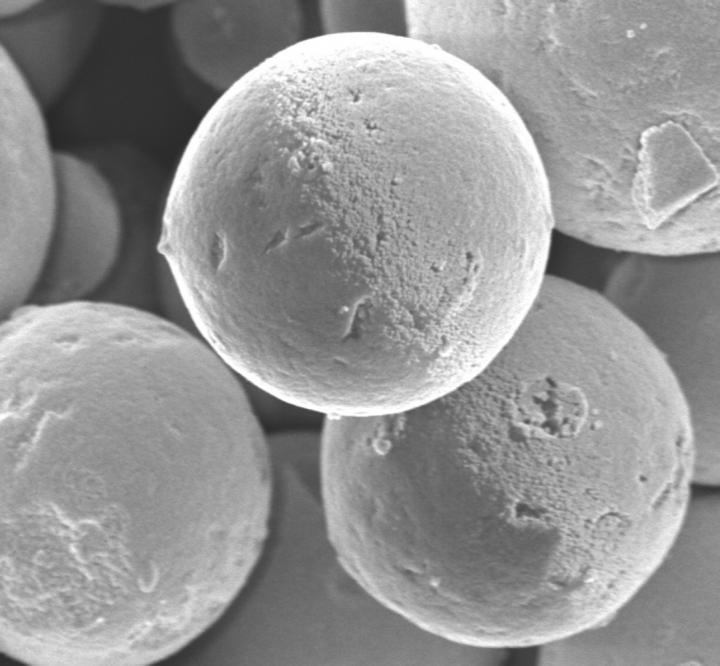
TU Dresden Freigeist fellow Dr Juliane Simmchen is investigating with her multidisciplinary junior research group the motion of synthetic microswimmers in liquids. Her goal is to enable these inanimate microparticles to move in a certain direction of their own accord and thus, in future, to be used in sensor technology or biological cleaning.
“Actually, it’s a bit like playing computer games in the laboratory,” the chemist describes her extraordinary research work in an interview with the Volkswagen Foundation.

The Simmchen group is working with the so-called “Janus particles”. These consist of a body of titanium dioxide with two differently coated sides: one side with a catalytically active layer of nickel and gold, the other side remains untreated. Titanium dioxide is used as a whitening agent, for example in wall paint, but it also reacts with light. As a result, Janus particles are photocatalytic, which means that as soon as light hits them, chemical reactions occur that set off a movement.

The group has now observed and analyzed an extremely unusual phenomenon in the motion of Janus particles: as soon as the particles leave an illuminated zone in the microscope, they turn around by themselves and swim back – a behavior that is actually only known from microorganisms. But how can such complex behavior be triggered in synthetic microswimmers?

First author Lukas Niese and Dr Simmchen were able to show that as long as the particles are active in the light, their swimming direction is stabilized by a combination of physicochemical effects. As soon as the particles are no longer exposed to light, there is no energy conversion and the direction of movement is no longer stable. “In this case,” explains Lukas Niese, “the natural thermal movement (Brownian Motion) sets in. This causes the particles to virtually flip, and then they swim back into the exposed area.”

“The fact that such simple effects as the Brownian Motion can lead to such complex behavior was quite astonishing and impressive, especially in terms of the evolution and the development of abilities. We could make use of this property for the targeted control of microrobots. Applications are conceivable in which the particles filter and remove pollutants from liquids or transport medicine through the body, and perhaps even transport information,” says Dr Simmchen, explaining the significance of the discovery.

###

Original publication: Lukas Niese, Linlin Wang, Sayan Dasb and Juliane Simmchen: Apparent phototaxis enabled by Brownian motion. Soft Matter 2020 https://doi.org/10.1039/D0SM01603A

Media Contact
Dr. Juliane Simmchen
[email protected]

Related Journal Article

http://dx.doi.org/10.1039/D0SM01603A

Tags: Chemistry/Physics/Materials Sciences
Share12Tweet8Share2ShareShareShare2

Related Posts

TU Graz Physicist Unveils Mobile Device for High-Precision Air Pollutant Measurement — Chemistry

TU Graz Physicist Unveils Mobile Device for High-Precision Air Pollutant Measurement

June 3, 2026
Breakthrough Dual Interlocked Mediators Pave Way for Ultrafast-Charging, Long-Life Sodium Metal Batteries with Single-Ion Conducting Quasi-Solid-State Electrolytes — Chemistry

Breakthrough Dual Interlocked Mediators Pave Way for Ultrafast-Charging, Long-Life Sodium Metal Batteries with Single-Ion Conducting Quasi-Solid-State Electrolytes

June 3, 2026

Revealing Spatial Chirality Through Terahertz Imaging

June 3, 2026

Modular Synthesis of Cyclobutane Amino Nitriles via Triplet Nitrene

June 3, 2026
Please login to join discussion

POPULAR NEWS

  • ESMO 2025: mRNA COVID Vaccines Enhance Efficacy of Cancer Immunotherapy

    321 shares
    Share 128 Tweet 80
  • Multi-Hospital Study Reveals Long Covid Burden Is Twice as High as Current Estimates

    87 shares
    Share 34 Tweet 22
  • Saying Goodbye to PGY-6: Pediatric Fellowship Realities

    67 shares
    Share 27 Tweet 17
  • Common Food Preservatives Associated with Elevated Blood Pressure and Increased Heart Disease Risk

    57 shares
    Share 23 Tweet 14

About

We bring you the latest biotechnology news from best research centers and universities around the world. Check our website.

Follow us

Recent News

Apatinib Blocks Synovial Sarcoma via VEGFR2 Pathways

Striatal Hyperechogenicity Signals Early XDP Detection

Exploring How Acupuncture Influences Motor Recovery After Stroke

Subscribe to Blog via Email

Enter your email address to subscribe to this blog and receive notifications of new posts by email.

Join 82 other subscribers
  • Contact Us

Bioengineer.org © Copyright 2023 All Rights Reserved.

Welcome Back!

Login to your account below

Forgotten Password?

Retrieve your password

Please enter your username or email address to reset your password.

Log In
No Result
View All Result
  • Homepages
    • Home Page 1
    • Home Page 2
  • News
  • National
  • Business
  • Health
  • Lifestyle
  • Science

Bioengineer.org © Copyright 2023 All Rights Reserved.