• HOME
  • NEWS
  • EXPLORE
    • CAREER
      • Companies
      • Jobs
    • EVENTS
    • iGEM
      • News
      • Team
    • PHOTOS
    • VIDEO
    • WIKI
  • BLOG
  • COMMUNITY
    • FACEBOOK
    • INSTAGRAM
    • TWITTER
Monday, June 29, 2026
BIOENGINEER.ORG
No Result
View All Result
  • Login
  • HOME
  • NEWS
  • EXPLORE
    • CAREER
      • Companies
      • Jobs
        • Lecturer
        • PhD Studentship
        • Postdoc
        • Research Assistant
    • EVENTS
    • iGEM
      • News
      • Team
    • PHOTOS
    • VIDEO
    • WIKI
  • BLOG
  • COMMUNITY
    • FACEBOOK
    • INSTAGRAM
    • TWITTER
  • HOME
  • NEWS
  • EXPLORE
    • CAREER
      • Companies
      • Jobs
        • Lecturer
        • PhD Studentship
        • Postdoc
        • Research Assistant
    • EVENTS
    • iGEM
      • News
      • Team
    • PHOTOS
    • VIDEO
    • WIKI
  • BLOG
  • COMMUNITY
    • FACEBOOK
    • INSTAGRAM
    • TWITTER
No Result
View All Result
Bioengineer.org
No Result
View All Result
Home NEWS Science News

Microseeding: A new way to overcome hemihedral twinning?

Bioengineer by Bioengineer
December 15, 2016
in Science News
Reading Time: 2 mins read
0
Share on FacebookShare on TwitterShare on LinkedinShare on RedditShare on Telegram
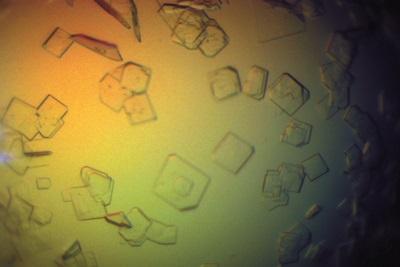
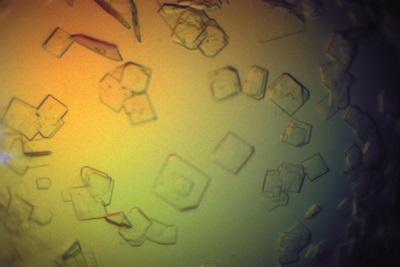
IMAGE

Credit: Harada et al.

Twinning is a crystal-growth disorder in which the specimen is composed of distinct domains whose orientations differ but are related in a particular, well-defined way. Twinning, which is a known problem in protein crystallography, usually hampers high-quality crystal structure determination unless it is detected and either avoided or corrected. Although effective computational methods have been developed for the determination of structures using data from twinned crystals (known as 'detwinning'), if possible it is preferable to obtain crystals that are not twinned.In some cases, optimising the length of the protein fragment used for crystallisation can lead to the growth of untwinned crystals, but this is a time-consuming process.

In a recent paper in Acta Crystallographica Section F, microseeding was used to produce untwinned crystals of LigM, an O-demethylase from Sphingobium sp. SYK-6, using twinned crystals as seeds. Microseeding is one of several seeding techniques that are used to successfully separate nucleation events from crystal-growth events. In this technique, crystals are used as seeds and introduced into new drops which are equilibrated at lower levels of supersaturation. It has frequently been used to improve reproducibility in crystallization and can yield different crystal forms.

In the work described by Harada et al. [(2016). Acta Cryst. F72, 897-902; doi:10.1107/S2053230X16018665], around 50% of the initially obtained crystals of LigM were hemihedrally twinned. These crystals were then used as a seed stock for microseeding. In combination with optimization of the reservoir solution, this led to crystals that were not twinned and belonged to a different space group. It is hoped that this method will have potential as a more general simple method for overcoming hemihedral twinning in protein crystals.

###

Media Contact

Dr. Jonathan Agbenyega
[email protected]
024-434-2878
@iucr

http://www.iucr.org

############

Story Source: Materials provided by Scienmag

Share12Tweet8Share2ShareShareShare2

Related Posts

Tracking Lanthanide-Labeled Microplastics in Plants

June 25, 2026

POSTECH Researchers Slash Cost of Reconstituted Cell-Free Systems by 95%

June 25, 2026

AI and Physics Collaborate to Design Advanced Hydrogen Storage Materials

June 25, 2026

Natural Hallucinogens: Evolution’s Ecological Tools, Not Mere Chemical Byproducts

June 25, 2026
Please login to join discussion

POPULAR NEWS

  • Saying Goodbye to PGY-6: Pediatric Fellowship Realities

    103 shares
    Share 41 Tweet 26
  • Multi-Hospital Study Reveals Long Covid Burden Is Twice as High as Current Estimates

    92 shares
    Share 36 Tweet 23
  • Detection of EDCs in Breast Milk and Infant Urine Up to Six Months Highlights Early Exposure Risks

    77 shares
    Share 31 Tweet 19
  • New Drug Candidate Developed at McMaster Shows Potential for Treating Brain Cancer

    58 shares
    Share 23 Tweet 15

About

We bring you the latest biotechnology news from best research centers and universities around the world. Check our website.

Follow us

Recent News

Tracking Lanthanide-Labeled Microplastics in Plants

POSTECH Researchers Slash Cost of Reconstituted Cell-Free Systems by 95%

AI and Physics Collaborate to Design Advanced Hydrogen Storage Materials

Subscribe to Blog via Email

Success! An email was just sent to confirm your subscription. Please find the email now and click 'Confirm' to start subscribing.

Join 82 other subscribers
  • Contact Us

Bioengineer.org © Copyright 2023 All Rights Reserved.

Welcome Back!

Login to your account below

Forgotten Password?

Retrieve your password

Please enter your username or email address to reset your password.

Log In
No Result
View All Result
  • Homepages
    • Home Page 1
    • Home Page 2
  • News
  • National
  • Business
  • Health
  • Lifestyle
  • Science

Bioengineer.org © Copyright 2023 All Rights Reserved.