
Credit: Mary Ann Liebert, Inc., publishers
New Rochelle, Sept. 18, 2017 — A new study has demonstrated the potential to use digital holographic microscopy (DHM) to detect microorganisms and evidence of life in water collected from the plume rising from the surface of Saturn's icy moon Enceladus. The cell detection capabilities of DHM and what may be learned from studying molecules obtained from Enceladus are discussed in articles published in the September issue of Astrobiology, a peer-reviewed journal from Mary Ann Liebert, Inc., publishers . These articles are part of a Special Collection on Enceladus that is available free on the Astrobiology website.
Senior Editor Carolyn Porco, PhD, the imaging team leader for the Cassini mission at Saturn and a visiting scholar at the University of California, Berkeley, organized this special collection of articles on Enceladus, which offers a wide-ranging look at "that little moon at Saturn with the big possibilities" as NASA's Cassini mission comes to an end.
"The papers in this collection offer a glimpse into the state of a rapidly changing subject at one moment in time… as the Cassini mission draws to a close and we are contemplating the next steps in the exploration of Enceladus," says Dr. Porco.
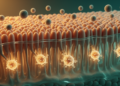
In the article "Digital Holographic Microscopy, a Method for Detection of Microorganisms in Plume Samples from Enceladus and Other Icy Worlds ," coauthors Manuel Bedrossian, Chris Lindensmith, and Jay Nadeau, California Institute of Technology, Pasadena, describe a light-weight microscope that collects both frequency and spatial information and can distinguish between particulate matter, like bits of rock, and dead microbes. With its video recording capabilities that would allow detection of motility as well, such a device could provide definitive, visual evidence of life beyond Earth.
In another article, Steven Benner, Foundation for Applied Molecular Evolution (Alachua, FL), proposes a universal biosignature that could be used to detect the presence of a biological system that undergoes Darwinian evolution, such as might be found on Enceladus or other ocean worlds. He proposes a particular characteristic, based on the structure of the genetic material found in terrestrial life, that should be present in any genetic biopolymer regardless of underlying chemistry. His article is entitled "Detecting Darwinism from Molecules in the Enceladus Plumes, Jupiter's Moons, and Other Planetary Water Lagoons."
###
About the Journal
Astrobiology, led by Editor-in-Chief Sherry L. Cady, a Chief Scientist at the Pacific Northwest National Laboratory, and a prominent international editorial board comprised of esteemed scientists in the field, is the authoritative peer-reviewed journal for the most up-to-date information and perspectives on exciting new research findings and discoveries emanating from interplanetary exploration and terrestrial field and laboratory research programs. The Journal is published monthly online with Open Access options and in print. Complete tables of content and a sample issue may be viewed on the Astrobiology website.
About the Publisher
Mary Ann Liebert, Inc., publishers is a privately held, fully integrated media company known for establishing authoritative peer-reviewed journals in many promising areas of science and biomedical research, including New Space and High Altitude Medicine & Biology. Its biotechnology trade magazine, GEN (Genetic Engineering & Biotechnology News), was the first in its field and is today the industry's most widely read publication worldwide. A complete list of the firm's 80 journals, books, and newsmagazines is available at the Mary Ann Liebert, Inc., publishers website .
Media Contact
Kathryn Ryan
[email protected]
914-740-2250
@LiebertPub
http://www.liebertpub.com
Original Source
http://www.liebertpub.com/global/pressrelease/researchers-describe-microscopic-technique-for-detecting-microbial-life-in-enceladus-water-plumes/2244/ http://dx.doi.org/10.1089/ast.2016.1616