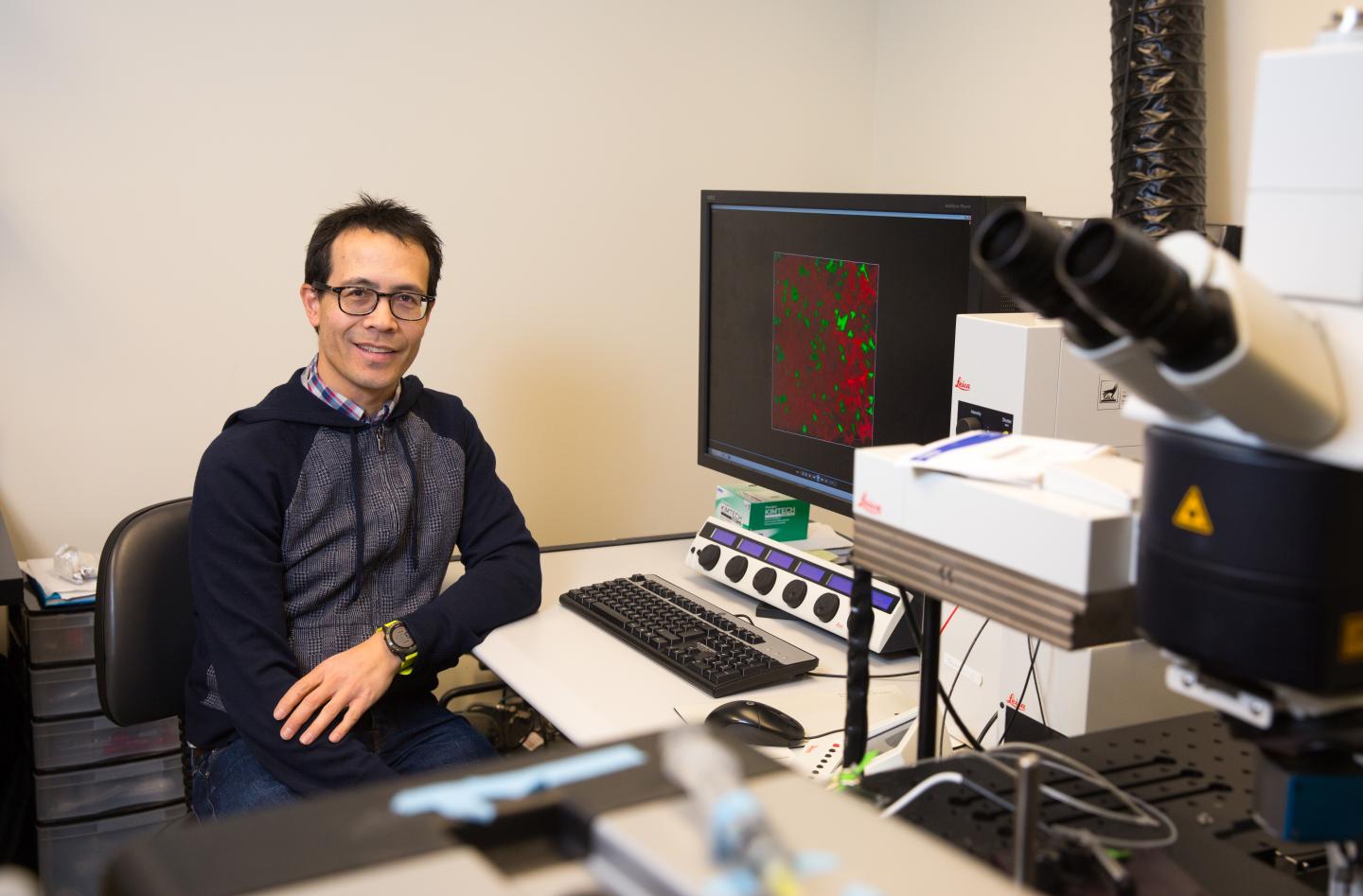
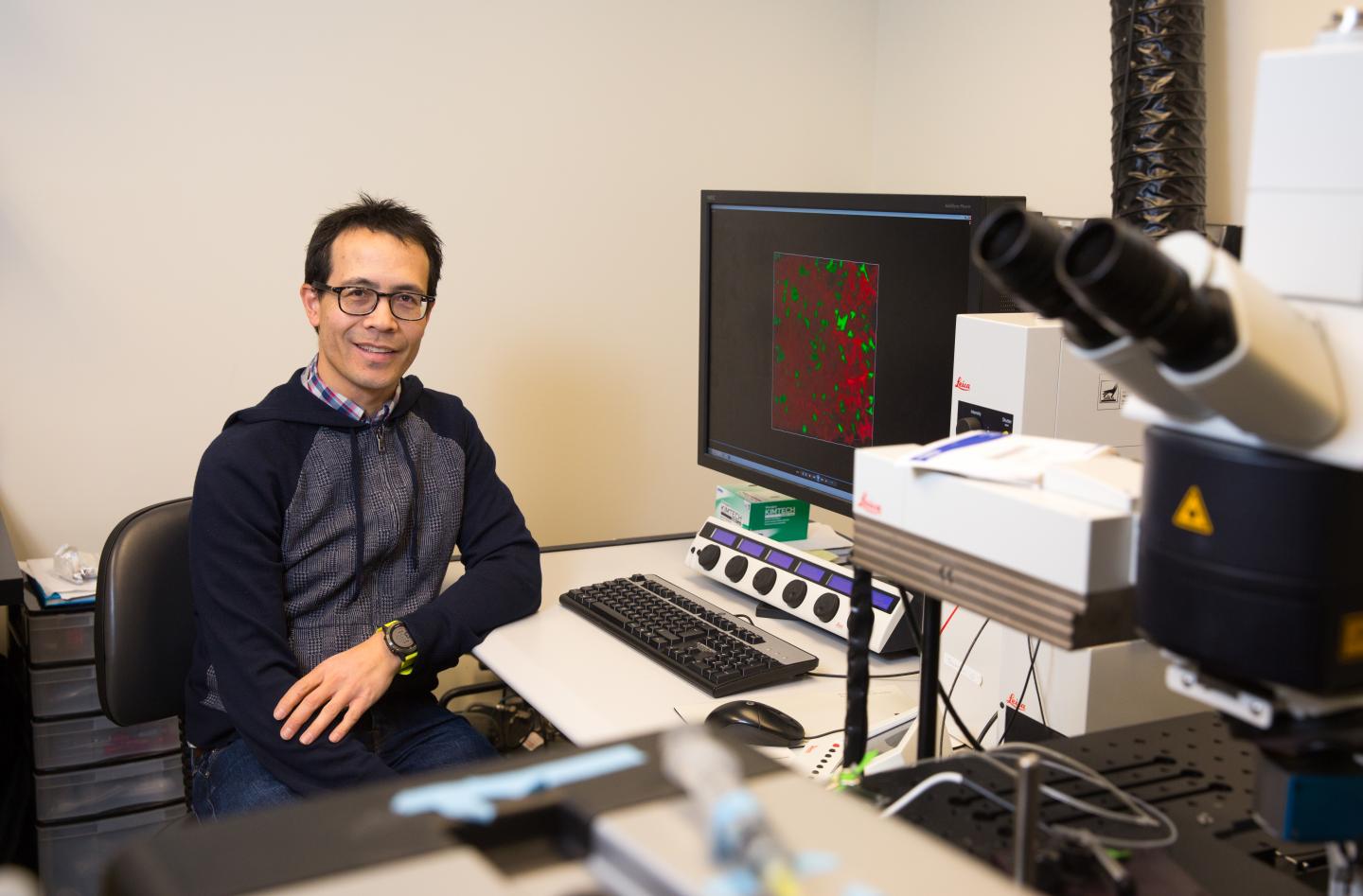
Credit: Riley Brandt, University of Calgary
Researchers at the University of Calgary's Cumming School of Medicine (CSM) have for the first time been able to observe — live and in real-time — how the human body responds to often lethal fungal blood infections in the lung.
In the study, the fungal infection Candida albicans was introduced to mice or human models of the lung vasculature and as blood was pumped over that system, researchers recorded what happened using highly sophisticated microscopes. And what they saw surprised them.
Immune cells rushed to the scene of the infection, which was expected. But then those cells swarmed, clustered and jammed up the blood vessels causing a potentially dangerous blockage, and that was a revelation, one that could lead to new treatment options for the usually deadly incursions.
This clumping of immune cells was captured in high resolution.
The research study which was led by Dr. Bryan Yipp, assistant professor in the Department of Critical Care Medicine at the Cumming School of Medicine and Tier II Canada Research Chair in Pulmonary Immunology, Inflammation and Host Defence, was recently published in CELL Host & Microbe.
Seeking a greater understanding of lung immune response
Candida albicans is a leading cause of bloodstream infection and fungal sepsis, with a high mortality rate. People with weakened immune systems, such as transplant recipients and patients with genetic deficiencies, are often susceptible to developing the condition. Additionally, those with critical illness requiring intensive care unit (ICU) support are at risk for acquiring a fungal blood infection.
Yipp and his team were interested in understanding how the lung in particular is involved in protecting the body from infections. "For some reason the lung itself has a lot of the main type of immune cell, the neutrophil. We knew this, but the reasons why they are in the lung has remained mysterious," Yipp says.
As well, he says, most research has been on bacterial sepsis but they wanted to focus on fungal sepsis because it is less well understood and fungal infections are growing in number and severity. "Our initial thought was that neutrophils would capture fungi the same as they capture bacteria," Yipp says. "But they became so activated they started to clump and cluster together and actually block the bloodstream."
Advancing diseases-on-chips technology
The research team used sophisticated imaging techniques and novel "disease-on-chips" technology to observe the body's response to fungal blood infections. The chips are about the size of a penny and are intended to mimic an organ system – in this case, lung vasculature.
Cumming School of Medicine researcher Mark Gillrie, now doing postdoc work at MIT, developed the study's high-resolution organs-on-chips.
"We generate a pattern of an organ that we want, creating a 3D hollowed-out structure, stick it on a piece of glass, then we can introduce a lot of different cell types," Gillrie says. Astonishingly, Gillrie says those cells types then have the intrinsic ability to self-organize to a certain degree, into an alveolus in the lung for example, or the blood-brain barrier in the brain.
Seeing is believing
"Our real focus is to visualize how everything actually works," Yipp says, emphasizing the imaging is everything. "These are results we never would have been able to guess at without seeing it."
With a clearer understanding of the disease — and pictures to prove how the human body reacts to a fungal blood infection in the lung — the researchers say they are looking next to new therapeutic targets.
Yipp says the goal is to find a way to block the clumping of cells without inhibiting the immune cells from capturing bugs. And the team has already had some success with anti-inflammatory drugs already on the market for asthma. "We were able to repurpose a drug that has already been approved in humans that could reduce negative consequences of infection and improve clinical outcomes," Gillrie says.
###
The University of Calgary's multidisciplinary Engineering Solutions for Health: Biomedical Engineering research strategy drives solutions to our most pressing health challenges in disease and injury prevention, diagnosis and treatments. Our biomedical engineering researchers make a significant impact in our communities by extending lives, improving quality of life, promoting independence, and continuously improving the health system.
Media Contact
Kelly Johnston
[email protected]
403-220-5012
@UCalgary
http://www.ucalgary.ca
Original Source
https://www.ucalgary.ca/utoday/issue/2018-03-01/microscopic-revelations-point-new-blood-infection-therapies http://dx.doi.org/10.1016/j.chom.2017.11.009