


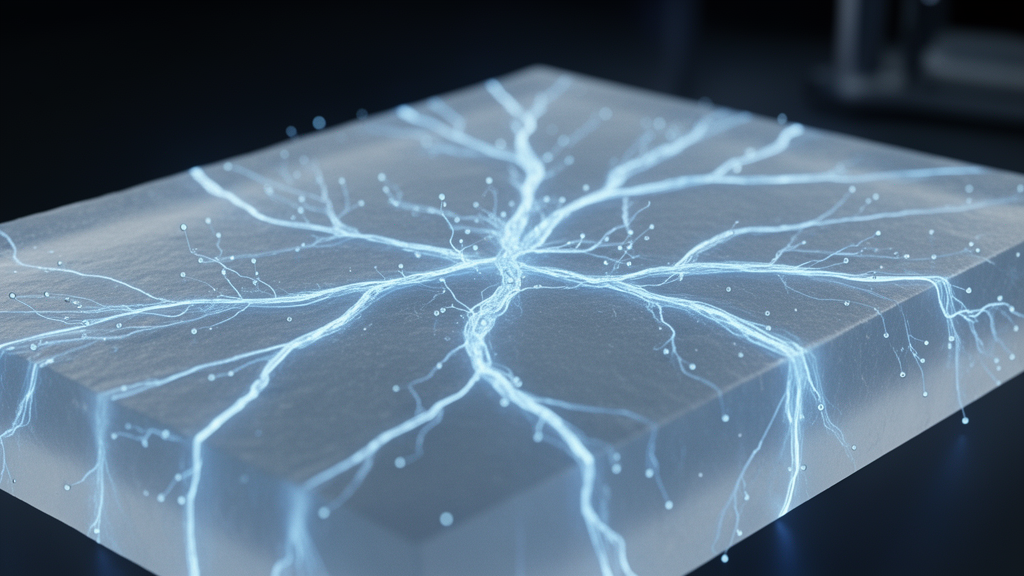
When electronics need to stretch, bend, or flex—such as wearable sensors or shape-changing robots—liquid metal often carries the electricity that makes them work. Yet researchers have not fully understood how the metal conducts electricity through the surrounding material, which has made it difficult to control how current flows in soft electronics. A new study from Virginia Tech, published in the journal Matter, shows how microscopic cracks can turn an insulating material into an electrical conductor, revealing the physical mechanism behind one of soft electronics’ most useful tricks.
“Our group and other researchers around the world have been using mechanical pressure to turn liquid metal composites into conductors for years, but we did not really understand what was happening inside the material,” said Michael Bartlett, associate professor of mechanical engineering and John R. Jones III Faculty Fellow at Virginia Tech. “We wanted to uncover the physical mechanism that allows isolated liquid metal droplets to suddenly become an electrical network.” The research, connected to Bartlett’s NSF CAREER award, was co-authored by Ph.D. candidates Wuzhou Zu and Hugh P. Grennan.
Liquid metal composites have enormous potential for soft electronics because they combine the conductivity of a metal with the pliability of a soft material. The team worked with a metal alloy called eutectic gallium indium, which is liquid at room temperature. At the microscopic level, the alloy looks like a collection of spheres resembling droplets. When the spheres touch, they merge to create pathways for electrical current to pass.
To hold those microscopic metal spheres in place, researchers embed them in a material such as a polymer or rubber. But that means the containing material also fills the spaces between the droplets, raising an obvious question: how does the current move if the insulator gets in the way?
Bartlett’s team used microscopes and 3D X-ray imaging to observe what happened to the liquid metal under different circumstances. When they compressed the soft electronics, they found their answer. Pressing the material caused the insulating substance between nearby metal droplets to crack, allowing the metal to flow into the gaps. After the pressure was removed, metal remained in the cracks, creating permanent pathways through which electricity could flow.
“We were able to watch the process happen in two dimensions and then reconstruct the pathways in three dimensions,” Zu said. “That gave us a much clearer picture of how local cracks and liquid transport build into a larger conductive network.” The imaging approach let the researchers connect what they saw at the scale of individual droplets to the emergence of a material-wide conductive network.
The team also developed a mathematical model that predicts how much force is needed to make the material conductive. According to the study, this prediction worked across many designs, from millimeter-sized droplets down to droplets only a few dozen micrometers wide. “By carefully observing what was going on during experiments, we could connect pathway formation to a fracture mechanics model,” Grennan said. “Now we can design liquid metal composites that activate at necessary forces and length scales for particular applications.”
The findings provide a new framework for designing how and when liquid metal composites become conductive. That could help manufacturers control where conductivity forms in stretchable sensors, wearable electronics, and soft robots, turning an previously empirical process into a predictable design tool.
“Knowing what governs how conductive networks form, we can use that knowledge to guide materials design and manufacturing,” Bartlett said. “That opens the door to manufacturing soft electronic systems where conductivity is programmed in through the material architecture and the way the device is processed.”
The study, published in Matter on 29 October 2026 with DOI 10.1016/j.matt.2026.103089, was a peer-reviewed publication from Virginia Tech. By explaining the crack-based mechanism that links isolated liquid metal droplets into conductive pathways, the work gives engineers a quantitative basis for building soft electronic devices in which the material itself determines when and where electricity flows.
Subject of Research: How microscopic cracks enable liquid metal droplets in soft materials to form electrical conductive pathways
Article Title: Cracks that carry current: Researchers unlock the secrets of liquid metal and electricity
Article References: Cracks that carry current: Researchers unlock the secrets of liquid metal and electricity. Original publication (Bibliographic details unavailable.)
Image Credits: AI Generated
DOI: Not provided
Keywords: liquid metal, soft electronics, eutectic gallium indium, conductive pathways, fracture mechanics, wearable electronics, stretchable sensors, soft robots, Virginia Tech, Matter journal, microscopy, 3D X-ray imaging
News Source: Denise Maddox. (October 29, 2026). Microscopic cracks turn soft insulating materials into electrical conductors. Scienmag.



