

• HOME
  • NEWS
  • EXPLORE
    • CAREER
      • Companies
      • Jobs
    • EVENTS
    • iGEM
      • News
      • Team
    • PHOTOS
    • VIDEO
    • WIKI
  • BLOG
  • COMMUNITY
    • FACEBOOK
    • INSTAGRAM
    • TWITTER
Sunday, October 4, 2026
BIOENGINEER.ORG
No Result
View All Result
  • Login
  • HOME
  • NEWS
  • EXPLORE
    • CAREER
      • Companies
      • Jobs
        • Lecturer
        • PhD Studentship
        • Postdoc
        • Research Assistant
    • EVENTS
    • iGEM
      • News
      • Team
    • PHOTOS
    • VIDEO
    • WIKI
  • BLOG
  • COMMUNITY
    • FACEBOOK
    • INSTAGRAM
    • TWITTER
  • HOME
  • NEWS
  • EXPLORE
    • CAREER
      • Companies
      • Jobs
        • Lecturer
        • PhD Studentship
        • Postdoc
        • Research Assistant
    • EVENTS
    • iGEM
      • News
      • Team
    • PHOTOS
    • VIDEO
    • WIKI
  • BLOG
  • COMMUNITY
    • FACEBOOK
    • INSTAGRAM
    • TWITTER
No Result
View All Result
Bioengineer.org
No Result
View All Result
Home Headlines

Microscope using UV instead of visible light emerging as diagnostic tool

Bioengineer.org by Bioengineer.org
January 21, 2018
in Headlines, Health, Science News
Reading Time: 2 mins read
0
Share on FacebookShare on TwitterShare on LinkedinShare on RedditShare on Telegram
IMAGE

Credit: Richard Levenson, UC Davis

December 4, 2017

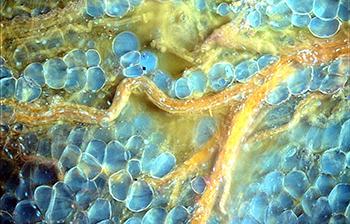
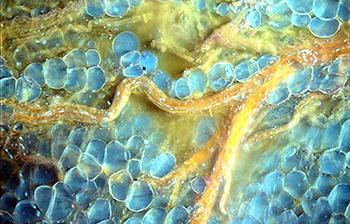
MUSE image of sebaceous glandA microscope using ultraviolet light to illuminate samples enables pathologists to assess high-resolution images of biopsies and other fresh tissue samples for disease within minutes, without requiring the time-consuming preparation of conventional slides or destroying the tissue.

This approach holds promise for improving the speed and efficiency of patient care and medical research nationwide, a study published today in the journal Nature Biomedical Engineering has found.

The technology, known as microscopy with UV surface excitation, or MUSE, uses ultraviolet light at wavelengths below the 300 nanometer range to penetrate the surface of tissue samples by only a few microns (about the same thickness of tissue slices on traditional microscope slides.) The phenomenon was originally described by Stavros Demos, one of the co-authors, who is now at the University of Rochester.

Samples that have been stained with eosin or other standard dyes to highlight important features such as nuclei, cytoplasm and extracellular components produce signals from the UV excitation that are bright enough to be detected by conventional color cameras using sub-second exposure times. The process allows for rapid imaging of large areas and immediate interpretation.

Richard Levenson with MUSE technology"MUSE eliminates any need for conventional tissue processing with formalin fixation, paraffin embedding or thin-sectioning," said Richard Levenson, professor and vice chair for strategic technologies in the Department of Pathology and Laboratory Medicine at UC Davis and senior author of the study.

"It doesn't require lasers, confocal, multiphoton or optical coherence tomography instrumentation, and the simple technology makes it well suited for deployment wherever biopsies are obtained and evaluated," he said.

MUSE's ability to quickly gather high-resolution images without consuming the tissue is an especially important feature.

"It has become increasingly important to submit relevant portion of often tiny tissue samples for DNA and other molecular functional tests," he said. "Making sure that the submitted material actually contains tumor in sufficient quantity is not always easy and sometimes just preparing conventional microscope slices can consume most of or even all of small specimens. MUSE is important because it quickly provides images from fresh tissue without exhausting the sample."

The ability to obtain instant, high-resolution, full-color images for histology, pathology or toxicology studies is also useful for basic scientists who want to assess tissue samples from experimental animal models at the laboratory bench. The technology is being commercialized by MUSE Microscopy Inc.

###

Media Contact

Carole Gan
[email protected]
916-734-9047
@UCDavisHealth

http://www.ucdmc.ucdavis.edu

Original Source

http://www.ucdmc.ucdavis.edu/publish/news/newsroom/12507 http://dx.doi.org/10.1038/s41551-017-0165-y


Share12Tweet8Share2ShareShareShare2

Related Posts

Grass Roots Fight Erosion in Compacted Soils, and a New Indicator Shows How

Grass Roots Fight Erosion in Compacted Soils, and a New Indicator Shows How

October 4, 2026
Drowning Costs the UK Nearly a Billion Pounds Every Year, Study Finds

Drowning Costs the UK Nearly a Billion Pounds Every Year, Study Finds

October 4, 2026

Ancient Chinese Herb Yields a Polysaccharide That Kills Staph and Calms Runaway Inflammation

October 4, 2026

AI Digital Twins Could Transform Intensive Care in Landmark $38 Million Federal Project

October 4, 2026
Please login to join discussion

POPULAR NEWS

  • Alloys That Shrink Their Own Grains: New PIX Mechanism Refines Metals With Heat Alone

    Alloys That Shrink Their Own Grains: New PIX Mechanism Refines Metals With Heat Alone

    29 shares
    Share 12 Tweet 7
  • Endurance Exercise Reshapes the Liver in Males and Females Through Distinct Molecular Routes

    29 shares
    Share 12 Tweet 7
  • Single Transcription Factor PU.1 Rapidly Converts Fibroblasts into Macrophage-Lineage Cells

    29 shares
    Share 12 Tweet 7
  • New Scale Measures How Ready Nurse Educators Really Are for the AI Era

    29 shares
    Share 12 Tweet 7

About

We bring you the latest biotechnology news from best research centers and universities around the world. Check our website.

Follow us

Recent News

Alloys That Shrink Their Own Grains: New PIX Mechanism Refines Metals With Heat Alone

Endurance Exercise Reshapes the Liver in Males and Females Through Distinct Molecular Routes

Single Transcription Factor PU.1 Rapidly Converts Fibroblasts into Macrophage-Lineage Cells

Subscribe to Blog via Email

Success! An email was just sent to confirm your subscription. Please find the email now and click 'Confirm' to start subscribing.

Join 85 other subscribers
  • Contact Us

Bioengineer.org © Copyright 2023 All Rights Reserved.

Welcome Back!

Login to your account below

Forgotten Password?

Retrieve your password

Please enter your username or email address to reset your password.

Log In
No Result
View All Result
  • Homepages
    • Home Page 1
    • Home Page 2
  • News
  • National
  • Business
  • Health
  • Lifestyle
  • Science

Bioengineer.org © Copyright 2023 All Rights Reserved.
