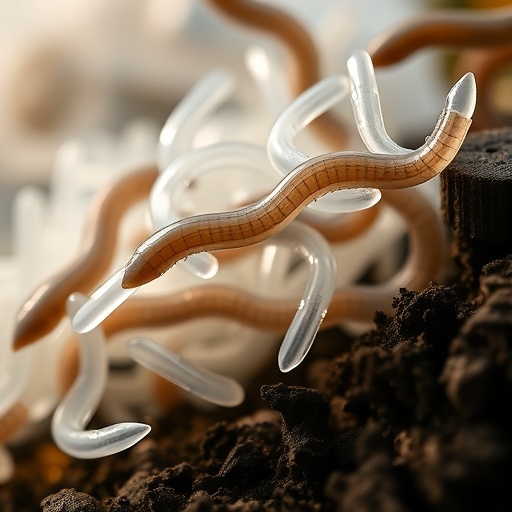
Micoplastics may be invisible to the naked eye, but their effects on the smallest inhabitants of the soil are proving impossible to ignore. A new study from researchers at Mindanao State University-Iligan Institute of Technology in the Philippines has revealed that microscopic particles of polystyrene can dramatically shrink populations and stunt the growth of common soil-dwelling nematodes, with the smallest particles inflicting the most severe damage. The findings, published in the journal Microplastics and Nanoplastics, add weight to a growing body of evidence that plastic pollution is quietly reshaping the biological communities that keep soils healthy.
The research team, led by Nurhana J. Sabaani and Joey Genevieve T. Martinez, focused on three species of bacterial-feeding nematodes isolated from agricultural soil in Davao de Oro, a province in the southern Philippines. Unlike the majority of previous ecotoxicology studies, which have relied almost exclusively on the laboratory model organism Caenorhabditis elegans, this investigation used wild-caught nematodes: Cephalobus sp., Cervidellus vexilliger, and Mesorhabditis sp. This distinction matters. Prolonged laboratory culturing can lead to adaptations that make model strains respond differently to environmental stressors than their free-living counterparts, meaning studies on laboratory worms may understate or misrepresent the true ecological toll of microplastic contamination in natural soils.
Nematodes are ideal sentinels for soil health. These translucent, thread-like roundworms, often less than a millimeter long, occupy multiple trophic levels, participate in the mineralization and decomposition of organic matter, and have long served as ecological indicators of heavy metal and organic pollution. Their limited mobility means they cannot escape toxicants in their surroundings, so their population abundance, body size, and reproductive success provide a direct readout of environmental conditions. If nematode communities decline, the consequences cascade through soil food webs, affecting nutrient cycling and ultimately plant health.
To test how microplastics affect these organisms, the researchers exposed the three nematode species to fluorescent polystyrene microspheres of three different diameters: 0.1 micrometers, 0.5 micrometers, and 1 micrometer. Polystyrene was chosen because it is one of the most widely manufactured polymers in the world and, once discarded, breaks down relatively easily into small fragments that wind and water disperse across the environment. The particles were prepared as a micropolystyrene feed suspension at a concentration of 1 × 10^7 beads per milliliter, mixed in equal parts with a suspension of E. coli OP50 bacteria, the nematodes’ food source. Before the experiment began, the team measured the buccal cavity sizes of all three species, confirming that their mouth openings, ranging from 1.73 to 2.10 micrometers, were at least 1.3 times larger than the beads, meaning every worm was physically capable of ingesting the particles.
The experimental design was rigorous and multilayered. For the population assay, five individuals of each species were placed on agar plates coated with the microplastic-laced bacterial feed, with five replicate plates per treatment per species and destructive sampling after 15, 30, and 45 days, yielding a total of 180 plates. For the body size assay, first-stage juvenile worms were reared individually in 24-well plates across four treatments, and their adult body length and volume were quantified roughly seven days later using FIJI, an open-source image analysis platform derived from ImageJ. All data were tested for normality and homogeneity of variance and then analyzed using one-way analysis of variance, followed by Tukey’s post-hoc test to pinpoint which particle sizes drove significant differences.
The results were unambiguous and, in places, startling. In the control plates free of microplastics, all three species flourished, their populations climbing steadily over the 45-day period. Mesorhabditis sp., the fastest reproducer, exceeded 9,000 individuals within just 15 days, and by the end of the experiment every species had surpassed 20,000 individuals per plate, likely the carrying capacity of that environment. Exposure to microplastics reversed this trajectory entirely. Within the first 15 days, C. vexilliger populations exposed to 0.1-micrometer particles had collapsed by eleven-fold compared with controls, while Cephalobus sp. and Mesorhabditis sp. declined six-fold and five-fold, respectively. By the experiment’s conclusion, all three species showed highly significant abundance losses across every particle size tested, with C. vexilliger emerging as the most sensitive species overall.
The effects on individual growth were equally striking. All three species developed significantly shorter bodies when reared on microplastic-contaminated food, regardless of particle size. Mesorhabditis sp. suffered the largest reduction, losing nearly a quarter of its normal adult body length, at 24.46 percent, with the 0.1-micrometer particles again producing the most severe effect at a statistical significance level of p < 0.001. Body volume, the second parameter measured, declined significantly only in Cephalobus sp., the smallest of the three species, which lost nearly half of its original volume when exposed to the smallest beads. This observation aligns with a well-established principle in toxicology: smaller organisms often exhibit greater sensitivity to toxicants because a given dose represents a larger fraction of their body mass and their physiological reserves are thinner.
Why would microscopic plastic beads be so devastating to animals that thrive in some of the harshest environments on Earth? The answer, the researchers explain, lies in a combination of physical and physiological mechanisms. Microplastics enter nematodes through ingestion, and once inside the buccal cavity, the beads can physically obstruct the intake of bacterial cells, effectively starving the worms even as food remains abundant. Consistent with this food-dilution mechanism, previous work has shown that bacterial consumption by C. elegans dropped by 49 to 67 percent in the presence of polystyrene beads, while inert silica beads produced no such effect. Beyond mechanical interference, ingested particles can lacerate internal tissues and trigger intestinal oxidative damage. Studies on model nematodes have documented reduced intestinal calcium levels, elevated expression of the detoxification enzyme glutathione S-transferase 4, and the generation of reactive oxygen species that damage mitochondria following polystyrene exposure. Under this toxic burden, organisms follow a fundamental principle of the dynamic energy budget: energy that would ordinarily fuel growth and reproduction is diverted toward detoxification and stress responses, producing the stunted body sizes observed here.
The pronounced toxicity of the 0.1-micrometer particles, the smallest tested, fits a broader pattern in the microplastics literature. Smaller particles carry a higher surface area-to-volume ratio, increasing contact with gut tissues, and are more readily ingested and retained within the body. Prior studies in C. elegans and marine copepods have similarly documented size-dependent toxicity, though some research had suggested 1-micrometer particles could be the most harmful in certain contexts. The present study partially complicates this picture: while 0.1-micrometer beads dominated the sublethal effects on body size and early population decline, no consistent size-dependent hierarchy emerged for long-term abundance, and by day 45 every particle size proved deleterious to every species. An intriguing anomaly appeared in the data as well, as C. vexilliger populations exposed to all sizes of microplastics briefly trended upward on day 30, though this rebound was not statistically significant.
The broader implications of the study extend well beyond three Philippine worm species. Nematodes are among the most numerous multicellular animals on the planet, and bacterivorous species in particular sit at the base of soil food webs, channeling energy from microbes to higher trophic levels while accelerating nutrient release. A pollutant capable of slashing their populations and shrinking their bodies within a matter of weeks poses a genuine threat to soil fertility, agricultural productivity, and the carbon and nitrogen cycles that depend on these understated ecosystem engineers. Field-based research has already shown that microplastic additions to soil reduce overall faunal abundance, and the new evidence from wild-caught organisms strengthens the case that such effects translate from laboratory to landscape.
The authors acknowledge important limitations and chart a clear path forward. The experiments were conducted on agar plates rather than natural soil, a simplification that maximizes experimental control but may alter exposure dynamics. All particles tested were polystyrene, while soils in the real world contain a heterogeneous mixture of polymers, from polyethylene to polypropylene, each with distinct additives and surface chemistries. Only a single concentration was examined, so dose-response relationships remain unexplored for these species. The team recommends future studies vary microplastic concentrations, test additional polymer types, and adopt soil-based experimental matrices to better approximate field conditions.
What the study establishes beyond doubt is that even plastic particles far too small to see can inflict measurable, statistically robust harm on wild soil animals at the level of both populations and individual development. As global plastic production continues and the fragmentation of existing waste generates ever smaller particles, the hidden toll on the subterranean world is likely to grow. For the worms that quietly sustain the ground beneath our feet, the age of plastic has arrived, one microscopic bead at a time.
Subject of Research: Size-dependent toxicity of micropolystyrene particles on population abundance and body size of three wild soil nematode species (Cephalobus sp., Cervidellus vexilliger, and Mesorhabditis sp.) from Davao de Oro, Philippines
Subject of Research: Technology and Engineering
Article Title: Microplastic-induced reductions in population abundance and body size of soil nematodes
Article References: Sabaani, N. J., Bacosa, H. P., Paradero, J. T. C., Pardillo, J. J. B., Maglupay, J. R. U., Casas, P. A., Madamba, M. R. S., & Martinez, J. G. T. (2026). Microplastic-induced reductions in population abundance and body size of soil nematodes. Microplastics and Nanoplastics, 6(1), Article 19. https://doi.org/10.1186/s43591-026-00175-8
Image Credits: AI Generated
DOI: 10.1186/s43591-026-00175-8
Keywords: microplastics, polystyrene, soil nematodes, Cephalobus sp., Cervidellus vexilliger, Mesorhabditis sp., size-dependent toxicity, population abundance, body size, soil ecotoxicology, Philippines
Cite Scienmag News
APA MLA Chicago
Alan Morgan. (September 6, 2026). Microplastics shrink soil nematode populations and body sizes, study finds. Scienmag. https://scienmag.com/microplastics-shrink-soil-nematode-populations-and-body-sizes-study-finds/
Alan Morgan. “Microplastics shrink soil nematode populations and body sizes, study finds.” Scienmag, 6 September 2026, https://scienmag.com/microplastics-shrink-soil-nematode-populations-and-body-sizes-study-finds/. Accessed 6 September 2026.
Alan Morgan. “Microplastics shrink soil nematode populations and body sizes, study finds.” Scienmag. September 6, 2026. https://scienmag.com/microplastics-shrink-soil-nematode-populations-and-body-sizes-study-finds/
Copy citation Download RIS
Tags: differences between laboratory and wild nematode responses to microplastic pollutionecotoxicology of microplastics in agricultural soilsecotoxicology of microplastics in natural environmentseffects of microplastics on soil biological communitieseffects of polystyrene microplastics on soil faunaeffects of polystyrene microplastics on soil-dwelling nematodesenvironmental consequences of microplastic contamination in soil ecosystemsimpact of microplastics on soil nematode body size and populationsinfluence of microplastics on soil biodiversitylong-term effects of microplastics onMicroplastics impact on soil nematode populationsmicroplastics impact soil nematodesmicroscopic plastic particles in agricultureplastic pollution effects on soil ecosystemsrole of soil nematodessoil contamination by microplastics and ecological consequencessoil health and microbial communitiessoil health and plastic pollutionsoil nematode population decline due to microplasticswild-caught nematodes as ecological indicators