BEAUFORT, N.C. – Microscopic plastic particles have been found in the fats and lungs of two-thirds of the marine mammals in a graduate student’s study of ocean microplastics. The presence of polymer particles and fibers in these animals suggests that microplastics can travel out of the digestive tract and lodge in the tissues.
Credit: Greg Merrill Jr., Duke University
BEAUFORT, N.C. – Microscopic plastic particles have been found in the fats and lungs of two-thirds of the marine mammals in a graduate student’s study of ocean microplastics. The presence of polymer particles and fibers in these animals suggests that microplastics can travel out of the digestive tract and lodge in the tissues.
The study, slated for the Oct. 15 edition of Environmental Pollution, appeared online this week.
Harms that embedded microplastics might cause to marine mammals are yet to be determined, but plastics have been implicated by other studies as possible hormone mimics and endocrine disruptors.
“This is an extra burden on top of everything else they face: climate change, pollution, noise, and now they’re not only ingesting plastic and contending with the big pieces in their stomachs, they’re also being internalized,” said Greg Merrill Jr., a fifth-year graduate student at the Duke University Marine Lab. “Some proportion of their mass is now plastic.”
The samples in this study were acquired from 32 stranded or subsistence-harvested animals between 2000 and 2021 in Alaska, California and North Carolina. Twelve species are represented in the data, including one bearded seal, which also had plastic in its tissues.
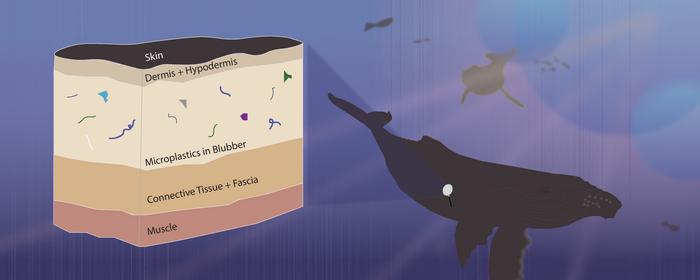
Plastics are attracted to fats – they’re lipophilic – and so believed to be easily attracted to blubber, the sound-producing melon on a toothed whale’s forehead, and the fat pads along the lower jaw that focus sound to the whales’ internal ears. The study sampled those three kinds of fats plus the lungs and found plastics in all four tissues.
Plastic particles identified in tissues ranged on average from 198 microns to 537 microns – a human hair is about 100 microns in diameter. Merrill points out that, in addition to whatever chemical threat the plastics pose, plastic pieces also can tear and abrade tissues.
“Now that we know plastic is in these tissues, we’re looking at what the metabolic impact might be,” Merrill said. For the next stage of his dissertation research, Merrill will use cell lines grown from biopsied whale tissue to run toxicology tests of plastic particles.
Polyester fibers, a common byproduct of laundry machines, were the most common in tissue samples, as was polyethylene, which is a component of beverage containers. Blue plastic was the most common color found in all four kinds of tissue.
A 2022 paper in Nature Communications estimated, based on known concentrations of microplastics off the Pacific Coast of California, that a filter-feeding blue whale might be gulping down 95 pounds of plastic waste per day as it catches tiny creatures in the water column. Whales and dolphins that prey on fish and other larger organisms also might be acquiring accumulated plastic in the animals they eat, Merrill said.
“We haven’t done the math, but most of the microplastics probably do pass through the gut and get defecated. But some proportion of it is ending up in the animals’ tissues,” Merrill said.
“For me, this just underscores the ubiquity of ocean plastics and the scale of this problem,” Merrill said. “Some of these samples date back to 2001. Like, this has been happening for at least 20 years.”
This work was supported by the National Science Foundation, the North Carolina Wildlife Federation and North Carolina Sea Grant (2018-2791-17).
CITATION: “Microplastics in Marine Mammal Blubber, Melon, & Other Tissues: Evidence of Translocation,” Greg Merrill, Ludovic Hermabessiere, Chelsea Rochman, Douglas Nowacek. Environmental Pollution, Oct. 15, 2023. DOI: 10.1016/j.envpol.2023.122252
Online (open access) – https://www.sciencedirect.com/science/article/pii/S026974912301254X
Journal
Environmental Pollution
DOI
10.1016/j.envpol.2023.122252
Method of Research
Observational study
Subject of Research
Animals
Article Title
Microplastics in Marine Mammal Blubber, Melon, & Other Tissues: Evidence of Translocation
Article Publication Date
9-Aug-2023