• HOME
  • NEWS
  • EXPLORE
    • CAREER
      • Companies
      • Jobs
    • EVENTS
    • iGEM
      • News
      • Team
    • PHOTOS
    • VIDEO
    • WIKI
  • BLOG
  • COMMUNITY
    • FACEBOOK
    • INSTAGRAM
    • TWITTER
Thursday, November 26, 2026
BIOENGINEER.ORG
No Result
View All Result
  • Login
  • HOME
  • NEWS
  • EXPLORE
    • CAREER
      • Companies
      • Jobs
        • Lecturer
        • PhD Studentship
        • Postdoc
        • Research Assistant
    • EVENTS
    • iGEM
      • News
      • Team
    • PHOTOS
    • VIDEO
    • WIKI
  • BLOG
  • COMMUNITY
    • FACEBOOK
    • INSTAGRAM
    • TWITTER
No Result
View All Result
Bioengineer.org
No Result
View All Result
Home NEWS Science News Health

Microcurrent Stimulation Alters Deep Sleep and Autonomic Patterns in Sleep Apnea

by
November 26, 2026
in Health
Reading Time: 2 mins read
0
Microcurrent Stimulation Alters Deep Sleep and Autonomic Patterns in Sleep Apnea

Microcurrent Stimulation Alters Deep Sleep and Autonomic Patterns in Sleep Apnea

Share on FacebookShare on TwitterShare on LinkedinShare on RedditShare on Telegram

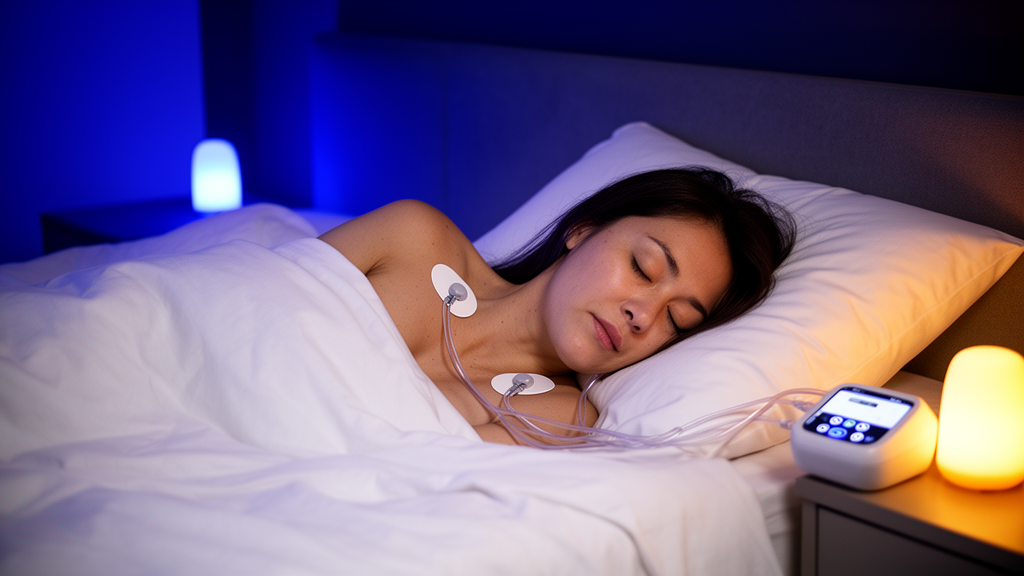
A randomized, double-blind, sham-controlled trial published in BMC Pulmonary Medicine has demonstrated that two weeks of microcurrent electrical nerve stimulation, or MENS, produces measurable short-term changes in sleep architecture and nocturnal autonomic activity among individuals diagnosed with obstructive sleep apnea. Specifically, investigators observed a statistically significant between-group difference in the alteration of deep sleep when comparing participants who received active electrical stimulation to those assigned to sham intervention.

The double-blind trial was specifically designed to evaluate whether short-term microcurrent electrical nerve stimulation could alter sleep-related outcomes, objective biochemical markers, and heart rate variability in individuals affected by obstructive sleep apnea.

The experimental protocol randomized participants into two distinct study arms, where individuals received either active microcurrent electrical nerve stimulation or sham stimulation over a continuous two-week intervention window. To capture relevant physiologic parameters under normal living conditions, investigators conducted home-based sleep monitoring and biochemical assessments both prior to the start of stimulation and immediately following the completion of the two-week regimen.

A focused analysis of nocturnal heart rate variability demonstrated distinct shifts in cardiac autonomic regulation during sleep. Participants in the active stimulation group exhibited an attenuation of the early-sleep rise in the root mean square of successive differences, or RMSSD, as well as the standard deviation of normal-to-normal intervals, or SDNN, resulting in statistically significant between-group contrasts when compared with the sham cohort.

While autonomic and deep sleep measures exhibited measurable modifications, circulating biochemical indicators showed no divergent shifts between the study arms. Subsequent between-group analyses revealed that differences in low-density lipoprotein cholesterol, or LDL-C, and glycated hemoglobin, or HbA1c, were not statistically significant after two weeks of active microcurrent electrical nerve stimulation compared to sham therapy.

The researchers noted that these findings provide preliminary evidence of short-term sleep-related and heart rate variability changes associated with microcurrent electrical nerve stimulation in obstructive sleep apnea.

Subject of Research: Microcurrent electrical nerve stimulation effects in obstructive sleep apnea

Article Title: Potential short-term effects of microcurrent electrical nerve stimulation on sleep and heart rate variability in obstructive sleep apnea: a randomized, double-blind, sham-controlled study

Article References: Liu, W.-T., Liu, I.-J., Chien, R., Chen, Y.-Y., Chen, Y.-L., Majumdar, A., Kang, J.-H., Lee, K.-Y., Cheng, W.-H., Lin, Y.-C., Kuan, Y.-C., Lee, H.-C., & Tsai, C.-Y. (2026). Potential short-term effects of microcurrent electrical nerve stimulation on sleep and heart rate variability in obstructive sleep apnea: a randomized, double-blind, sham-controlled study. BMC Pulmonary Medicine. https://doi.org/10.1186/s12890-026-05043-y

Image Credits: AI Generated

DOI: 10.1186/s12890-026-05043-y

Keywords: obstructive sleep apnea, microcurrent electrical nerve stimulation, heart rate variability, deep sleep, RMSSD, SDNN, autonomic imbalance, metabolic dysregulation, low-density lipoprotein cholesterol, glycated hemoglobin, sham-controlled trial, randomized controlled trial, home sleep monitoring, polysomnography, sleep medicine, nocturnal HRV, cardiac autonomic regulation, biochemical assessments

News Source: Ophelia Keating. (November 26, 2026). Microcurrent Stimulation Alters Deep Sleep and Autonomic Patterns in Sleep Apnea. Scienmag.

Tags: autonomic imbalancebiochemical assessmentscardiac autonomic regulationdeep sleepglycated hemoglobinheart rate variabilityhome sleep monitoringLow-density lipoprotein cholesterolmetabolic dysregulationmicrocurrent electrical nerve stimulationnocturnal HRVobstructive sleep apneapolysomnographyrandomized controlled trialRMSSDSDNNsham-controlled trialSleep Medicine
Share12Tweet7Share2ShareShareShare1

Related Posts

Geodesic MRI Mapping Resolves Continuous Peritumoral Tissue Gradients in Glioblastoma

Geodesic MRI Mapping Resolves Continuous Peritumoral Tissue Gradients in Glioblastoma

November 26, 2026
Peripheral VA ECMO Generates Negligible Kinetic Afterload Against Left Ventricular Ejection

Peripheral VA ECMO Generates Negligible Kinetic Afterload Against Left Ventricular Ejection

November 26, 2026

Machine-Readable Reliability Passports Expose Hidden Integrity Faults in Medical Imaging Models

November 26, 2026

Intravenous NAD+ Infusion Enhances Cardiac Function in Ischemic Cardiomyopathy Trial

November 26, 2026

POPULAR NEWS

  • Ambulatory Epilepsy Monitoring Shows Promise for Presurgical Evaluation Despite Technical Constraints

    Ambulatory Epilepsy Monitoring Shows Promise for Presurgical Evaluation Despite Technical Constraints

    29 shares
    Share 12 Tweet 7
  • Fungal Culture Optimization Boosts Compound Yield Against Resistant Gastric Pathogen

    29 shares
    Share 12 Tweet 7
  • Researchers Map Complete Scattering Amplitudes for Ghost-Free Bimetric Theory

    29 shares
    Share 12 Tweet 7
  • Herbal Medicines Reduce Atorvastatin Systemic Exposure in Healthy Volunteer Trial

    29 shares
    Share 12 Tweet 7

About

We bring you the latest biotechnology news from best research centers and universities around the world. Check our website.

Follow us

Recent News

Geodesic MRI Mapping Resolves Continuous Peritumoral Tissue Gradients in Glioblastoma

Researchers Propose Governance Model to Control How Robots Remember Personal Habits

Audit Protocol Shows Embedded Fuzzy Soil Decision System Is Highly Compressible

Subscribe to Blog via Email

Enter your email address to subscribe to this blog and receive notifications of new posts by email.

Join 89 other subscribers
  • Contact Us

Bioengineer.org © Copyright 2023 All Rights Reserved.

Welcome Back!

Login to your account below

Forgotten Password?

Retrieve your password

Please enter your username or email address to reset your password.

Log In
No Result
View All Result
  • Homepages
    • Home Page 1
    • Home Page 2
  • News
  • National
  • Business
  • Health
  • Lifestyle
  • Science

Bioengineer.org © Copyright 2023 All Rights Reserved.