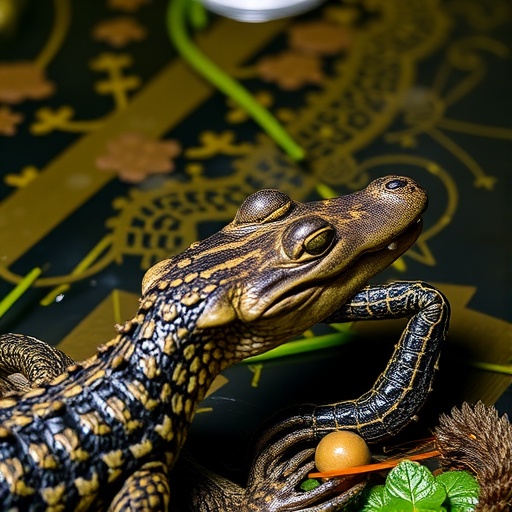
In a groundbreaking study that dives deep into the intricacies of ecosystem dynamics, scientists have unveiled fascinating findings regarding the intestinal microbiota in juvenile Chinese alligators. This research, conducted by a team of experts including Li, W., Liu, J., and Cui, L., sheds light on the size-dependent effects of these microbial communities, revealing critical implications for the conservation of this species. These juvenile alligators serve as key indicators in understanding the broader implications of environmental changes on biodiversity and ecosystem health.
Microbiota, the diverse community of microorganisms residing in a host’s digestive tract, play pivotal roles in nutrient absorption, immune function, and overall health. In reptiles, these microbial populations are especially crucial, as they contribute to the host’s capability to digest complex carbohydrates and synthesize essential vitamins. Yet, the relationships between microbiota composition and host size, particularly during the early developmental stages of juvenile alligators, have remained largely unexplored until now.
The researchers meticulously collected fecal samples from juveniles of varying sizes to analyze the diversity and composition of their intestinal microbiota using advanced sequencing technologies. This effort aimed to identify significant differences in microbial communities corresponding to the size and age of the alligators. The study protocol was designed to eliminate confounding variables by maintaining controlled environments that reflected the alligators’ natural habitat.
Findings revealed that smaller juvenile alligators hosted a significantly different composition of intestinal microbes compared to their larger counterparts. This stark contrast indicated that the microbial community adapts in response to the size and growth phase of the animals, a phenomenon that could have far-reaching consequences on their digestive efficiency and overall health. The research highlights the potential for harnessing this knowledge in conservation efforts and species protection strategies.
Furthermore, the research team unearthed a crucial aspect of this microbial transition: the growth of specific bacterial taxa that are particularly well-suited to digesting the dietary changes associated with increased size. This metabolic flexibility is vital, as it optimizes nutrient absorption and energy expenditure, enabling these reptiles to thrive in their environments. These insights not only enhance our understanding of alligator biology but also bolster the foundational knowledge of microbiome interactions across species.
The implications for conservation are profound. As environmental changes threaten the ecosystems inhabited by Chinese alligators, understanding the role of the microbiota can inform strategies aimed at mitigating the impacts of habitat loss and pollution. By supporting the health of these microbial communities, conservationists can potentially enhance the resilience of alligator populations in the wild.
Moreover, this study serves as a model for other species grappling with similar ecological challenges. It underscores the importance of examining microbial communities in various taxa to better understand their adaptive mechanisms in the face of environmental stressors. By deciphering the relationship between organism size, microbiota composition, and health, a pathway emerges for improving breeding and rehabilitation practices not only in reptiles but across a range of endangered species.
The research further emphasizes the interdisciplinary nature of modern conservation science. Integrating microbiology, ecology, and evolutionary biology forms a comprehensive framework for addressing the complex challenges posed by biodiversity loss. The study acts as a compelling reminder of the interconnected nature of life on Earth, illustrating how the smallest organisms can impact the survival of much larger ones.
As the scientific community continues to unravel the secrets of the microbiome, the study’s findings are poised to influence future research directions. Given the staggering rate of biodiversity decline worldwide, leveraging the knowledge gained from this research could be pivotal in promoting sustainable management practices that aim to preserve both species and ecosystems.
In a world increasingly influenced by climate change and habitat fragmentation, the call for innovative conservation strategies has never been more urgent. Understanding the intricate roles played by gut microbiota in juvenile Chinese alligators may be just the beginning of a larger narrative on wildlife health, resilience, and conservation success. Ultimately, this study not only contributes to the academic discourse but also emphasizes the need for immediate action in safeguarding our planet’s rich biodiversity.
With the publication of their findings in the esteemed journal “Front Zool,” Li, W., Liu, J., and Cui, L. have opened a door to further inquiries into reptilian microbiomes. Their work not only paves the way for additional studies focusing on other species but also highlights the need for ongoing collaboration between ecological scientists and conservation practitioners. This synergistic approach can enhance wildlife management efforts, ensuring that future generations inherit a world where both species and ecosystems flourish.
The era of microbial ecology is upon us, and its implications for wildlife conservation are profound. As researchers continue to explore these microscopic ecosystems, the potential for transformative impacts on conservation practices will only grow. This study stands as a testament to the intricate web of life, reminding us that sometimes the smallest elements can wield the most considerable influence over life itself.
The lessons learned from juvenile Chinese alligators and their unique microbiota are likely to resonate across the biological sciences. By fostering awareness and understanding of these relationships, we can initiate a broader conversation about the significance of microbes in shaping the world around us. The future of conservation may very well depend on our ability to appreciate the role of these unseen allies in the survival of species and preservation of ecosystems.
In conclusion, as the scientific narrative around microbiomes continues to evolve, this pivotal research serves as both a revelation and a call to action. It challenges prevailing assumptions and beckons us to embrace the complexity of life. The journey into understanding the microbial dynamics at play in juvenile Chinese alligators is not merely an academic pursuit; it is a critical endeavor crucial for the survival of countless species that share our planet.
Subject of Research: Intestinal microbiota in juvenile Chinese alligators
Article Title: Size-dependent effects of the intestinal microbiota in juvenile Chinese alligators: implications for species protection
Article References:
Li, W., Liu, J., Cui, L. et al. Size-dependent effects of the intestinal microbiota in juvenile Chinese alligators: implications for species protection.
Front Zool 22, 15 (2025). https://doi.org/10.1186/s12983-025-00572-4
Image Credits: AI Generated
DOI: https://doi.org/10.1186/s12983-025-00572-4
Keywords: intestinal microbiota, juvenile Chinese alligators, conservation, biodiversity, gut health, ecosystem dynamics, microbiome research
Tags: advanced sequencing technologies in microbiome studiesconservation of Chinese alligatorsearly developmental stages of reptilesecosystem dynamics and biodiversityfecal sample analysis in wildlife researchimmune function in juvenile reptilesimpacts of environmental changes on ecosystemsintestinal microbiota in reptilesmicrobial communities and host sizemicrobiota influence on juvenile alligator healthnutrient absorption in alligatorssignificance of microbial diversity in health