A newly compiled editorial synthesis of empirical field surveys, controlled greenhouse trials, and critical reviews demonstrates how rhizosphere microbial diversity and agricultural management strategies alleviate salt and alkali stress in crops. Across arid and semi-arid global agroecosystems, soil salinization and alkalization present severe obstacles to agricultural productivity by disrupting plant physiology, impairing nutrient cycling, and altering rhizosphere microbial assemblages. While microbial mitigation strategies offer low-input, sustainable alternatives to conventional physicochemical remediation, practical implementation continues to face significant translational bottlenecks.
Agricultural interventions in saline-alkali soils introduce complex microbial responses that depend heavily on management practices. In an empirical field investigation across two experimental sites in Xinjiang cotton fields, Wu and colleagues evaluated the effects of conventional polyethylene mulch against two thicknesses of biodegradable polybutylene adipate terephthalate film. Their findings revealed that local environmental conditions and the physical dynamics of film cracking exerted a stronger influence on overall microbial alpha diversity than the specific mulch material selected.
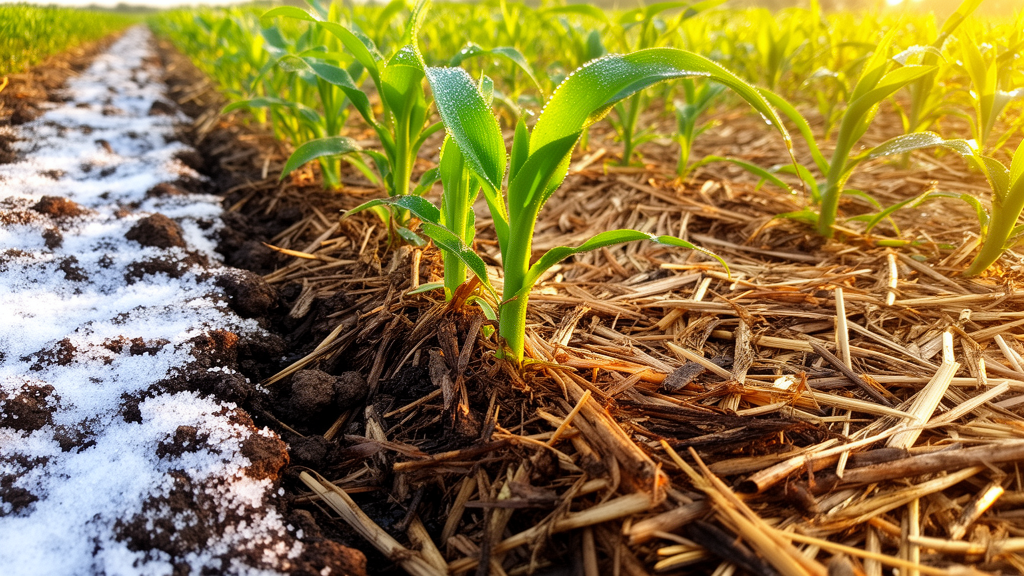
The evaluation of mulching amendments also uncovered distinct taxonomic shifts and practical management trade-offs in saline farmland. Conventional polyethylene mulch sustained higher abundances of bacteria and actinomycetes, whereas thicker biodegradable film favored fungal populations. The authors identified a 0.01-millimeter biodegradable film as an effective compromise, balancing minimal cracking during the crop seedling stage with acceptable soil microbial compatibility, while emphasizing that snapshot sampling must be expanded to long-term, multi-season monitoring.
Controlled mechanistic investigations have clarified how symbiotic fungi interact with broader soil communities under stress gradients. In a greenhouse pot assay, Liu and colleagues examined tall fescue inoculated with the arbuscular mycorrhizal fungus Claroideoglomus etunicatum across varying levels of saline-alkali pressure. Inoculation altered rhizosphere bacterial and fungal community composition and resulted in measurable increases in plant biomass across the experimental gradient.
Structural equation modeling in the tall fescue experiment indicated that growth improvements were driven primarily by the enrichment of rhizosphere bacterial diversity rather than fungal diversity. This demonstrates that mycorrhizal stress protection operates not only through direct host-fungus symbiotic physiology, but also through indirect modulation of the surrounding bacterial microbiome. However, because these observations were obtained in greenhouse pots, field validation remains necessary to account for competition from native soil microbes and real-world environmental variation.
Complementary literature reviews within the collection cataloged the physiological strategies used by halophilic and salt-tolerant microorganisms. Cheng and Rong synthesized key mechanisms including phytohormone regulation, nutrient solubilization, maintenance of ion homeostasis, antioxidant induction, biofilm development, and the production of osmoprotectants. Despite these diverse capabilities, the authors noted that strain-host specificity, poor reproducibility between laboratory and field conditions, insufficient ecological safety testing, and delivery challenges continue to hinder practical deployment.
Focusing on fungal contributions, Kaushik and colleagues evaluated how beneficial fungi facilitate mineral solubilization, nutrient acquisition, and salinity tolerance. Their synthesis established important distinctions between mineral solubilization, mobilization, and uptake processes in crops. The authors emphasized that functional traits measured in laboratory in-vitro assays do not reliably forecast real-world performance, and correlative multi-omics datasets require confirmation through direct gene-functional validation.
Across the gathered contributions, researchers identified persistent cross-cutting challenges that constrain microbial soil management. Promising growth-promoting and stress-relieving effects documented in controlled settings frequently prove difficult to reproduce in heterogeneous agricultural soils. Furthermore, observational community profiling currently dominates the literature, leaving a shortage of causal genetic validation, microbial strain tracking, and multi-year field evaluations.
The synthesis also highlighted experimental difficulties in isolating microbial effects from the physical and chemical changes caused by agronomic amendments like plastic mulching.
To advance microbial technologies for saline-alkali agriculture, the contributors outlined key research priorities. These include multi-site field trials that evaluate inoculant efficacy and ecological establishment, functional genetic validation of key taxa via mutant and gene-silencing assays, enhanced inoculant formulations utilizing bacterial motility and biofilm transitions, and comprehensive assessments that integrate crop yield, soil health, and microbial indicators.
The synthesis emphasizes that soil salinization and alkalization impair global agricultural systems through dual stressors: excess soluble salts and elevated soil pH. These concurrent pressures disrupt fundamental plant physiology, hinder regular nutrient cycling, and force substantial structural rearrangements across rhizosphere microbial assemblages. While microbial interventions offer low-input, sustainable alternatives to traditional physicochemical remediation, researchers face four unresolved knowledge gaps across arid and semi-arid agroecosystems. Specifically, field studies have not yet clarified how plastic mulching amendments alter the composition of saline-alkali soil microbiomes over time. Mechanistic questions also surround how arbuscular mycorrhizal fungi reprogram indigenous rhizosphere communities to bolster host stress resilience. Furthermore, the explicit functional pathways deployed by halotolerant microorganisms to relieve salt stress require deeper characterization, as does the process by which beneficial fungal partners mobilize critical minerals when crops face simultaneous nutrient deficiencies and high salinity. To resolve these challenges, the compiled research bridges field observational surveys, controlled greenhouse trials, and critical narrative syntheses.
In assessing field-scale agronomic interventions, investigations in Xinjiang cotton fields revealed subtle interactions between mulch degradation and soil biology across two distinct experimental sites. Wu and colleagues demonstrated that overall microbial alpha diversity was not dictated primarily by the chemical composition of the mulch material itself, but rather by local environmental conditions and the physical dynamics of film cracking. The researchers tracked conventional polyethylene mulch alongside two thicknesses of biodegradable polybutylene adipate terephthalate film, uncovering divergent demographic responses between microbial kingdoms. Polyethylene mulching sustained higher population abundances of bacteria and actinomycetes, whereas thicker biodegradable polybutylene adipate terephthalate film promoted fungal proliferation. From an agronomic management standpoint, the data highlighted that a 0.01-millimeter biodegradable film establishes a practical balance, maintaining low cracking rates during the critical crop seedling stage while ensuring acceptable compatibility with native soil microbes. Nevertheless, the study cautioned that snapshot field sampling cannot capture long-term ecological shifts, underscoring the absolute necessity of multi-season monitoring to gauge the cumulative consequences of biodegradable films in saline-alkali farmland.
At the mechanistic pot scale, Liu and colleagues clarified the indirect pathways through which fungal symbionts bolster host growth under harsh saline-alkali conditions. By testing tall fescue along an experimental saline-alkali stress gradient, the investigators observed that inoculation with the arbuscular mycorrhizal fungus Claroideoglomus etunicatum substantially altered the taxonomic composition of both bacterial and fungal communities in the plant rhizosphere. Crucially, structural equation modeling demonstrated that the mycorrhizal-mediated enhancement of plant biomass was statistically associated with an increase in rhizosphere bacterial diversity rather than fungal community diversity. This statistical modeling indicates that arbuscular mycorrhizal fungal protection does not stem exclusively from direct physiological symbiosis between the host root and the fungal hyphae. Instead, the fungus indirectly modulates the wider rhizosphere bacterial community, creating an essential auxiliary pathway that helps the host withstand saline-alkali stress. Despite these clear pot-based observations, the authors noted that controlled greenhouse assays exclude natural environmental heterogeneity and competition from indigenous soil microbes, meaning these community-level relationships still require rigorous empirical confirmation in open agricultural fields.
Reviewing broader microbial mitigation strategies, Cheng and Rong synthesized the complex biochemical pathways through which halophilic and salt-tolerant microorganisms alleviate environmental stress in host crops. Their synthesis categorized core physiological mechanisms into phytohormone modulation, nutrient solubilization, maintenance of intracellular ion homeostasis, antioxidant enzyme induction, protective biofilm formation, and the production of cellular osmoprotectants. However, translating these laboratory-characterized traits into reliable agricultural practices faces formidable bottlenecks. The reviewers documented that beneficial microbial strains frequently display narrow host specificity, limiting their utility across different crop varieties. Furthermore, high performance recorded under controlled laboratory settings consistently fails to replicate under variable field conditions. Inoculant development is further constrained by inadequate assessments of ecological safety regarding introduced strains and major technological deficiencies in commercial formulation and delivery systems, which impede the effective introduction of living bioinoculants into established agricultural soils.
Addressing fungal contributions to soil fertility, Kaushik and colleagues provided an integrated literature framework evaluating how beneficial fungi mediate mineral solubilization, nutrient acquisition, and salinity tolerance. A critical contribution of their synthesis was establishing a precise operational distinction between three sequential steps: the initial solubilization of insoluble minerals, their subsequent physical and chemical mobilization through the rhizosphere, and actual plant nutrient uptake. By contrasting data collected across in-vitro laboratory assays, greenhouse pot trials, and open field experiments, the authors illustrated that in-vitro functional capabilities do not reliably forecast real-world performance under agricultural conditions. Moreover, the review cautioned against over-interpreting modern high-throughput sequencing surveys. The vast majority of multi-omics datasets yield correlative associations rather than causal mechanistic proof, making direct gene-functional validation experiments an urgent requirement to confirm the genuine physiological roles of candidate fungal taxa.
To address these limitations, the contributors outlined strategic priorities for advancing rhizosphere technologies in saline-alkali farming. Current research remains heavily dominated by correlative community profiling through amplicon sequencing and redundancy analysis, while causal genetic validation, in-soil strain tracking, and multi-year trials remain scarce. Moving forward, the field requires multi-site, long-term trials that balance inoculant efficacy with ecological establishment against native competitors. Researchers must also conduct mutant and gene-silencing assays to quantify specific microbial contributions to plant nutrition and stress adaptation. Additionally, formulation and delivery systems must incorporate chemotaxis, motility, and biofilm transitions to enhance colonization, while comprehensive evaluations simultaneously track crop yield, soil physicochemical health, and microbial indicators.
Subject of Research: Rhizosphere microbial interactions and crop stress alleviation in saline-alkali soils
Article Title: Editorial: Salt-stress-relieving and growth-promoting microbial diversity and its interaction mechanism with plant rhizosphere
Article References: Shi, Y., Zahir, Z. A., & Wang, X. (2026). Editorial: Salt-stress-relieving and growth-promoting microbial diversity and its interaction mechanism with plant rhizosphere. Frontiers in Microbiology, 17, Article 2022716. https://doi.org/10.3389/fmicb.2026.2022716
Image Credits: AI Generated
DOI: 10.3389/fmicb.2026.2022716
Keywords: saline-alkali soils, rhizosphere microbiome, arbuscular mycorrhizal fungi, Claroideoglomus etunicatum, tall fescue, polyethylene mulch, PBAT mulch film, biodegradable mulching, halotolerant microorganisms, bacterial community diversity, nutrient solubilization, phytohormone modulation, biofilm formation, cotton fields, osmoprotectants, structural equation modeling, soil salinization, inoculant delivery systems
News Source: Morgan Morrow. (November 15, 2026). Microbial Diversity and Mulching Help Crops Cope With Saline Soils. Scienmag.