A comprehensive critical narrative review synthesises the evolving technological, manufacturing, and clinical landscape of microarray patches, highlighting their potential to transform transdermal drug delivery and global vaccination while detailing the rigorous chemistry, manufacturing, and control hurdles that remain before commercial scale can be achieved. Writing in the Journal of Pharmacy and Pharmaceutical Sciences, an international multidisciplinary research team assessed how these micron-scale projection arrays breach the stratum corneum to deliver therapeutic payloads directly into the immunologically rich viable epidermis and dermis. While conventional hypodermic needles and syringes have served as the clinical standard for parenteral delivery for more than 170 years, they require trained medical personnel, demand continuous cold-chain infrastructure, generate biohazardous sharps waste, and cause injection-associated pain that exacerbates vaccine hesitancy. Microarray patches offer an alternative delivery architecture designed to bridge the user convenience of traditional transdermal patches with the potent systemic or intradermal bioavailability of hypodermic injections.
The biological rationale underpinning microarray patch delivery relies on targeting the abundant network of antigen-presenting cells residing within human skin layers. Unlike intramuscular injections that deposit vaccines into muscle tissue characterised by relatively low baseline immunogenicity, microarray projections typically ranging between 50 and 900 micrometres in height directly engage epidermal Langerhans cells and dermal dendritic cells. These cutaneous compartments possess between one and two orders of magnitude more antigen-presenting cells per unit volume than subcutaneous muscle tissue. This concentrated cellular activation allows for dose sparing, a mechanism wherein protective humoral and cellular immune responses can be established using only a fraction of the standard antigen quantity required by standard intramuscular injections. In evaluating the broader utility of these devices, the investigators noted applications extending beyond prophylactic vaccines to include transdermal diagnostics, chemotherapeutics, and biotherapeutics like monoclonal antibodies.
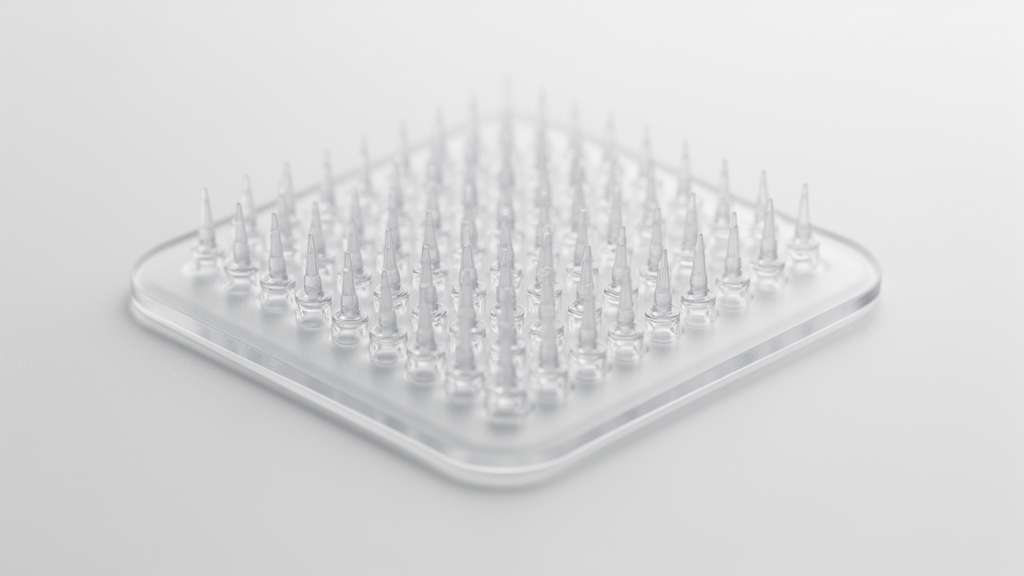
Microarray patch architectures have diversified across five distinct operational classifications, each governed by specific drug-release mechanisms, material fabrication constraints, and clinical maturity levels. Solid microarray patches rely on a poke-and-patch approach, creating transient skin microchannels through silicon, metal, or non-degradable polymer projections before a separate topical formulation is applied. Coated microarray patches implement a coat-and-poke mechanism, drying formulated vaccine or drug directly onto the solid micro-projection surface, dissolving rapidly upon skin hydration but inherently limited by surface-area payload capacities that typically remain below one milligram per array. Dissolving and biodegradable patches encapsulate active pharmaceutical agents within water-soluble sugar or polymer matrices, such as carboxymethylcellulose, polyvinylpyrrolidone, polyvinyl alcohol, or sucrose, dissolving fully within minutes to hours without generating sharp biohazardous waste. Hydrogel-forming patches use cross-linked matrices that swell upon imbibing interstitial fluid, forming continuous porous channels that allow drugs to diffuse continuously from an attached backing reservoir. Finally, hollow patches utilize internal microscopic bores for pressurised liquid micro-infusions, delivering higher volumetric fluid payloads but requiring complex micromachining and remaining vulnerable to lumen clogging from compressed dermal tissue.
Overcoming payload restrictions has driven substantial engineering innovations across patch fabrication, especially for high-dose biopharmaceuticals and monoclonal antibodies. The authors detailed how novel powder-filling techniques bypass the solubility and viscosity constraints of conventional liquid solution casting by packing lyophilised drug powder directly into micro-mould cavities prior to polymer backing addition. This method has achieved antibody loading capacities reaching 4.5 milligrams per square-centimetre patch, representing an approximate 20-fold cargo increase over solution-cast equivalents. Concurrently, additive manufacturing using high-precision three-dimensional printing enables the fabrication of complex undercut and arrowhead geometries designed to improve dermal anchoring and mechanical retention. Recent formulation advances have also yielded second-generation dissolving patches formulated with methylcellulose, which replace standard carboxymethylcellulose to permit sterile membrane filtration during production, resolving a critical current good manufacturing practice compliance obstacle.
In preclinical and clinical vaccine evaluations, microarray platforms have demonstrated protective immunogenicity across diverse bacterial and viral targets. In human trials, seasonal influenza candidates have established foundational clinical safety and immunogenicity, including Phase I studies demonstrating that a 2.5-microgram haemagglutinin dose administered via coated high-density patches induced neutralising antibody responses comparable to a conventional 15-microgram intramuscular injection. Crucially, the most clinically advanced paediatric trial evaluated a dissolving measles and rubella patch in The Gambia across an age de-escalation protocol encompassing adults, toddlers, and measles-rubella-naïve infants aged 9 to 10 months. That double-blind trial demonstrated 93 percent measles and 100 percent rubella seroconversion in infant cohorts, matching subcutaneous injection controls while exhibiting only mild, transient erythema and induration as primary local reactogenicity signals.
Despite these clinical milestones, the authors caution that public health discourse frequently overstates key operational benefits, confusing idealized technology claims with setting-dependent realities. Promises of total cold-chain elimination, entirely painless self-administration, complete waste eradication, and effortless leaps in vaccine coverage must be viewed through rigorous technical qualifiers. Microarray patches do not intrinsically ensure thermostability; formulation stability depends heavily on specific polymer matrices, dry-state excipients such as trehalose and sucrose, protective foil barrier pouches with desiccants, and ambient tropical humidity controls. Furthermore, true self-administration demands foolproof mechanical applicators or integrated sensory feedback mechanisms that visually confirm adequate penetration force, as user error could otherwise lead to insufficient skin engagement and under-dosing. Even painlessness is nuanced, as high-velocity spring-loaded applicators can induce acoustic shock and mechanical discomfort that patients perceive as painful, while discarded plastic applicators and non-dissolving patch backings simply replace sharp hypodermic refuse with voluminous secondary clinical waste streams.
The review emphasizes that the primary barrier impeding widespread adoption is no longer early biological proof-of-concept, but rather the immense challenge of industrial platform scale-up. Moving from small laboratory batches to commercial production lines delivering millions or billions of sterile units requires establishing robust chemistry, manufacturing, and control protocols. Critical quality attributes demand exacting specifications, including antigen loading uniformity across microscopic projection arrays, mechanical fracture resistance under axial and transverse loads, insertion efficiency across diverse skin phenotypes, and strict residual moisture limits monitored by Karl Fischer titration. Because excessive drying renders polymer microneedles brittle while surplus moisture degrades sensitive protein antigens and accelerates matrix relaxation, environmental humidity must be tightly maintained during moulding, drying, and primary packaging. In addition, extractable and leachable chemical contaminants migrating from structural polymers, adhesives, and mould-release agents must be systematically characterized through exaggerated solvent extractions and shelf-life monitoring.
Regulatory and operational classification presents further structural complexities because microarray patches function as drug-device combination products. Finished configurations unite pharmaceutical or biological active ingredients with polymeric micro-arrays and precision mechanical applicators, requiring compliance with medical device design controls under 21 CFR Part 820 alongside standard drug substance quality metrics. Health-economic modelling indicates substantial prospective value, showing manufacturing costs between 0.50 and 5.00 US dollars per patch, accompanied by projected operational savings of 0.24 to 0.61 US dollars per dose resulting from reduced cold-chain burdens, streamlined injection labour, and simplified non-sharps disposal. In low- and middle-income countries, where logistical cold-chain failures incur an estimated 200 to 300 million US dollars in annual vaccine losses, epidemiological models project that deploying measles-rubella microarray patches could reduce measles disease burdens by 27 to 37 percent across 70 nations by successfully immunising marginalized, zero-dose children living in remote or conflict-affected regions.
To transition these systems from experimental platforms into licensed global health tools, international public health bodies and regulatory authorities have established structured development frameworks. A definitive Phase III clinical trial design developed with the World Health Organization outlines an individually randomised, active-controlled non-inferiority protocol comparing measles-rubella dissolving patches directly against standard subcutaneous injections in healthy nine-to-ten-month-old infants, evaluating sero-response rates at a six-week primary endpoint. This framework also incorporates a second-dose cohort at 15 to 16 months to verify clinical interchangeability between microneedle and needle-and-syringe routes. The authors stress that moving beyond early safety data requires distinguishing clinical proof-of-concept from mass disease protection, emphasizing that commercial translation must prioritize unified platform manufacturing rather than disconnected, single-product development trajectories.
In evaluating the limitations of their synthesis, the authors acknowledge that their narrative methodology restricted literature collection to English-language publications without applying systematic PRISMA pooling, potentially admitting selection and publication biases. Moreover, the broader evidence base remains heavily weighted toward preclinical animal studies, which cannot fully replicate human epidermal thickness, hair follicle density, or cutaneous immunology. The authors conclude that the definitive public health value of microarray patches will not be measured merely by replacing hypodermic syringes, but by whether international consortiums can industrialise production, align regulatory standards, and deliver reliable, decentralised, and infrastructure-independent immunisation to vulnerable populations worldwide.
Subject of Research: Microarray patches for transdermal drug delivery and global vaccination
Article Title: Microarray patches for transdermal drug delivery: a critical narrative review of technological innovations, CMC challenges, clinical translation, and global health implementation
Article References: Pattnaik, P., Tuglo, L. S., Alissa, M., Mishra, S., Alghamdi, A., Alshehri, M. A., Juraybi, T. N., Alanazi, H. G., Alnafesah, G. M., & Mohapatra, R. K. (2026). Microarray patches for transdermal drug delivery: a critical narrative review of technological innovations, CMC challenges, clinical translation, and global health implementation. Journal of Pharmacy & Pharmaceutical Sciences, 29, Article 17200. https://doi.org/10.3389/jpps.2026.17200
Image Credits: AI Generated
Keywords: microarray patches, microneedles, transdermal drug delivery, vaccine technology, CMC manufacturing, clinical translation, measles rubella vaccine, global health logistics, Microarray, patches, transdermal, drug
News Source: Louis Brooks. (November 9, 2026). Microarray Patches Offer Needle-Free Drug Delivery While Facing Scale-Up Realities. Scienmag.