New research could help create a circular economy for waste-generated greenhouse gas emissions
Credit: Image: Professor PJ Cullen, Dr Tianqi Zhang and Dr Emma Lovell.
Methane emissions from landfill could be turned into sustainable jet fuel in plasma chemistry leap
New research could help create a circular economy for waste-generated greenhouse gas emissions
In a world first, University of Sydney researchers have developed a chemical process using plasma that could create sustainable jet fuel from methane gas emitted from landfills, potentially creating a low-carbon aviation industry.
Methane is a far more potent greenhouse gas than carbon dioxide (CO2). According to the International Energy Agency, the concentration of methane in the atmosphere is currently around two-and-a-half times greater than pre-industrial levels and is increasing steadily, with waste emissions and the burning of fossil fuels accounting for a significant proportion.
The research was published in the Journal of the American Chemical Society.
Australia recently joined the international methane mitigation agreement with the United States, the European Union, Japan and the Republic of Korea.
Lead author, Professor PJ Cullen from the University of Sydney’s School of Chemical and Biomolecular Engineering and Net Zero Initiative said: “Globally, landfills are a major emitter of greenhouse gases, mainly a mixture of CO2 and methane. We have developed a process that would take these gases and convert them into fuels, targeting sectors that are difficult to electrify, like aviation.”
“Modern landfill facilities already capture, upgrade and combust their gas emissions for electricity generation, however, our process creates a much more environmentally impactful and commercially valuable product,” he said.
Global landfill emissions are estimated at 10–20 million tonnes of greenhouse gases per year, a value comparable to the emissions of the global energy sector.
Aviation currently accounts for approximately three percent of the world’s emissions. Creating a “closed loop” fuel based on existing emissions would eliminate the need for traditional and sustainable jet fuels, which add further emissions into the atmosphere.
How plasma makes the process work
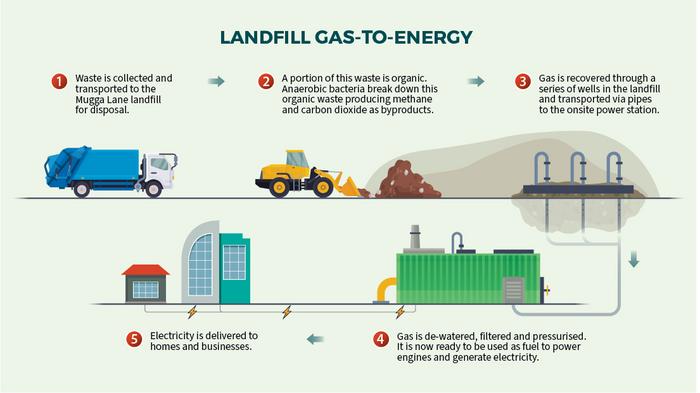
The process would work by extracting methane from a landfill site, known as a methane well, which uses a shaft-like mechanism to extract gases.
“The beauty of this is that this simple process captures almost the exact composition that we need for our process,” said Professor Cullen.
“Non-thermal plasma is an electricity-driven technology which can excite gas at both a low temperature and atmospheric pressure. Essentially, what this means is this approach facilitates the conversion of the gas into value-added products by inducing plasma discharge within forming gas bubbles. The process doesn’t require heat or pressure, meaning it requires less energy, making it highly compatible with renewable energy power sources.”
DISCLOSURE
Authors PJ Cullen, Emma Lovell and Tianqi Zhang are associated with PlasmaLeap Technologies, the supplier of the plasma technology employed to generate plasma bubbles in this study.
The authors acknowledge the MagRes node at Sydney Analytical Core Research Facility for access to the NMR infrastructure, Michelle Wood at Sydney Analytical for additional assistance in ATR-FTIR and Aditya Rawal at the University of New South Wales Mark Wainwright Analytical Centre for solid-state NMR measurements.
RESEARCH
Long-Chain Hydrocarbons from Non-Thermal Plasma-Driven Biogas Upcycling was published in the Journal of the American Chemical Society. DOI:
CONTACT
Luisa Low, Media and PR Adviser, University of Sydney
+61 438 021 390 | [email protected]
Journal
Journal of the American Chemical Society
DOI
10.1021/jacs.4c01641
Method of Research
Experimental study
Subject of Research
Not applicable
Article Title
Long-Chain Hydrocarbons from Non-Thermal Plasma-Driven Biogas Upcycling
Article Publication Date
30-Apr-2024
COI Statement
Authors PJ Cullen, Emma Lovell and Tianqi Zhang are associated with PlasmaLeap Technologies, the supplier of the plasma technology employed to generate plasma bubbles in this study.
The authors acknowledge the MagRes node at Sydney Analytical Core Research Facility for access to the NMR infrastructure, Michelle Wood at Sydney Analytical for additional assistance in ATR-FTIR and Aditya Rawal at the University of New South Wales Mark Wainwright Analytical Centre for solid-state NMR measurements.