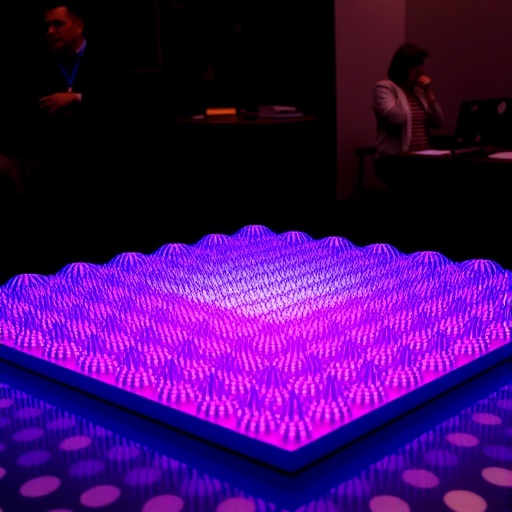
In the rapidly evolving domain of wireless communications, the relentless pursuit of increased data capacity and spectral efficiency continues to drive scientific innovation. A breakthrough study by Zhang and Cui introduces a pioneering approach utilizing space-time-coding metasurfaces to unlock unprecedented dimensions of communication channels. Their research, recently published in Light: Science & Applications, sets a transformative milestone by synergistically merging orbital angular momentum (OAM), polarization, and frequency-division multiplexing within a single metasurface platform. This novel integration heralds a new era in high-dimensional communications, promising to revolutionize how we transmit and receive data in an ever-connected world.
The core innovation lies in the design of a space-time-coding metasurface that manipulates electromagnetic waves with exquisite precision across multiple degrees of freedom. Unlike traditional antennas that modulate signals via amplitude or phase alone, this advanced metasurface can encode information dynamically in both spatial and temporal domains. By harnessing the unique properties of OAM modes, wherein electromagnetic waves carry distinct corkscrew-like phase fronts, the system significantly expands channel capacity. Simultaneously, the metasurface exploits polarization states and frequency bands to construct a multi-layered multiplexing framework that richly diversifies communication pathways.
Historically, OAM has been a tantalizing yet challenging avenue for enhancing wireless communication capacity due to difficulties in generation, detection, and multiplexing of OAM modes. Zhang and Cui’s work overcomes these barriers by leveraging the tunability and programmability of space-time-coding metasurfaces. These structures, composed of subwavelength meta-atoms arrayed across a surface, can be dynamically reconfigured by external stimuli such as electrical signals. This enables the controlled emission of electromagnetic waves bearing specific OAM states synchronized with polarization and frequency cues, thereby enabling simultaneous transmission of multiple independent data streams without mutual interference.
At the technical heart of the metasurface is an intricate algorithmic control scheme that orchestrates the space-time coding patterns. These patterns carefully tailor the phase and amplitude response of each meta-atom to the incident wave, effectively synthesizing superposition states of OAM modes. The temporal modulation further adds a frequency shift dimension, enabling frequency-division multiplexing to coexist harmoniously alongside spatial and polarization multiplexing. This multidimensional encoding synergistically optimizes the spectral usage, surpassing the limitations of existing communication technologies such as MIMO (multiple-input-multiple-output) and conventional frequency division multiplexing.
Furthermore, the experimental demonstration validates the metasurface’s capacity to encode and decode high-order OAM modes with high fidelity, highlighting robustness against channel impairments and environmental perturbations. The use of polarization-division multiplexing allows independent data streams to be superimposed onto orthogonal polarization states, which not only doubles the channel capacity but also enhances security against eavesdropping due to polarization diversity. The frequency-division approach complements these layers by allocating distinct carrier frequencies to each data channel, mitigating crosstalk and optimizing bandwidth utilization.
An exciting implication of this work is the potential integration of the space-time-coding metasurface into next-generation wireless networks, including 6G and beyond. As data demands surge exponentially driven by applications ranging from immersive virtual reality to autonomous vehicle communications, traditional spectrum expansion strategies risk hitting physical and regulatory limits. The proposed metasurface design sidesteps these constraints by creating parallel communication channels within the same frequency band, effectively multiplying capacity without carving out new spectral resources. This evolution could profoundly impact mobile communications, satellite links, and dense urban network infrastructures.
Moreover, the metasurface’s compact and planar architecture offers practical advantages over bulky and energy-intensive phased arrays or traditional antenna arrays. Fabricated from lightweight, low-cost materials with CMOS-compatible processes, these metasurfaces could be seamlessly integrated into portable devices, base stations, and deployable communication units. The dynamic control capability ensures adaptability to varying channel conditions and user requirements, facilitating smart network management and real-time reconfiguration to optimize throughput and latency.
The research also opens doors for secure communication paradigms leveraging the multidimensionality of the metasurface-encoded signals. The combined use of OAM, polarization, and frequency multiplexing creates a highly complex signal space that is inherently difficult to intercept or decode without precise knowledge of the coding schemes. Such complexity can be harnessed for physical layer security, resisting jamming and unauthorized access, which is crucial for military, governmental, and critical infrastructure communications.
In terms of theoretical modeling, Zhang and Cui’s framework extends classical metasurface theory by incorporating time-varying elements and dynamic control of electromagnetic boundary conditions. They establish a comprehensive mathematical foundation describing the interaction between meta-atom configurations and incident waves in coupled spatiotemporal domains. This rigorous theoretical approach underpins the design principles and enables predictive optimization of metasurface performance for diverse communication scenarios.
Another striking aspect of the study is the scalability potential. By expanding the metasurface area or refining meta-atom designs, it is plausible to access higher-order OAM modes, further multiplying data channels and achieving terabit-scale wireless transmission rates. The modularity of the metasurface design supports stacking and hybridization with other emerging technologies such as terahertz communications and quantum information systems, laying groundwork for future-proof network architectures.
Importantly, the research team addresses practical challenges including signal crosstalk, mode dispersion, and fabrication tolerances. Through careful calibration and adaptive algorithms, the system maintains high signal integrity, even under realistic propagation environments. The experiments conducted in anechoic chambers validate the robustness and versatility of the metasurface, instilling confidence in translation from laboratory prototypes to real-world deployment.
Looking forward, the integration of machine learning-based control algorithms could automate metasurface pattern generation and channel optimization in real time. Such intelligent metasurfaces could dynamically learn from changing network conditions and user behaviors to maximize capacity, minimize interference, and enhance energy efficiency. This fusion of artificial intelligence with advanced electromagnetic engineering heralds a future where communication infrastructures are not only smarter but fundamentally redefined at the physical layer.
Zhang and Cui’s contribution marks a paradigm shift in wireless communication technology by unveiling a highly versatile, high-dimensional multiplexing platform grounded in smart metasurfaces. As digital ecosystems evolve toward hyper-connectivity, the demand for bandwidth-rich, secure, and adaptable communication channels will escalate. Space-time-coding metasurfaces represent a key enabler to meet these demands, positioning themselves at the frontier of next-generation communication science and engineering.
In summary, the demonstrated approach represents a quantum leap in leveraging multiple electromagnetic degrees of freedom simultaneously. By unifying OAM, polarization, and frequency multiplexing through space-time-coding metasurfaces, Zhang and Cui provide a comprehensive solution to overcoming spectral scarcity and pushing the envelope of wireless channel capacity. Their work not only enriches the theoretical understanding of dynamic metasurfaces but also establishes a robust platform for future communication technologies that can keep pace with the insatiable hunger for data in the digital era.
The implications of this study resonate beyond conventional communications. With the ability to encode multidimensional information securely and efficiently, applications may extend into sensing, imaging, and quantum communication networks. This fusion of physics, materials science, and information theory exemplifies the interdisciplinary approach needed to tackle the grand challenges of modern connectivity. As research in smart metasurfaces continues to flourish, the horizon of wireless communications will expand into realms previously considered unattainable.
Subject of Research:
Space-time-coding metasurfaces for high-dimensional wireless communication exploiting orbital angular momentum, polarization, and frequency-division multiplexing.
Article Title:
Space-time-coding metasurfaces for high-dimensional communications with OAM-, polarization-, and frequency-division multiplexing.
Article References:
Zhang, L., Cui, T.J. Space-time-coding metasurfaces for high-dimensional communications with OAM-, polarization-, and frequency-division multiplexing. Light Sci Appl 15, 205 (2026). https://doi.org/10.1038/s41377-026-02282-w
Image Credits:
AI Generated
Tags: advanced electromagnetic wave manipulationcorkscrew phase front OAM modesfrequency-division multiplexing metasurfaceshigh-dimensional orbital angular momentum communicationmetasurface-enabled communication innovationmulti-degree-of-freedom signal encodingmultiplexing frameworks for data transmissionnext-generation communication antennaspolarization multiplexing techniquesspace-time-coding metasurfacesspectral efficiency in wireless networkswireless data capacity enhancement