

• HOME
  • NEWS
  • EXPLORE
    • CAREER
      • Companies
      • Jobs
    • EVENTS
    • iGEM
      • News
      • Team
    • PHOTOS
    • VIDEO
    • WIKI
  • BLOG
  • COMMUNITY
    • FACEBOOK
    • INSTAGRAM
    • TWITTER
Sunday, April 26, 2026
BIOENGINEER.ORG
No Result
View All Result
  • Login
  • HOME
  • NEWS
  • EXPLORE
    • CAREER
      • Companies
      • Jobs
        • Lecturer
        • PhD Studentship
        • Postdoc
        • Research Assistant
    • EVENTS
    • iGEM
      • News
      • Team
    • PHOTOS
    • VIDEO
    • WIKI
  • BLOG
  • COMMUNITY
    • FACEBOOK
    • INSTAGRAM
    • TWITTER
  • HOME
  • NEWS
  • EXPLORE
    • CAREER
      • Companies
      • Jobs
        • Lecturer
        • PhD Studentship
        • Postdoc
        • Research Assistant
    • EVENTS
    • iGEM
      • News
      • Team
    • PHOTOS
    • VIDEO
    • WIKI
  • BLOG
  • COMMUNITY
    • FACEBOOK
    • INSTAGRAM
    • TWITTER
No Result
View All Result
Bioengineer.org
No Result
View All Result
Home NEWS Science News

Metallic nanoparticles light up another path towards eco-friendly catalysts

Bioengineer by Bioengineer
November 15, 2018
in Science News
Reading Time: 2 mins read
0
Share on FacebookShare on TwitterShare on LinkedinShare on RedditShare on Telegram
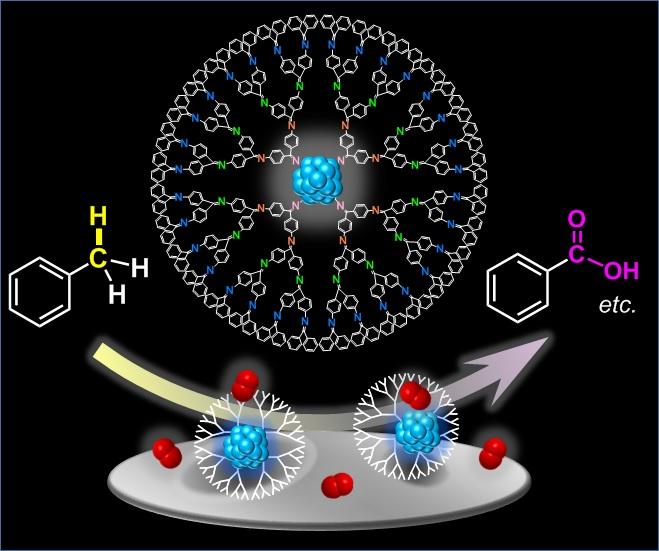
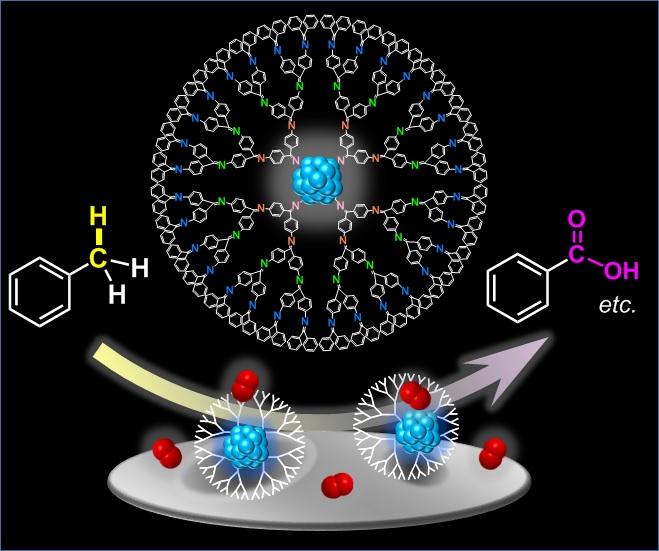
IMAGE

Credit: Angewandte Chemie

Scientists at Tokyo Institute of Technology produced subnano-sized metallic particles that are very effective as catalysts for the oxidation of hydrocarbons. These catalysts can be as much as 50 times more effective than well-known Au-Pd bimetallic nanocatalysts.

The oxidation of aromatic hydrocarbons is critically important for producing a great variety of useful organic compounds that are used throughout all types of industries. These oxidation processes require the use of catalysts and solvents, which are usually environmentally hazardous. Thus, finding a solvent-free oxidation process using nanosized catalytic particles has attracted considerable attention. Interestingly, sub-nanoscale catalytic particles (subnanocatalysts, or SNCs) composed of noble metals are even better at their job because their increased surface area and unique electronic state results in favorable effects for oxidizing hydrocarbons and also prevents them from getting oxidized themselves. This makes them cost-effective because the amount of metal required for SNCs is lower than for nano-sized catalysts.

A team including Dr. Miftakhul Huda, Keigo Minamisawa, Dr. Takamasa Tsukamoto, and Dr. Makoto Tanabe at Tokyo Institute of Technology (Tokyo Tech), led by Prof. Kimihisa Yamamoto, created multiple types of SNCs by using dendrimers, which are tree-like spherical molecules that can be used as a template to contain the desired catalysts. "Dendrimer is expected to provide internal nanospaces that could be suitable for catalytic conversion in the presence of metal particles," explains Yamamoto .

The team created various catalysts of different sizes, depending on the noble metal used and the number of atoms of each catalytic particle. They compared their performance to find the best noble metal for making SNCs and then tried to determine the mechanism behind their high catalytic activity. Smaller SNCs were found to be better, while less oxophilic metals (such as platinum) were superior. The team postulated that the surface of platinum SNCs does not oxidize easily, which makes them reusable and results in the highest catalytic performance of the Pt19 SNC that can be as high as 50 times more effective than the common Au-Pd nanocatalysts. The team will continue working to shed light on these catalytic phenomena. "The development of a more detailed mechanism including theoretical considerations is currently in progress," says Tanabe. The applications of such catalysts could greatly contribute for reducing pollution and enhancing our effective use of Earth's metal resources.

###

Related links

Breakthrough in blending metals: Precise control of multimetallic one-nanometer cluster formation achieved

How a tetrahedral substance can be more symmetrical than a spherical atom

A Preparative-Scale Reaction Using Platinum Clusters with a Single-Digit Atomicity Realized

One-Nanometer Trimetallic Alloy Particles Created

Media Contact

Emiko Kawaguchi
[email protected]
81-357-342-975

http://www.titech.ac.jp/english/index.html

Related Journal Article

http://dx.doi.org/10.1002/anie.201809530

Share12Tweet8Share2ShareShareShare2

Related Posts

Stable Ferrimagnetism in Cr(pyrazine)3 Framework — Chemistry

Stable Ferrimagnetism in Cr(pyrazine)3 Framework

April 26, 2026

Multidimensional Stress Impacting Rural China’s Elderly Mental Health

April 26, 2026

Oral Frailty in Older Chinese with Chronic Diseases

April 26, 2026

Diazoboranes React with Oxygen to Form Dioxaboriranes

April 25, 2026
Please login to join discussion

POPULAR NEWS

  • Research Indicates Potential Connection Between Prenatal Medication Exposure and Elevated Autism Risk

    821 shares
    Share 328 Tweet 205
  • New Study Reveals Plants Can Detect the Sound of Rain

    682 shares
    Share 272 Tweet 170
  • Scientists Investigate Possible Connection Between COVID-19 and Increased Lung Cancer Risk

    66 shares
    Share 26 Tweet 17
  • Salmonella Haem Blocks Macrophages, Boosts Infection

    60 shares
    Share 24 Tweet 15

About

We bring you the latest biotechnology news from best research centers and universities around the world. Check our website.

Follow us

Recent News

Stable Ferrimagnetism in Cr(pyrazine)3 Framework

Multidimensional Stress Impacting Rural China’s Elderly Mental Health

Oral Frailty in Older Chinese with Chronic Diseases

Subscribe to Blog via Email

Enter your email address to subscribe to this blog and receive notifications of new posts by email.

Join 81 other subscribers
  • Contact Us

Bioengineer.org © Copyright 2023 All Rights Reserved.

Welcome Back!

Login to your account below

Forgotten Password?

Retrieve your password

Please enter your username or email address to reset your password.

Log In
No Result
View All Result
  • Homepages
    • Home Page 1
    • Home Page 2
  • News
  • National
  • Business
  • Health
  • Lifestyle
  • Science

Bioengineer.org © Copyright 2023 All Rights Reserved.