Credit: ©Science China Press
In the quest to solve solar energy conversion as well as environmental remediation issues, photocatalysis using sunlight have been attracting tremendous attention. Various semiconductors with large band gaps have been proven to be effective under UV light, e.g., TiO2. However, UV light accounts for only ~4% while visible light occupies ~43% of total sunlight. From the perspective of both chemistry and practical applications, it is undoubtedly important to develop visible-light-responsive photocatalytic materials.
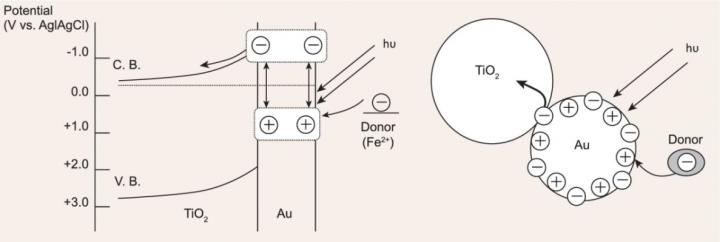
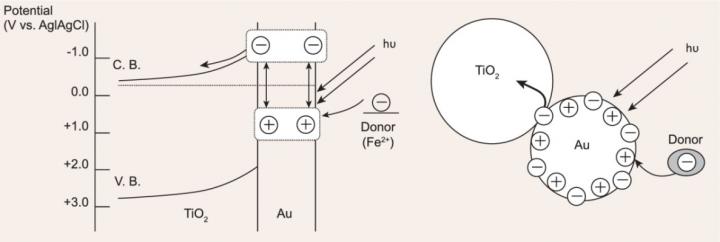
Over the past several years, coinage metal (Au, Ag and Cu) nanoparticles (NPs) photosensitization over semiconductors with a large band gap has emerged as a promising strategy for developing visible-light responsive photocatalytic materials. In this review, mechanisms of metal-induced photocatalysis (MIP) were first summarized, e.g., hot-electron transfer (see in the Figure 1). Subsequently, the progress towards MIP applications in photocatalytic and PEC water splitting, photoreduction of CO2 and activation of inert molecules such as CH4, N2 were reviewed. Generally, visible-light activity or enhancement was achieved after the introduction of these metal NPs. Nevertheless, for most present metal induced photocatalytic water-splitting under visible light, the obtained apparent quantum efficiency (AQE) was relatively low (i.e.
On the other hand, it is undoubted that particle-size effect was important even crucial in MIP systems. Particular attention was paid on this issue and selected works were reviewed though consensus has not been reached yet. Some researchers claimed that larger metal NPs were favorable for its strong SPR intensity leading to high electron transfer efficiency, while some others pointed out that smaller ones were better because of more efficient charge separation could be achieved. Compromise viewpoint also existed, i.e., both small and large metal NPs were important. So, more effort is needed on this issue.
Exploring light absorption of metal NPs in photocatalysis represents a class of novel and promising approaches in exploring efficient visible-light responsive photocatalysts. However, to achieve this goal, there are still many challenges to be addressed. At the end of this review, the authors briefly discussed the challenges and possible development directions of MIP. It includes deeper understanding the mechanism behind MIP, further improve the efficiency, rational design and precise control of plasmonic metal etc. For detailed information, please refer to the article "Metal nanoparticles induced photocatalysis", https://doi.org/10.1093/nsr/nwx019.
###
This research received funding from the National Basic Research Program of China and the National Natural Sciences Foundation of China.
See the article:
Lequan Liu, Xinnan Zhang, Lufeng Yang, Liteng Ren, Defa Wang and Jinhua Ye
Metal nanoparticles induced photocatalysis
Natl Sci Rev (February 2017). DOI: 10.1093/nsr/nwx019
https://doi.org/10.1093/nsr/nwx019
The National Science Review is the first comprehensive scholarly journal released in English in China that is aimed at linking the country's rapidly advancing community of scientists with the global frontiers of science and technology. The journal also aims to shine a worldwide spotlight on scientific research advances across China.
Media Contact
Lequan Liu
[email protected]
http://zh.scichina.com/english/
############
Story Source: Materials provided by Scienmag