Overview
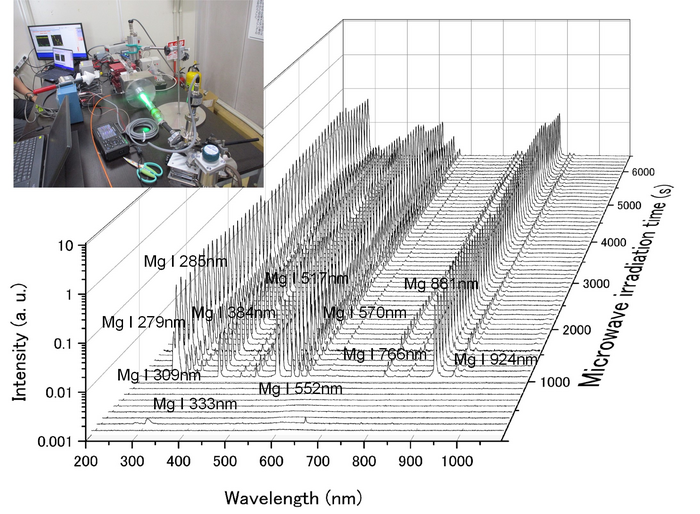
Credit: COPYRIGHT (C) TOYOHASHI UNIVERSITY OF TECHNOLOGY. ALL RIGHTS RESERVED.
Overview
Professor Satoshi Fujii (Department of Electrical and Electronic Information Engineering, Toyohashi University of Technology) and Assistant Professor Jun Fukushima (Department of Applied Chemistry, Graduate School of Engineering, Tohoku University) discovered that metal ions and electrons emitted directly from a solid metal can generate and maintain a plasma using only a strong magnetic field generated by a microwave resonator without using a liquid or gas. Since Mg ions and Ca ions have high internal energy, they can be used as reducing agents for metal oxides, and will likely achieve significant energy savings compared to conventional methods.
A paper on this result was published on January 31 by AIP Publishing, the publishing office of the American Physical Society.
Details
Around the middle of the 18th century, the invention of the Leyden jar marked the start of research on electrical discharge phenomena from the fact that it was possible to easily achieve high voltages. Advances in vacuum technology, glow discharge, and the emergence of high-frequency power sources have led to the formation of stable plasma. Today, plasma technology is widely used as a key technology for microfabrication technology processes in the manufacture of automobiles, projector headlights, and semiconductor devices. Most plasma technologies inject a liquid or gas into a chamber, where a strong electric field is created by high voltage or high frequency, and the strong electric field ionizes atoms and molecules. Furthermore, plasma is maintained by continuously applying energy to groups of ions and electrons by means of a strong electric field. An example of a strong magnetic field is a tokamak-type nuclear fusion reactor that uses a strong magnetic field to confine plasma and is used for nuclear fusion reactions. In this microwave TM110 mode resonator, a strong magnetic field is generated on the central axis. In this paper, when a metal is introduced, an induced current is generated, heating the metal itself. When the temperature reaches about half of its melting point, it emits thermoelectrons and then emits metal atoms. The magnetic field rotates the electrons, and when these electrons collide with atoms, an electric discharge is started. Since the plasma is a conductor and the plasma formation area is limited to the size of the quartz tube inside the double quartz tube, we succeeded in maintaining the state in which energy can be supplied from the strong magnetic field to the plasma until the raw material is exhausted. Intellectual property rights related to this discovery are pending.
Research Background
Initially, the research team generated metal plasma in the electric field mode and verified metal plasma for about one minute, but the plasma was maintained for only a short time and it could not be used for reduction reactions using metal plasma. A magnetic mode resonator was used for reduction reactions. By chance, we discovered that plasma could be maintained stably by using another magnetic mode resonator in the laboratory. It has been shown that the discharge phenomenon obeys Paschen’s law, which is indicated by the pressure and the electric field. When the vacuum increases, no plasma is generated, but the vacuum in this experiment increased rapidly due to the gettering effect of Mg ions, so it diverged from Paschen’s law. In addition, there are almost no examples of plasma textbooks or academic papers reporting electrical discharges by a strong magnetic field. Although the present method we have discovered is very simple, it’s the first. I am surprised to discover another electrical discharge phenomenon about 250 years after the electrical discharge experiment using a Leyden jar.
Future Outlook
We plan to achieve this as the final goal of the “Equipment Development and Applications for Advanced Scandium Oxide Refining Techniques” (NEDO Feasibility Study Program) that we are working on with Furuya Metal Co.,Ltd., and to make it a successful example of real world implementation of microwave chemistry and engineering.
As shown in Figure 2, this method can also be applied as a reduction method for rare earths and rare metals, and we expect it to bring about innovation in the field of materials.
In addition, many modern semiconductor manufacturing processes use plasma, and we believe that there is potential to utilize plasma with the method described in this paper. These will be proposed to the Government Research and Development Project (National Project) as the research results of the feasibility study.
Reference
S. Fujii and J. Fukushima ” Metal ion plasma generation under strong magnetic field in microwave resonator” AIP-Advances, featured article, doi.org/10.1063/5.0134071.
Acknowledgement
This research was supported by the New Energy and Industrial Technology Development Organization (NEDO) Grant No. JPNP0622001.
Journal
AIP Advances
DOI
10.1063/5.0134071
Method of Research
Experimental study
Subject of Research
Not applicable
Article Title
Metal ion plasma generation under strong magnetic field in microwave resonator
Article Publication Date
30-Jan-2023