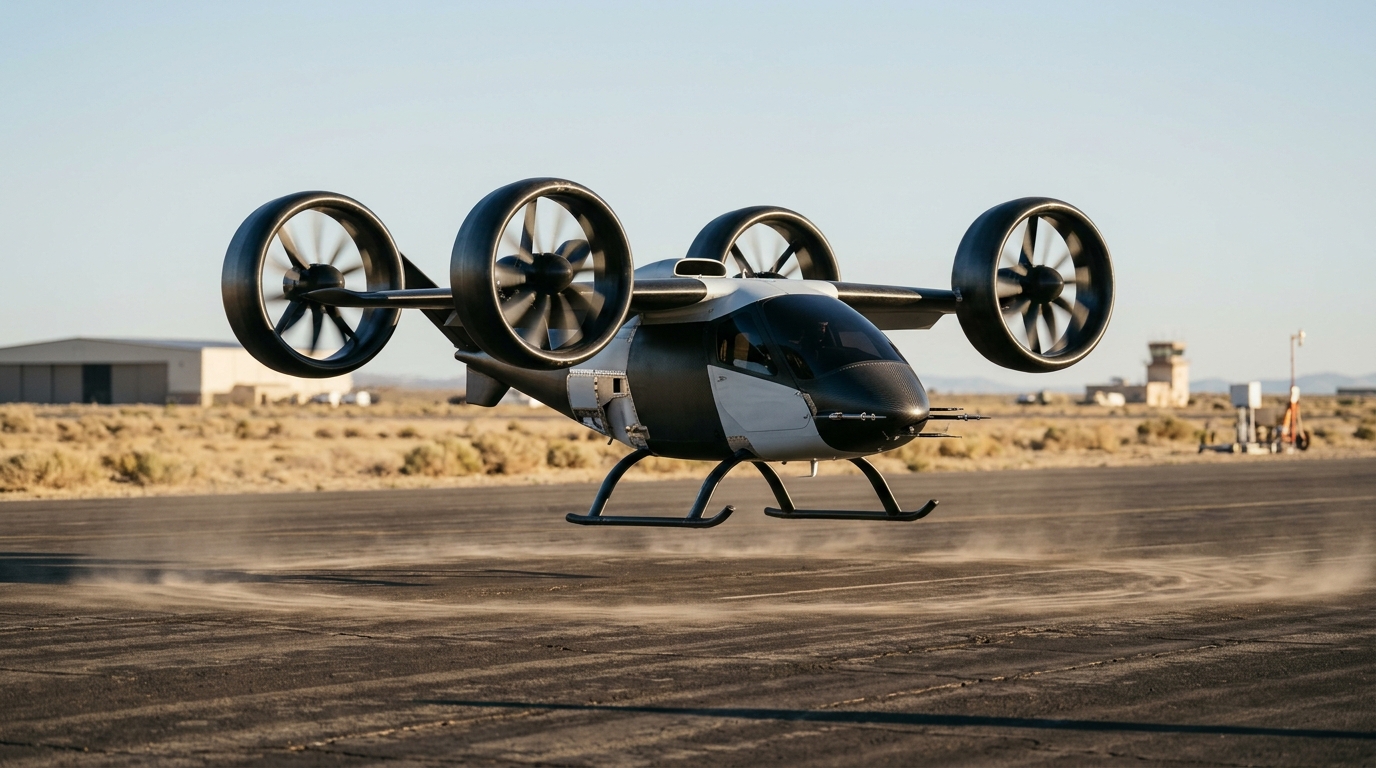
A research team has developed a physics-inspired data-driven model that accurately predicts transient, non-linear in-ground-effect thrust fluctuations in ducted-fan electric vertical take-off and landing aircraft. Experimental evaluations revealed that the model achieved mean relative errors of 1.1 percent on training tasks and 0.7 percent on testing tasks. In comparative benchmarks, the hybrid model outperformed conventional physical models by 4.6 percent on training data and 1.7 percent on testing data, while surpassing purely data-driven baselines by 1.5 percent and 2.7 percent, demonstrating that coupling aerodynamic theory with neural learning enables precise real-time prediction of unsteady rotor thrust.
Developing reliable thrust prediction models has become crucial as electric vertical take-off and landing vehicles emerge as key candidates for future urban air mobility. However, safe commercial operation demands dependable stability during takeoff and landing, where interactions with boundaries induce severe aerodynamic disruptions. When ducted fan aircraft approach ground surfaces, ceilings, or walls, turbulent recirculating flow fields trigger pronounced oscillations in both thrust and rotational velocity. Rotorcraft accident records identify unsteady in-ground-effect thrust fluctuations as a major contributor to takeoff and landing accidents, with adverse weather conditions like crosswinds exacerbating the danger. Formulating precise thrust models is therefore essential for active attitude stabilization, safe trajectory planning, and energy efficiency.
Existing aerodynamic modeling paradigms have faced significant limitations when attempting to capture the transient dynamics of in-ground-effect thrust. Traditional analytical formulations derived from fluid mechanics, including momentum disk theory, blade element momentum theory, the Moore-Greitzer method, and vortex panel representations, establish direct mathematical links between altitude and thrust suitable for fast computation. However, these physical models rely on steady-state or quasi-steady assumptions, neglecting the transient oscillations observed during actual operations. Furthermore, analytical frameworks often overlook blade parameters such as chord length and encounter mathematical singularities as calculated elevation approaches zero. Conversely, purely data-driven algorithms, including support vector machines and deep neural networks, can capture non-linear patterns but require large volumes of authentic flight data that are difficult to acquire, while their parameter density complicates real-time onboard computation.
To resolve these limitations, the researchers formulated a hybrid strategy decomposing total thrust into a time-averaged steady component and an unsteady transient component. Under this physics-inspired data-driven framework, the steady-state baseline is governed by an explicit theoretical formulation based on blade element momentum theory, while dynamic fluctuations are predicted using a meta-learning neural network. The physical branch captures foundational aerodynamic relationships connecting blade geometry, rotor rotational velocity, and baseline lift under near-steady operating conditions. Meanwhile, the data-driven branch focuses exclusively on predicting the volatile high-frequency residue force, defined as instantaneous in-ground-effect thrust minus steady out-of-ground-effect thrust.
The analytical foundation of the physical submodel applies blade element theory to express the rotor thrust coefficient as an integral across the blade span. To account for radial variations while preserving tractability, the researchers adopted an ideal twist assumption wherein the product of local blade pitch angle and radial position remains constant. Combining blade element mechanics with momentum disk equations yielded an explicit formulation for out-of-ground-effect thrust coefficients based on rotor solidity, lift curve slope, and tip pitch angle. To prevent mathematical singularities near the ground, the team implemented an exponential formulation relating thrust amplification to altitude-to-radius ratios. Within this formulation, undetermined coefficients Ca and Cb depend directly on blade geometry, with Cb expressed empirically as a linear function of rotor solidity (0.93 sigma + 1.23), producing a closed, singularity-free physical expression.
To predict the transient residual thrust time series, the authors applied a domain-agnostic meta-learning approach based on separation of variables. Recognizing that aerodynamic ground effects exhibit shared characteristics across different heights, the framework decomposes residual thrust into an altitude-invariant mapping network and an altitude-variant vector. The invariant mapping network, composed of linear layers, captures universal flow dynamics that persist regardless of flight elevation. In parallel, the altitude-variant vector encodes height-specific operational states, enabling the model to adapt dynamically across diverse flight conditions. By decoupling altitude-independent aerodynamic patterns from altitude-dependent scaling factors, the meta-learning system avoids training separate models for each flight altitude. This structural decomposition enhances generalization across multiple environments, allowing effective evaluation through interpolation and extrapolation tests across varied operational flight profiles.
Training the dual-network meta-learning architecture involves an adversarial optimization scheme governed by a compound objective function. The system pairs the altitude-invariant regression network with a classification network that attempts to determine the specific flight height or task indicator from latent representations generated by the regression model. During training, the two networks engage in a structured competitive process. The classification network minimizes categorical cross-entropy loss to improve its ability to identify altitude indices from intermediate features. Concurrently, the regression network minimizes thrust prediction errors while maximizing classification entropy to prevent the classifier from identifying the operating altitude. This adversarial mechanism removes altitude-dependent information from the invariant feature representation, ensuring that the primary network isolates pure aerodynamic correlations while height-specific variations are managed entirely by the designated task vector.
Empirical validation of the modeling methodology was conducted through bench tests at the School of Vehicle and Mobility at Tsinghua University. The experimental apparatus utilized a quad-duct unmanned drone measuring 600 millimeters in length, 544 millimeters in width, and 50 millimeters in thickness. The platform featured four ducted propellers of 114 millimeters radius symmetrically distributed across the airframe. Flight altitude was defined as the vertical distance between the lower surface of the fuselage and the ground plane. Acrylic plates mounted beneath the aircraft simulated ground boundaries, with plate positions and velocities regulated using precision motor-driven screws. Maximum plate deflection was approximately 1.5 millimeters during testing, allowing the simulated ground to be treated as a rigid boundary, thereby preserving geometric consistency during force acquisition.
The data acquisition system was built around an STM32 microcontroller unit connected to an ADS1256 data acquisition module. This instrumentation suite captured real-time measurements of multiaxis force, reaction torque, motor current, supply voltage, and rotational velocity at a 10 kilohertz sampling frequency, transmitting data to a computer via an RS-485 serial communication interface. To ensure measurement integrity, the authors performed an uncertainty analysis of sensor accuracy under nominal operating loads. Aerodynamic thrust was recorded using a piezoelectric six-degree-of-freedom force and torque sensor. For total thrust measurements ranging between 20 and 50 Newtons, sensor measurement uncertainty remained between 0.04 and 0.10 Newtons. This low uncertainty level confirmed that instrumentation noise remained minimal compared to measured thrust values, validating the acquired experimental dataset for subsequent model development.
Raw experimental telemetry was preprocessed to balance information scale and training effectiveness. Because excessive data points lengthen processing times and increase overfitting risks, the researchers downsampled the native 10 kilohertz sensor data to 1 kilohertz. A 10-point moving average filter was then applied to attenuate high-frequency noise while preserving low-frequency aerodynamic oscillations. The experimental matrix investigated eight non-dimensionalized altitudes, specifically 5R, 4R, 3R, 2R, 1.5R, 1.2R, 1R, and 0.8R relative to rotor radius. At each altitude, the drone was tested at three rotational speeds (3500, 4000, and 4500 revolutions per minute) for 10 to 15 seconds per speed. Telemetry from 5R, 3R, 2R, 1.5R, 1.2R, and 1R formed the training set, while data from 4R and 0.8R were isolated to evaluate model testing performance.
Model training was conducted on a consumer-grade laptop computer equipped with an Intel Core i7-9750H processor, an NVIDIA GeForce GTX 1650 graphics card, and 16 gigabytes of memory. Training completed 2000 iterations in approximately 12 minutes, demonstrating notable computational efficiency. Once trained, the model generated thrust predictions for a 40-second flight dataset in approximately 5 seconds. Quantitative statistical evaluations showed that the hybrid model delivered superior accuracy in predicting both time-averaged thrust values and dynamic oscillation ranges. While conventional physical models produced only static values and failed to predict thrust ranges, the hybrid model tracked dynamic fluctuations accurately. Furthermore, physical model error exceeded 3 percent under ground-effect conditions, whereas the hybrid model maintained relative errors below 1 percent across all tested altitudes, matching experimental amplitudes and frequencies across both training and testing datasets.
Spectral analysis via Fourier transformation confirmed the hybrid model’s accuracy across distinct frequency regimes. Compared to purely data-driven baselines, the hybrid framework closely matched experimental values across both low and high frequencies. In the 10 to 50 Hertz range, where mechanical vibrations introduce noise, the model effectively suppressed extraneous disturbances. Around the blade-passing frequency of 200 to 225 Hertz, the model preserved genuine thrust fluctuation signals without distortion. At higher frequencies, the model acted as a whitening filter, spreading the magnitude distribution while reducing measurement noise at the second harmonic of the blade-passing frequency.
Subject of Research: Aerodynamic modeling of transient in-ground-effect thrust for ducted fan electric vertical take-off and landing aircraft
Article Title: A physics-inspired-data-driven model of eVTOL in-ground-effect thrust based on meta-learning and BEMT
Article References: He, Y., Luo, Y., Qian, Y., & Zhang, Y. (2025). A physics-inspired-data-driven model of eVTOL in-ground-effect thrust based on meta-learning and BEMT. Propulsion and Energy, 1(1), Article 15. https://doi.org/10.1007/s44270-025-00016-8
Image Credits: AI Generated
DOI: 10.1007/s44270-025-00016-8
Keywords: electric vertical take-off and landing, eVTOL, in-ground effect, ducted fan, blade element momentum theory, meta-learning, physics-inspired data-driven model, transient thrust fluctuation, urban air mobility, aerodynamic ground effect, rotor solidity, cross-entropy classification, piezoelectric force sensor, Fourier analysis, data acquisition system, flight stability control, thrust prediction, quad-duct drone
News Source: Katie Riggs. (November 25, 2026). Meta-Learning and Physics Model Accurately Predicts Ducted eVTOL Ground Effect Thrust. Scienmag.