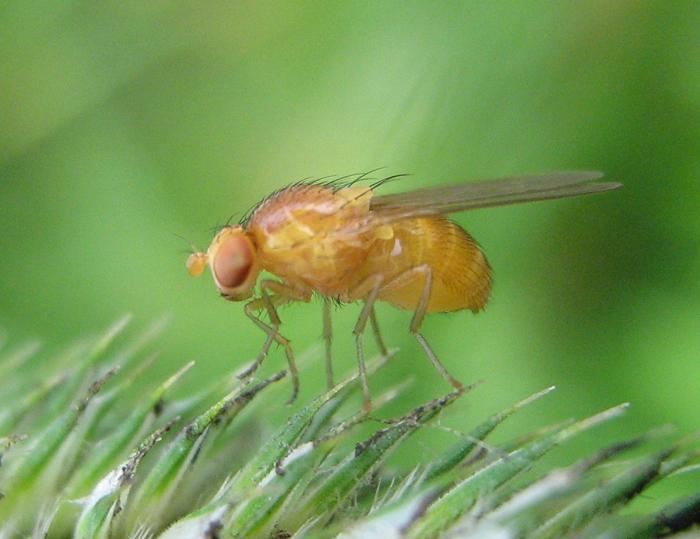
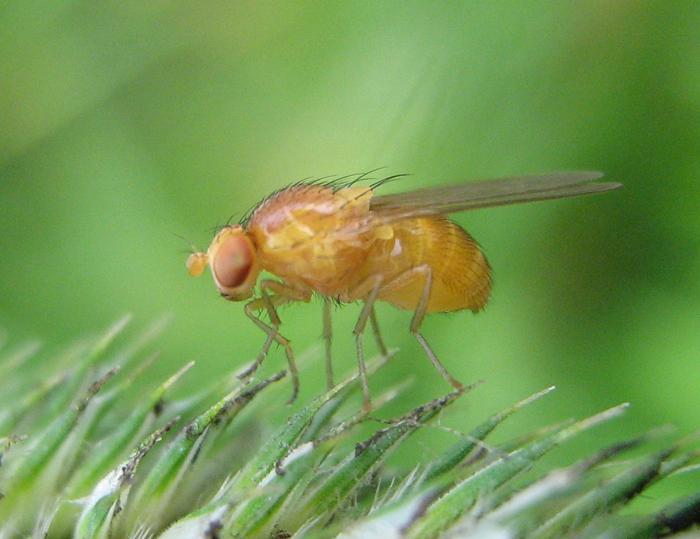
IMAGE: Brain cells from a fruit fly model of Alzheimer's disease were compared to healthy brain cells to show a type of dysfunction in the diseased cells, said a researcher from…
Credit: Public domain image of fruit fly by Botaurus
SAN ANTONIO (Feb. 4, 2016)–Brain cell death in Alzheimer's disease is linked to disruption of a skeleton that surrounds the nucleus of the cells, a researcher in the School of Medicine at The University of Texas Health Science Center at San Antonio said.
The finding is expected to open new avenues of study of how to prevent the earliest biological events that result in Alzheimer's.
The nucleus is the control center of cells. A mesh-like scaffold called the lamin nucleoskeleton surrounds this control center but is disordered in Alzheimer's, said Bess Frost, Ph.D., assistant professor of cellular and structural biology at the UT Health Science Center at San Antonio. Dr. Frost was trained at Harvard Medical School and in November started her new laboratory at the UT Health Science Center's Barshop Institute for Longevity and Aging Studies.
Confirmed in human cells
Dr. Frost and two co-authors showed–for the first time–that lamin dysfunction can cause the death of brain cells, which are called neurons. The team made this finding in a fruit fly disease model initially and confirmed it in postmortem brain tissue of people who had Alzheimer's disease, whose families donated their brains to research.
"Human brain donation is a very critical part of this work," Dr. Frost said. "It was important to show that what we found in the fly is really relevant to human disease."
Dr. Frost and her colleagues used a technique called super-resolution microscopy to analyze the fruit fly and human specimens. They found peculiar features that looked like tunnels in the lamin of Alzheimer's-affected specimens.
Seems to be Alzheimer's-specific
The team also studied a fruit fly model of Huntington's disease and did not find any problems with the lamin. "So, at least compared to one other neurodegenerative disease, lamin dysfunction seems to be specific to Alzheimer's disease," Dr. Frost said.
The findings, made while Dr. Frost was at Harvard and Brigham and Women's Hospital, are in in the journal Current Biology and were posted online in January.
Dr. Frost encourages people to consider brain donation, whether or not they have a neurodegenerative disease. Comparing healthy, normal brain tissue to diseased brain tissue is a very useful tool for neuroscientists, she said.
New Alzheimer's institute
A state-of-the-art tissue biorepository will be part of the Institute for Alzheimer and Neurodegenerative Diseases announced by the Health Science Center last September. The biobank will be linked to a database containing the health history of each donor.
Dr. Frost said she is very excited that the institute is being launched and plans to be involved once it is operational. Dr. Frost is establishing her laboratory with support from The University of Texas System Rising STARS Award. STARS stands for Science and Technology Acquisition and Retention.
###
News online
For current news from the UT Health Science Center San Antonio, please visit our online newsroom, like us on Facebook, follow us on Twitter or view us on YouTube.
About the UT Health Science Center at San Antonio
The University of Texas Health Science Center at San Antonio, with missions of teaching, research and healing, is one of the country's leading health sciences universities. Its schools of medicine, nursing, dentistry, health professions and graduate biomedical sciences have more than 32,200 alumni who are advancing their fields throughout the world. With six campuses in San Antonio and Laredo, the university has a FY 16 revenue operating budget of $801.8 million and is the primary driver of its community's $30.6 billion biomedical and health care industry. For more information on the many ways "We make lives better®," visit http://www.uthscsa.edu.
Media Contact
Will Sansom
[email protected]
210-567-2579
@uthscsa
Sidebar Shop