• HOME
  • NEWS
  • EXPLORE
    • CAREER
      • Companies
      • Jobs
    • EVENTS
    • iGEM
      • News
      • Team
    • PHOTOS
    • VIDEO
    • WIKI
  • BLOG
  • COMMUNITY
    • FACEBOOK
    • INSTAGRAM
    • TWITTER
Sunday, August 16, 2026
BIOENGINEER.ORG
No Result
View All Result
  • Login
  • HOME
  • NEWS
  • EXPLORE
    • CAREER
      • Companies
      • Jobs
        • Lecturer
        • PhD Studentship
        • Postdoc
        • Research Assistant
    • EVENTS
    • iGEM
      • News
      • Team
    • PHOTOS
    • VIDEO
    • WIKI
  • BLOG
  • COMMUNITY
    • FACEBOOK
    • INSTAGRAM
    • TWITTER
  • HOME
  • NEWS
  • EXPLORE
    • CAREER
      • Companies
      • Jobs
        • Lecturer
        • PhD Studentship
        • Postdoc
        • Research Assistant
    • EVENTS
    • iGEM
      • News
      • Team
    • PHOTOS
    • VIDEO
    • WIKI
  • BLOG
  • COMMUNITY
    • FACEBOOK
    • INSTAGRAM
    • TWITTER
No Result
View All Result
Bioengineer.org
No Result
View All Result
Home NEWS Science News Chemistry

Membrane intercalation enhances photodynamic bacteria inactivation

Bioengineer by Bioengineer
November 6, 2019
in Chemistry
Reading Time: 2 mins read
0
IMAGE
Share on FacebookShare on TwitterShare on LinkedinShare on RedditShare on Telegram

IMAGE

Credit: Tian Ye


Bacterial infections pose a threat to human health. Now, with increasing antibiotic resistance, such infections may again ravage humanity as they did in the pre-antibiotic era. Scientists are thus seeking new, non-antibiotic means to combat bacterial infection.

One promising strategy is photodynamic inactivation (PDI). It uses photosensitizers to generate reactive oxygen species (ROS) that damage bioactive substances in the cell membrane, thus causing irreversible bacterial death in the presence of light and O2. Unfortunately, ROS has a short half-life and reaction radius. As a result, a big challenge for PDI is how to enhance membrane intercalation.

Recently, researchers from the Technical Institute of Physics and Chemistry (TIPC) of the Chinese Academy of Sciences, Shanghai Jiao Tong University and the University of Utah reported their work on achieving enhanced membrane intercalation.

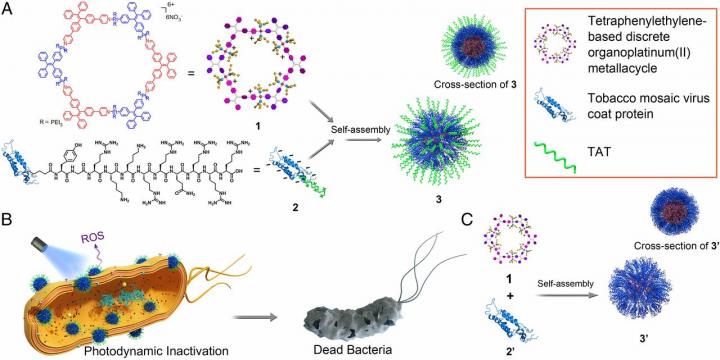
In this work, the scientists arranged for a peptide-decorated cell-penetrating virus coat protein (TAT-TMVCP) and an organoplatinum metallacycle (TPE-Pt-MC), which acts as a photosynthesizer with aggregation-induced emission, to self-assemble through electrostatic interaction.

In the “new” assembly, the photosensitizer provides ROS-generation capacity. The peptide exposed on the surface provides membrane-intercalating capacity.

The researchers discovered that the assembly achieved significantly enhanced PDI efficiency against E. coli and S. aureus, especially against gram-negative E. coli. The assembly decreased E. coli’s survival rate from 55% in the dark to nearly 0% upon light irradiation.

This study has wide implications, ranging from improving PDI efficiency to generating multifunctional nanomaterials.

###

The results, entitled “Membrane intercalation-enhanced photodynamic inactivation of bacteria by a metallacycle and TAT-decorated virus coat protein”, were published in PNAS on November 4th 2019.

This research was supported by the National Key R&D Program of China, the National Natural Science Foundation of China, the National Institutes of Health of the U.S., and the Beijing Municipal Natural Science Foundation, among others.

Media Contact
Tian Ye
[email protected]

Original Source

http://english.cas.cn/newsroom/research_news/chem/201911/t20191104_222513.shtml

Related Journal Article

http://dx.doi.org/10.1073/pnas.1911869116

Tags: BiochemistryBiomechanics/BiophysicsChemistry/Physics/Materials SciencesMaterialsMolecular Physics
Share12Tweet8Share2ShareShareShare2

Related Posts

Butterfly-Inspired Technology Could Transform Air Quality Monitoring

August 15, 2026
Artesunate Targets GBA, Triggering Apoptosis in Liver Cancer Cells

Artesunate Targets GBA, Triggering Apoptosis in Liver Cancer Cells

August 15, 2026

New molecule may enable cleaner, more efficient metal recovery

August 15, 2026

Controlled sulfidation enhances supercapacitor electrode performance

August 15, 2026
Please login to join discussion

POPULAR NEWS

  • KAIST develops semiconductor neuron that harnesses noise to selectively process signals

    29 shares
    Share 12 Tweet 7
  • Imagining natural and extra robotic thumbs together strengthens kinesthetic sensorimotor networks

    29 shares
    Share 12 Tweet 7
  • PARP1 Drives Neuropathic Pain Through GPX4-Dependent Ferroptosis in Injured Mice’s Sensory Neurons

    29 shares
    Share 12 Tweet 7
  • Strubbelig–NHL3 Receptor Complex Helps Arabidopsis Respond to Cellulose Deficiency

    29 shares
    Share 12 Tweet 7

About

We bring you the latest biotechnology news from best research centers and universities around the world. Check our website.

Follow us

Recent News

KAIST develops semiconductor neuron that harnesses noise to selectively process signals

Imagining natural and extra robotic thumbs together strengthens kinesthetic sensorimotor networks

PARP1 Drives Neuropathic Pain Through GPX4-Dependent Ferroptosis in Injured Mice’s Sensory Neurons

Subscribe to Blog via Email

Success! An email was just sent to confirm your subscription. Please find the email now and click 'Confirm' to start subscribing.

Join 85 other subscribers
  • Contact Us

Bioengineer.org © Copyright 2023 All Rights Reserved.

Welcome Back!

Login to your account below

Forgotten Password?

Retrieve your password

Please enter your username or email address to reset your password.

Log In
No Result
View All Result
  • Homepages
    • Home Page 1
    • Home Page 2
  • News
  • National
  • Business
  • Health
  • Lifestyle
  • Science

Bioengineer.org © Copyright 2023 All Rights Reserved.