The largest marine predator that ever lived was no cold-blooded killer.
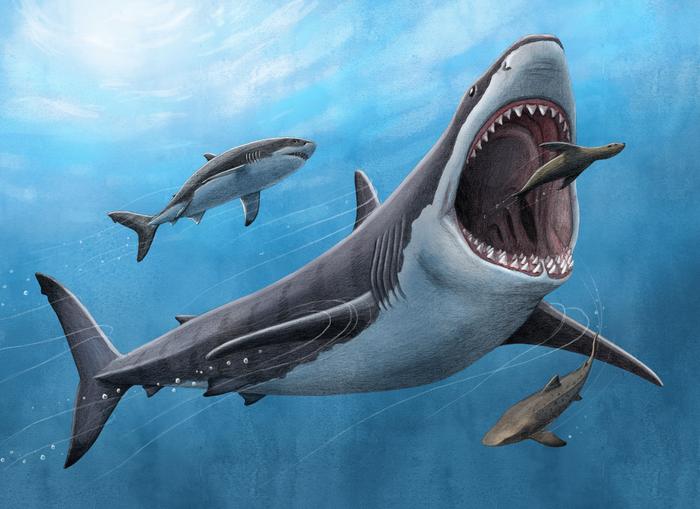
Credit: Alex Boersma/PNAS
The largest marine predator that ever lived was no cold-blooded killer.
Well, a killer, yes. But a new analysis by environmental scientists from UCLA, UC Merced and William Paterson University sheds light on the warm-blooded animal’s ability to regulate its body temperature — and might help explain why it went extinct.
After analyzing isotopes in the tooth enamel of the ancient shark, which went extinct about 3.6 million years ago, the scientists concluded the megalodon could maintain a body temperature that was about 13 degrees Fahrenheit (about 7 degrees Celsius) warmer than the surrounding water.
That temperature difference is greater than those that have been determined for other sharks that lived alongside the megalodon and is large enough to categorize megalodons as warm-blooded.
The paper, published in Proceedings of the National Academy of Sciences, suggests that the amount of energy the megalodon used to stay warm contributed to its extinction. And it has implications for understanding current and future environmental changes.
“Studying the driving factors behind the extinction of a highly successful predatory shark like megalodon can provide insight into the vulnerability of large marine predators in modern ocean ecosystems experiencing the effects of ongoing climate change,” said lead researcher Robert Eagle, a UCLA assistant professor of atmospheric and oceanic sciences and member of the UCLA Institute of the Environment and Sustainability.
Megalodons, which are believed to have reached lengths up to 50 feet, belonged to a group of sharks called mackerel sharks — members of that group today include the great white and thresher shark. While most fish are cold-blooded, with body temperatures that are the same as the surrounding water, mackerel sharks keep the temperature of all or parts of their bodies somewhat warmer than the water around them, qualities called mesothermy and regional endothermy, respectively.
Sharks store heat generated by their muscles, making them different from fully warm-blooded or endothermic animals like mammals. In mammals, a region of the brain called the hypothalamus regulates body temperature.
Various lines of evidence have hinted that megalodon might have been mesothermic. But without data from the soft tissues that drive body temperature in modern sharks, it has been difficult to determine if or to what extent megalodon was endothermic.
In the new study, the scientists looked for answers in the megalodon’s most abundant fossil remains: its teeth. A main component of teeth is a mineral called apatite, which contains atoms of carbon and oxygen. Like all atoms, carbon and oxygen can come in “light” or “heavy” forms known as isotopes, and the amount of light or heavy isotopes that make up apatite as it forms can depend on a range of environmental factors. So the isotopic composition of fossil teeth can reveal insights about where an animal lived and the types of foods it ate, and — for marine vertebrates — information like the chemistry of the seawater where the animal lived and the animal’s body temperature.
“You can think of the isotopes preserved in the minerals that make up teeth as a kind of thermometer, but one whose reading can be preserved for millions of years,” said Randy Flores, a UCLA doctoral student and fellow of the Center for Diverse Leadership in Science, who worked on the study. “Because teeth form in the tissue of an animal when it’s alive, we can measure the isotopic composition of fossil teeth in order to estimate the temperature at which they formed and that tells us the approximate body temperature of the animal in life.”
Because most ancient and modern sharks are unable to maintain body temperatures significantly higher than the temperature of surrounding seawater, the isotopes in their teeth reflect temperatures that deviate little from the temperature of the ocean. In warm-blooded animals, however, the isotopes in their teeth record the effect of body heat produced by the animal, which is why the teeth indicate temperatures that are warmer than the surrounding seawater.
The researchers hypothesized that any difference between the isotope values of the megalodon and those of other sharks that lived at the same time would indicate the degree to which the megalodon could warm its own body.
The researchers collected teeth from the megalodon and other shark contemporaries from five locations around the world, and analyzed them using mass spectrometers at UCLA and UC Merced. Using statistical modeling to estimate sea water temperatures at each site where teeth were collected, the scientists found that megalodons’ teeth consistently yielded average temperatures that indicated it had an impressive ability to regulate body temperature.
Its warmer body allowed megalodon to move faster, tolerate colder water and spread out around the world. But it was that evolutionary advantage that might have contributed to its downfall, the researchers wrote.
The megalodon lived during the Pliocene Epoch, which began 5.33 million years ago and ended 2.58 million years ago, and global cooling during that period caused sea level and ecological changes that the megalodon did not survive.
“Maintaining an energy level that would allow for megalodon’s elevated body temperature would require a voracious appetite that may not have been sustainable in a time of changing marine ecosystem balances when it may have even had to compete against newcomers such as the great white shark,” Flores said.
Project co-leader Aradhna Tripati, a UCLA professor of Earth, planetary and space sciences and a member of the Institute of Environment and Sustainability, said the scientists now plan to apply the same approach to studying other species.
“Having established endothermy in megalodon, the question arises of how frequently it is found in apex marine predators throughout geologic history,” she said.
Journal
Proceedings of the National Academy of Sciences