A humble Mediterranean herb long used in herbal teas and traditional remedies is now being positioned as a candidate for the modern meat industry. Researchers in Türkiye have optimized a way to pull antioxidant-rich compounds from the leaves of Micromeria fruticosa, an aromatic member of the mint family, and then stirred the resulting extract directly into beef patties to see whether a natural plant ingredient could improve the performance of one of the world’s most consumed meat products. The study, published in Food Science of Animal Resources, combined a statistical optimization technique with practical burger production, and its most striking result was not a dramatic antioxidant effect but a measurable improvement in cooking yield, the proportion of the patty that survives the frying pan and ends up on the plate.
The motivation behind the work reflects a broader shift in food science. Processed meat products such as patties are popular because they are cheap and easy to produce, but their shelf life is limited. Grinding, mixing, and salting damage cell membranes in muscle tissue, exposing lipids to oxygen and setting off oxidation reactions that degrade flavor, color, texture, and nutritional value. Cooking makes matters worse, because high temperatures accelerate the same destructive chemistry. For decades, the industry has leaned on synthetic antioxidants to slow this process, but growing consumer suspicion of artificial additives, along with concerns about their potential toxicity and carcinogenicity, has pushed manufacturers to hunt for plant-based alternatives rich in phenolic compounds and flavonoids that can naturally inhibit oxidation.
Micromeria fruticosa, known across the Mediterranean region and traditionally brewed as a tea, has accumulated an intriguing pharmacological file. Previous studies have reported antiseptic and anti-inflammatory properties, gastroprotective effects in mice, and even antiproliferative activity against human breast, colorectal, and glioblastoma cancer cell lines in laboratory experiments. Earlier work had also tested the plant in meat systems, but the Turkish team, led by Pınar Anlar Daldal of Atatürk University together with Kübra Cinar Topcu and Özlem Çakır of Bayburt University, saw a gap: no one had combined a formal statistical optimization of ultrasound-assisted ethanol extraction with a direct test of the optimized extract in cooked beef patties.
The extraction method itself is a piece of applied physics. Ultrasound waves passing through a solvent create microscopic bubbles that collapse violently, a phenomenon called cavitation. The implosions rupture plant cell walls and drive solvent deep into the tissue, releasing polyphenols far more efficiently than simple soaking. The researchers dried and powdered leaves collected from Erzurum in eastern Türkiye, then used 80 percent ethanol as the extraction solvent in an ultrasonic bath. Rather than guessing at the best conditions, they applied Box-Behnken response surface methodology, a statistical design that varies several factors simultaneously and fits a mathematical model to the results. Three variables were explored: sample amount ranging from 4 to 12 grams, sonication time from 20 to 50 minutes, and ultrasonic power from 25 to 75 percent, across fifteen experimental runs.
Each extract was evaluated with three assays. Total phenolic content was measured with the Folin-Ciocalteu colorimetric method and expressed as gallic acid equivalents, while antioxidant capacity was assessed with two complementary tests, the DPPH radical scavenging assay and the ferric reducing antioxidant power, or FRAP, assay, both expressed as Trolox equivalents. Because antioxidant measurements depend heavily on the substrate and reaction conditions, using two independent assays gives a more reliable picture than either alone. Across the experimental runs, phenolic content ranged from 7.86 to 39.59 milligrams of gallic acid equivalent per gram of dry weight, DPPH values spanned 4.83 to 37.98 milligrams of Trolox equivalent per gram, and FRAP values stretched from 25.53 to 219.25 milligrams of Trolox equivalent per gram.
The statistical models told a nuanced story. For DPPH activity, both sample amount and extraction time had significant effects, and the model explained 88.44 percent of the variation in the data. For total phenolic content and FRAP, none of the individual factors reached statistical significance, yet the models remained valid, explaining 75.26 percent and 71.03 percent of the variation respectively, with non-significant lack-of-fit tests confirming that the fitted equations were compatible with the experimental data. Weighing all three responses together, the optimum emerged as 12 grams of plant material, 20 minutes of extraction, and 75 percent ultrasonic power. Under those conditions the team measured a phenolic content of 37.13 milligrams GAE per gram, a DPPH value of 42.87, and a FRAP value of 254.78 milligrams of Trolox equivalent per gram, closely matching the model’s predictions.
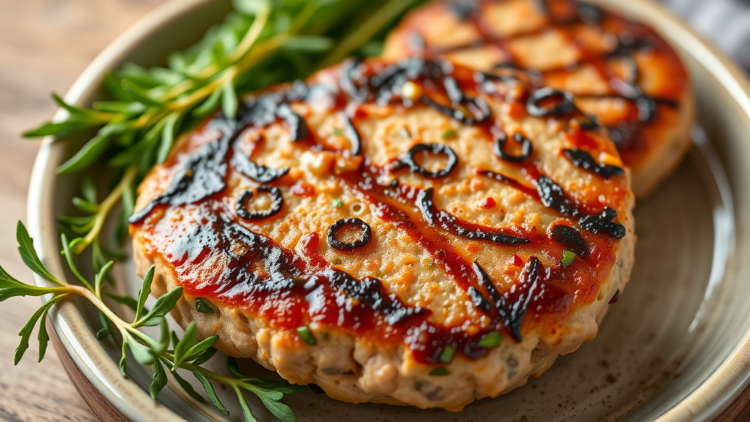
With the optimized extract in hand, the researchers moved to the grill. Beef patties containing 20 percent fat and 1.5 percent salt were formulated with the liquid extract at four concentrations: zero as a control, 0.5 percent, 1.0 percent, and 1.5 percent. Each patty was shaped to roughly 50 grams, nine centimeters in diameter, and one centimeter thick, then cooked on a hot plate at 180 degrees Celsius for six minutes per side, a protocol designed to push the interior to at least 72 degrees Celsius in line with food safety standards. The patties were then analyzed for pH, moisture content, lipid oxidation via the thiobarbituric acid-reactive substances, or TBARS, test, and cooking yield.
The results split cleanly between what changed and what did not. Moisture content was unaffected by the extract, and TBARS values, although lower in the treated patties, about 10.57 micromoles of malondialdehyde per kilogram compared with 13.18 in the control, did not differ statistically. The authors suggest that heat during cooking may have degraded some of the phenolic compounds or reduced their activity, and note that earlier studies using dried leaves or marinades of the same plant did report significant antioxidant protection during storage. pH, by contrast, rose significantly in patties containing 1.0 and 1.5 percent extract, an effect attributed partly to the extract’s own near-neutral pH of about 6.15 and partly to cooking itself, which releases imidazole, hydroxyl, and sulfhydryl groups from meat proteins.
The headline finding was cooking yield, which climbed steadily with extract concentration. The mechanism, the researchers argue, lies in protein chemistry. Phenolic compounds can form hydrogen bonds with muscle proteins, building a more compact protein network that traps water more effectively during heat treatment. These interactions may also limit protein denaturation and aggregation, reducing the fluid losses that normally accompany frying, while the extract’s antioxidant components help preserve the structural integrity of muscle proteins under thermal stress. Because cooking losses determine the technological efficiency and economics of meat processing, an ingredient that keeps patties juicier and heavier through the pan is commercially significant, and the result aligns with earlier reports that various plant extracts improve water retention in burger-type products.
The authors are careful about the limits of their work. There was no sensory evaluation, no long-term storage trial, and no comparison with other natural additives, all of which would be needed before Micromeria fruticosa extract could claim a place in a commercial formulation. The modest and statistically insignificant reduction in lipid oxidation also leaves open the question of whether the extract’s real value in meat lies in antioxidant protection, in water retention, or in both. Still, the study delivers a validated, food-grade extraction protocol and a proof of concept that a traditional Mediterranean tea herb can function as a natural, clean-label ingredient in cooked meat products. As consumer demand for functional, health-oriented foods continues to grow, the researchers conclude that the plant holds promising potential as a natural additive in meat and meat products, provided that future studies confirm its performance over storage, on the palate, and against competing plant-derived ingredients.
Subject of Research: Optimization of ultrasound-assisted extraction of Micromeria fruticosa and its application as a natural additive in beef patties
Article Title: Optimization of extraction conditions of Micromeria fruticosa and use of optimized extract in beef patties production
Article References: Anlar Daldal, P., Cinar Topcu, K., & Çakır, Ö. (2026). Optimization of extraction conditions of Micromeria fruticosa and use of optimized extract in beef patties production. Food Science of Animal Resources, 46(1), Article 81. https://doi.org/10.1007/s44463-026-00082-9
Image Credits: AI Generated
DOI: 10.1007/s44463-026-00082-9
Keywords: Micromeria fruticosa, beef patties, ultrasound-assisted extraction, response surface methodology, antioxidant activity, phenolic compounds, cooking yield, TBARS, natural additives, meat quality, clean-label foods, food science
Cite Scienmag News
APA
MLA
Chicago
Alan Morgan. (September 25, 2026). Mediterranean Herb Extract Boosts Cooking Yield in Beef Patties, Study Finds. Scienmag. https://scienmag.com/mediterranean-herb-extract-boosts-cooking-yield-in-beef-patties-study-finds/
Alan Morgan. “Mediterranean Herb Extract Boosts Cooking Yield in Beef Patties, Study Finds.” Scienmag, 25 September 2026, https://scienmag.com/mediterranean-herb-extract-boosts-cooking-yield-in-beef-patties-study-finds/. Accessed 25 September 2026.
Alan Morgan. “Mediterranean Herb Extract Boosts Cooking Yield in Beef Patties, Study Finds.” Scienmag. September 25, 2026. https://scienmag.com/mediterranean-herb-extract-boosts-cooking-yield-in-beef-patties-study-finds/
Copy citation
Download RIS
Tags: antioxidant activityantioxidant-rich plant extracts in meat processingbeef pattiesclean-label foodscooking yieldfood sciencefood science research on natural meat preservativesimpact of herbal antioxidants on meat shelf lifeMeat QualityMediterranean herb extract for beef patty cooking yield improvementMicromeria fruticosaMicromeria fruticosa extract for meat productsnatural additivesnatural plant ingredients in meat industrynatural solutionsoptimizing herbal extracts for meat qualityPhenolic compoundsplant-based additives to improve meat cooking efficiencyresponse surface methodologyrole of antioxidants in meat product performanceTBARStraditional herbs used in modern meat processingTurkish studies on herbal extracts for meat enhancementultrasound-assisted extraction