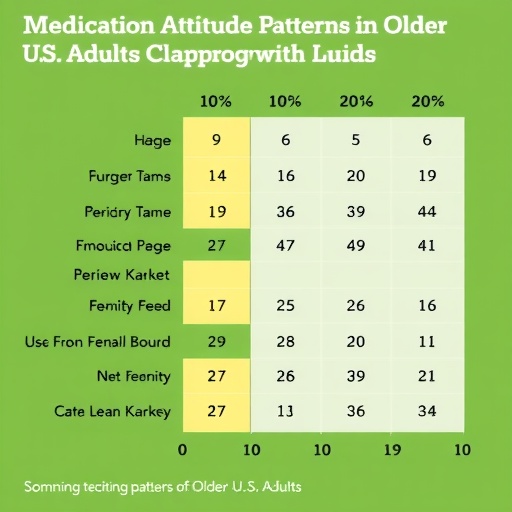
In the ever-evolving landscape of healthcare for aging populations, understanding the nuanced attitudes toward medication adherence among older adults has become a paramount concern. The recent study by Liang, Kwak, Shirvani, and colleagues, published in BMC Geriatrics in 2026, sheds unprecedented light on the complex patterns of how older individuals perceive and manage their medications. By employing advanced latent class analysis, the researchers reveal multifaceted clusters of medication attitudes, offering a comprehensive framework that could revolutionize personalized healthcare strategies.
Medication adherence is a critical determinant of health outcomes, especially in seniors who often navigate multiple chronic conditions requiring complex pharmacological regimens. Yet, previous research has largely treated older adults as a homogeneous group, overlooking the diversity in beliefs, fears, and behaviors that influence medication use. This study’s latent class approach decisively moves beyond this oversimplification. It uncovers discrete latent classes that capture distinct attitudinal profiles, providing a sophisticated lens to examine psychosocial and demographic correlates influencing medication-related behaviors.
The authors analyzed a nationally representative sample of older adults in the United States, incorporating data that encompass cognitive, emotional, and behavioral dimensions. Leveraging sophisticated statistical modeling, they identified latent classes that encapsulate varying degrees of medication acceptance, skepticism, and ambivalence. These classes serve as a basis to understand why adherence rates vary widely and why some older adults are predisposed to non-adherence despite medical advice.
One of the pivotal findings is the identification of latent classes characterized by differential trust in healthcare providers and perceived medication necessity. Some groups exhibited high trust and perceived medication benefits, correlating with better adherence patterns. Conversely, others reflected deep-seated concerns about side effects, polypharmacy, and skepticism about medication efficacy, often linked with poorer adherence outcomes. The granularity of these results clarifies the heterogeneity in medication attitudes that medical professionals must navigate.
Importantly, the study highlights the influence of socio-demographic factors such as age, education level, and socio-economic status, revealing their role in shaping medication attitudes. Older individuals with higher education levels showed greater acceptance and understanding of pharmacotherapy, whereas those from economically disadvantaged backgrounds exhibited more mistrust and resistance, underscoring the intersection of health literacy and social determinants in medication management.
Cognitive function and mental health also emerged as significant correlates. The research demonstrates that cognitive decline, often prevalent in older populations, can impair medication management skills and alter perceptions of medication necessity and safety. Similarly, depressive symptoms were associated with increased negative attitudes toward medication, emphasizing the need for integrated mental health assessments in routine geriatric care.
Crucially, the latent class model provides a predictive framework for healthcare providers. By identifying which class a patient may belong to, clinicians can tailor communication and intervention strategies more effectively. For example, individuals in the skeptical class may benefit from enhanced counseling regarding medication risks and benefits, while those in the ambivalent group might require motivational interviewing techniques to reinforce the importance of adherence.
The implications of these findings extend beyond individual care to public health policy. Understanding the distribution of these attitudinal classes within the older adult population can inform the development of targeted educational campaigns and community-based support programs aimed at improving medication adherence. Tailored interventions could significantly reduce healthcare costs associated with medication non-compliance, such as hospitalizations and complications from poorly managed chronic diseases.
Additionally, the study’s methodological rigor sets a new standard in geriatric pharmacology research. The application of latent class analysis in this context allows for the disentanglement of complex psychosocial variables that were previously difficult to quantify and interpret. This approach may be adapted for future research exploring other health behaviors in aging populations, facilitating a more nuanced understanding of eldercare challenges.
Moreover, the study’s findings prompt a critical reevaluation of current prescribing practices. Recognizing the diverse medication attitudes among older adults should encourage prescribers to engage in shared decision-making, fostering greater patient autonomy and satisfaction. This paradigm shift aligns with contemporary movements toward patient-centered care and could improve therapeutic alliances.
The research also underscores the significance of cultural factors influencing medication attitudes. While the study was conducted in the United States, its latent class typologies likely echo similar patterns in other multicultural societies. Future cross-cultural research could expand on these insights, exploring how cultural beliefs and traditional health practices intersect with medication adherence in older populations globally.
Furthermore, this study adds to the growing evidence that personalized medicine must consider psychological and social dimensions alongside biological factors. The complex interplay between a person’s worldview, social environment, and health behaviors necessitates a multidisciplinary approach to optimize medication adherence and health outcomes in seniors.
In conclusion, Liang and colleagues’ innovative use of latent class analysis illuminates the intricate and varied attitudes older adults hold toward their medications. This research provides a valuable roadmap for clinicians, policymakers, and researchers aiming to enhance medication adherence and ultimately improve the quality of life for an aging population. As the global demographic shift towards older age continues, such insights are indispensable for creating adaptive, effective, and humane healthcare systems.
The horizon for aging research now includes a potent analytical tool and a deeper appreciation of the psychosocial fabric governing medication behaviors. Bridging the gap between statistical modeling and practical healthcare applications could pave the way for a new era in geriatric medicine, where understanding and respecting individual patient narratives become standard practice rather than an ideal.
Liang et al.’s work stands as a compelling call to action, urging healthcare communities to embrace complexity and variability in medication attitudes. Their findings offer hope that through tailored interventions and personalized care, the persistent challenges of medication adherence among older adults can be significantly mitigated, leading to healthier, more empowered aging populations worldwide.
Subject of Research: Patterns of medication attitudes and their correlates among older adults in the United States
Article Title: Latent class patterns of medication attitudes and their correlates among older adults in the United States
Article References:
Liang, J., Kwak, M.J., Shirvani, M. et al. Latent class patterns of medication attitudes and their correlates among older adults in the United States. BMC Geriatr (2026). https://doi.org/10.1186/s12877-026-07546-z
Image Credits: AI Generated
Tags: ambivalence toward medication usechronic condition management in elderlycognitive and emotional aspects of medicationdemographic influences on medication adherencehealthcare strategies for aging populationslatent class analysis of medication attitudesmedication adherence in older adultsmedication attitude patterns in U.S. seniorsmedication beliefs and behaviorsmedication skepticism in older adultspersonalized healthcare for seniorspsychosocial factors in medication use