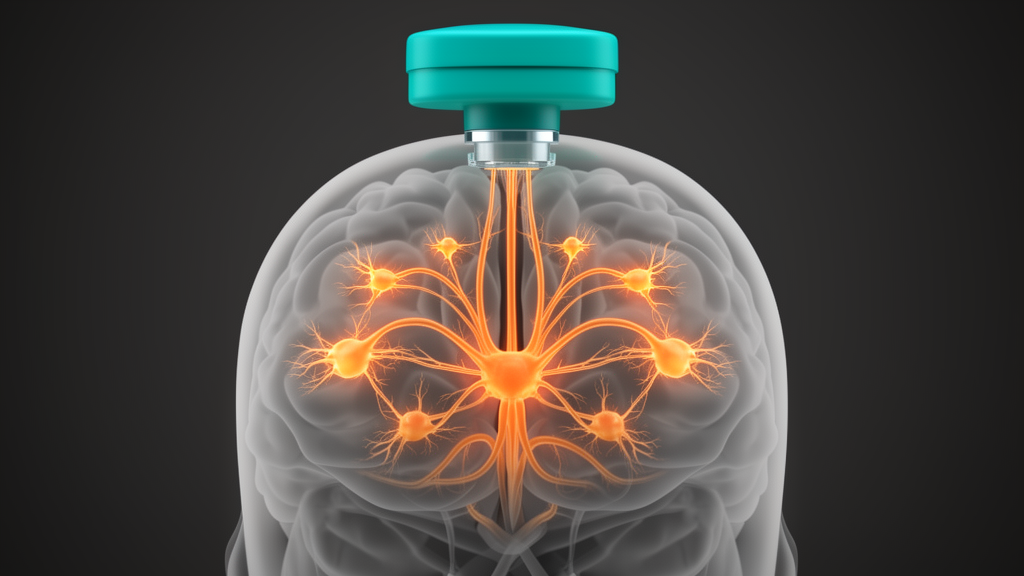
A personalized neural field theory model indicates that recurrent feedback from layer 5 to layers 2/3 of the motor cortex is a major regulator of the motor potentials evoked by transcranial magnetic stimulation. The study found that the model’s recurrent weighted inhibitory gain was especially important for reproducing short-interval intracortical inhibition and individual responses to theta-burst stimulation. This was a computational modeling study based on experimental input–output curves, not a clinical trial of treatment efficacy.
The researchers extended an established feedforward motor-cortex model by adding recurrent connections between the specified cortical layers. Synaptic coupling coefficients were derived through a bottom-up approach using microanatomical data and then calibrated against experimental input–output curves with particle swarm optimization. To personalize the model, they optimized three recurrent weighted gains: W_ev, W_iv and W_vv. The model was then used to simulate single-pulse input–output curves, paired-pulse protocols known as short-interval intracortical inhibition, intracortical facilitation and long-interval intracortical inhibition, as well as responses to intermittent and continuous theta-burst stimulation.
One central result was a sigmoidal, nonlinear relationship between TMS intensity and neuronal input. This differed from the linear relationship assumed in previous feedforward models. Recurrent weighted inhibitory gain, W_iv, was critical for generating realistic short-interval intracortical inhibition and was the dominant parameter used to personalize the model. With that parameter, the simulations successfully fit 13 of 18 individual intermittent theta-burst stimulation response profiles and 15 of 18 individual continuous theta-burst stimulation profiles.
The model also connected distinct paired-pulse responses to protocol-specific settings of the same recurrent microcircuit. Short-interval intracortical inhibition and facilitation emerged through different tuning of recurrent activity, while long-interval intracortical inhibition required greater suppression of recurrent excitation. The latter model result was consistent with GABAB mediation. The authors therefore present recurrent inhibitory feedback as a mechanism that helps organize TMS dynamics and may help account for differences among individuals in their responses to stimulation.
Generalization was assessed using an independent continuous theta-burst stimulation dataset that had not been used for the initial calibration. The personalized model produced robust fits on that dataset, supporting its ability to reproduce responses beyond the measurements used to tune it. The authors describe the framework as a mechanistically interpretable approach for linking clinical TMS metrics to specific motor-cortex circuits, with potential value for personalized neuromodulation. However, the reported evidence concerns model construction, calibration and computational validation; it does not demonstrate that the model improves patient outcomes or that its parameters can yet be used to select effective stimulation protocols.
Subject of Research: Personalized neural field modeling of recurrent motor-cortex feedback in TMS-evoked motor potentials
Article Title: Mechanistic Role of Layer 5-to-2/3 Recurrent Feedback in TMS-Evoked Motor Potentials
Article References: Mahmouie, S., Saviz, M., Baghdadi, G., & Towhidkhah, F. (2026). Mechanistic Role of Layer 5-to-2/3 Recurrent Feedback in TMS-Evoked Motor Potentials. Neuroinformatics, 24(4), Article 68. https://doi.org/10.1007/s12021-026-09818-w
Image Credits: AI Generated
DOI: 10.1007/s12021-026-09818-w
Keywords: transcranial magnetic stimulation, motor cortex, neural field theory, recurrent feedback, cortical inhibition, theta-burst stimulation, paired-pulse protocols, inter-individual variability, neuromodulation, Mechanistic, Role, Layer
News Source: Ophelia Keating. (October 20, 2026). Mechanistic Role of Layer 5-to-2/3 Recurrent Feedback in TMS-Evoked Motor Potentials. Scienmag.