Solid state batteries are still not very fast and powerful. One reason is that Lithium ions may find it difficult to cross the solid electrolyte separator. Now a study with neutrons shows for the first time the diffusion process in detail. The method can be used to test new electrolytes for efficient lithium diffusion.
Credit: HZB
Solid state batteries are still not very fast and powerful. One reason is that Lithium ions may find it difficult to cross the solid electrolyte separator. Now a study with neutrons shows for the first time the diffusion process in detail. The method can be used to test new electrolytes for efficient lithium diffusion.
Lithium-based solid-state batteries have some advantages, such as being less flammable. But they are also much less powerful. This is because the lithium ions in this type of battery have to diffuse through a solid electrolyte, which is a cumbersome process.
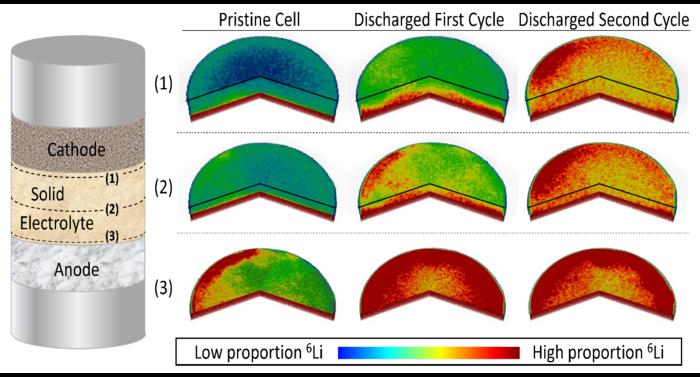
Using a clever trick, a team led by Dr Ingo Manke and Dr Robert Bradbury from HZB and several collaborators has now succeeded in observing this transport of lithium ions through the electrolyte in real time for the first time. They took advantage of the fact that lithium usually exists as a mixture of two isotopes: about 90% lithium7, which is transparent to neutron beams, and the remaining 10% lithium6, which strongly absorbs neutrons. “We had the idea that we could use the different transparency of the lithium ions to follow their path through the electrolyte. And that works very well with operando neutron radiography and in situ neutron tomography,” says Bradbury. The neutron measurements were carried out at the Institut Laue-Langevin in Grenoble, France, where HZB expert Dr Nicolay Kardjilov has set up a joint tomography facility.
A lithium-sulphur battery with an anode made of pure lithium6 was manufactured for the investigation. The solid electrolyte consisted of the usual mixture of Li6 and Li7. “This allowed us to distinguish during the initial discharge between the mobile lithium ions diffusing through the cell from the anode and those initially in the solid electrolyte,” Bradbury explains. Using operando neutron radiography, the researchers observed the diffusion of the lithium ions through the cell, while in situ neutron tomography provided a three-dimensional view of the distribution of the trapped lithium ions within the cell in the charged and discharged states. The study also involved teams from the Universities of Giessen and Braunschweig and the Jülich Research Centre.
The most important result: the diffusion of Li is not homogeneous and uniform. In addition, this method allows new electrolytes to be tested with the Li isotope Li6 in order to more quickly find electrolytes through which lithium can diffuse particularly well.”Elucidating the transport pathways of lithium ions through a solid electrolyte separator is a crucial step on the way to developing reliable, functional solid-state batteries,” says Ingo Manke.
DOI
10.1002/adfm.202302619
Method of Research
Experimental study
Subject of Research
Not applicable
Article Title
Visualizing Lithium Ion Transport in Solid-State Li–S Batteries Using 6Li Contrast Enhanced Neutron Imaging
Article Publication Date
6-Jun-2023
COI Statement
none