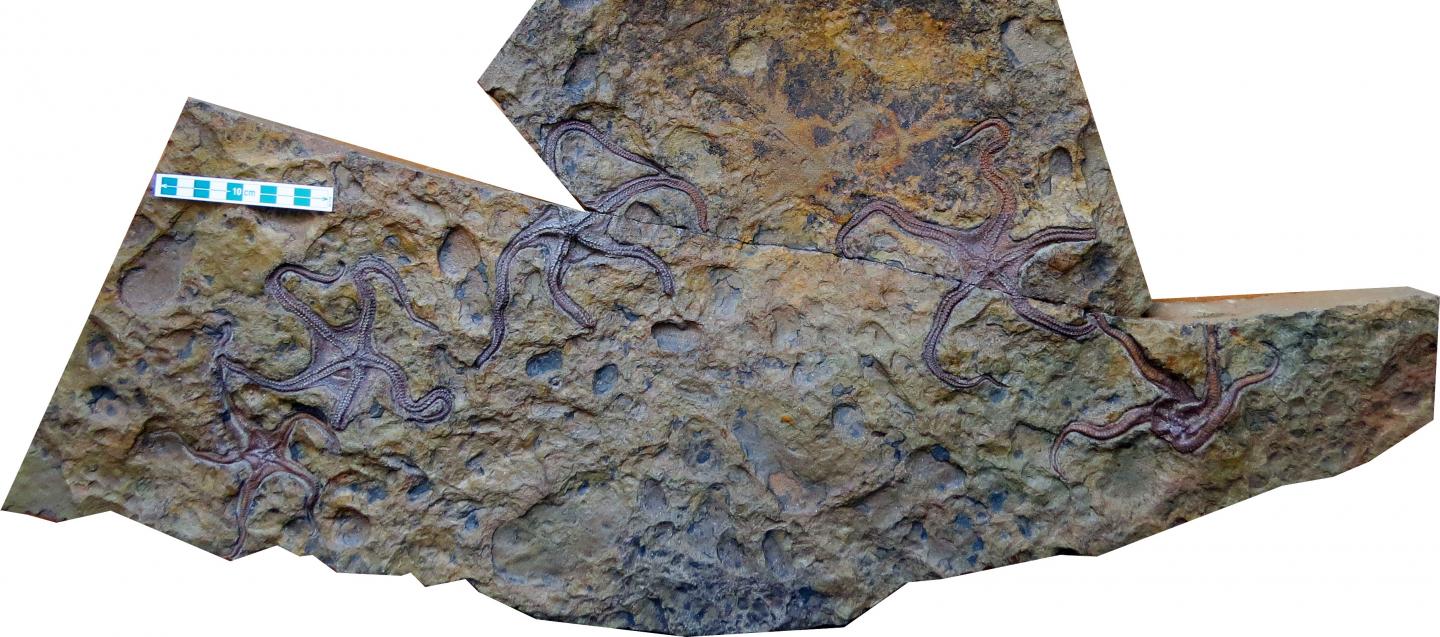
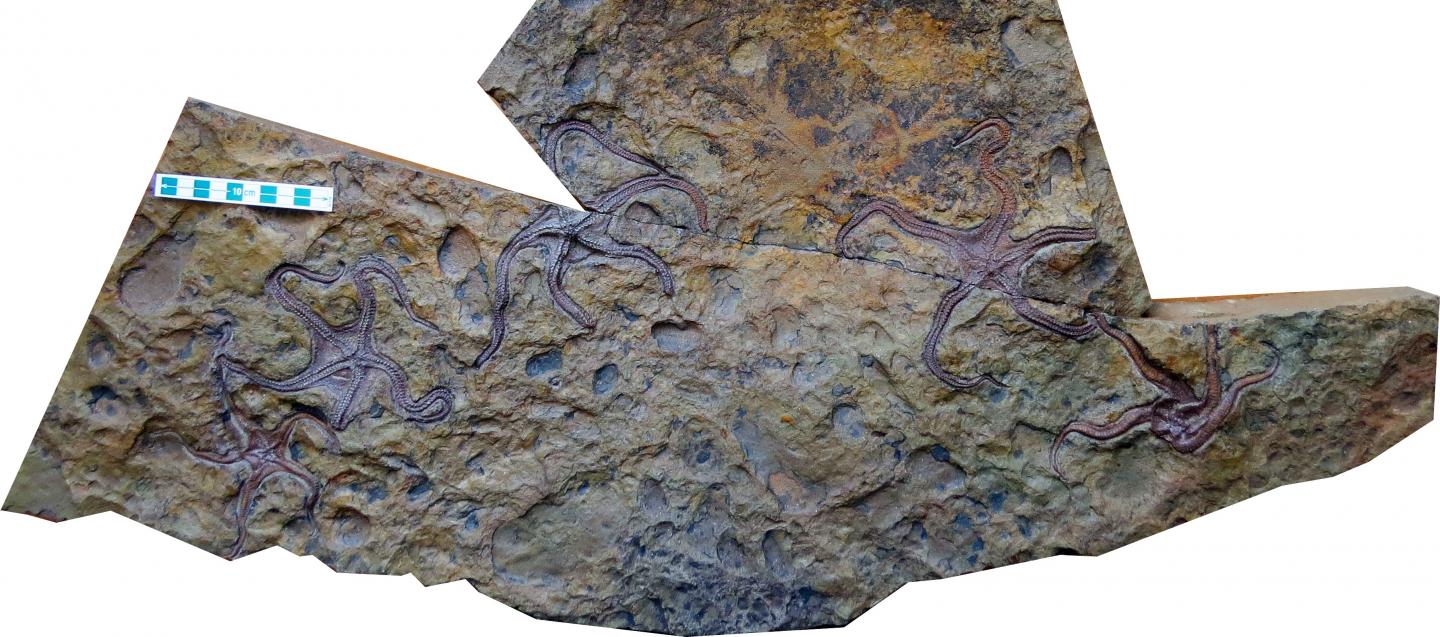
Credit: Kenneth McNamara
Researchers have described a new species of brittle star, which are closely related to starfish, and showed how these sea creatures evolved in response to the rise of shell-crushing predators during the late Palaeozoic Era. The results, reported in the Journal of Systematic Palaeontology, also suggest that brittle stars evolved new traits before the largest mass extinction event in Earth's history, and not after, as was the case with many other forms of life.
A fossilised 'meadow' of dancing brittle stars – frozen in time in the very spot that they lived – was found in Western Australia and dates from 275 million years ago. It contains several remarkably preserved 'archaic' brittle stars, a newly-described genus and species called Teleosaster creasyi. They are the last known complete brittle stars of their kind, an evolutionary hangover pushed to the margins of the world's oceans by the threat from predators.
The researchers, from the University of Cambridge, suggest that while other species of brittle stars evolved in response to predators such as early forms of rays and crabs, these archaic forms simply moved to where the predators weren't – namely the seas around Australia, which during the Palaeozoic era was pushed up against Antarctica. In these cold, predator-free waters, the archaic forms were able to grow much larger, and lived at the same time as the modern forms of brittle star, which still exist today.
Brittle stars consist of a central disc and five whip-like appendages, which are used for locomotion. They first appear in the fossil record about 500 million years ago, in the Ordovician Period, and today there are about 2,100 different species, mostly found in the deep ocean.
Early brittle stars were just that: brittle. During the Palaeozoic Era, when early shell-crushing predators first appeared, brittle stars made for easy prey. At this point, a split in the evolutionary tree appears to have occurred: the archaic, clunky brittle stars moved south to polar waters, while the modern form first began to emerge in response to the threat from predators, and was able to continue to live in the warmer waters closer to the equator. Both forms existed at the same time, but in different parts of the ocean.
"The threat from predation is an under-appreciated driver of evolutionary change," said study co-author Dr Kenneth McNamara of Cambridge's Department of Earth Sciences. "As more predators began to appear, the brittle stars started to evolve more flexible bodies, which enabled them to either burrow into the sediment, or to move more rapidly to escape."
About 250 million years ago, the greatest mass extinction in Earth's history – the Permian-Triassic extinction event, or the "Great Dying" – occurred. More than 90% of marine species and 70% of terrestrial species went extinct, and as a result, most surviving species underwent major evolutionary changes as a result.
"Brittle stars appear to have bucked this trend, however," said co-author Dr Aaron Hunter, a visiting postdoctoral researcher in the Department of Earth Sciences. "They seem to have evolved before the Great Dying, into a form which we still see today."
Meadows of brittle stars and other invertebrates such as sea urchins and starfish can still be seen today in the seas around Antarctica. As was the case during the Palaeozoic, the threat from predators is fairly low, although the warming of the Antarctic seas due to climate change has been linked to the recent arrival of armies of king crabs, which represent a real threat to these star-filled meadows.
###
Media Contact
Sarah Collins
[email protected]
44-012-237-65542
@Cambridge_Uni
http://www.cam.ac.uk
Related Journal Article
http://dx.doi.org/10.1080/14772019.2017.1353549