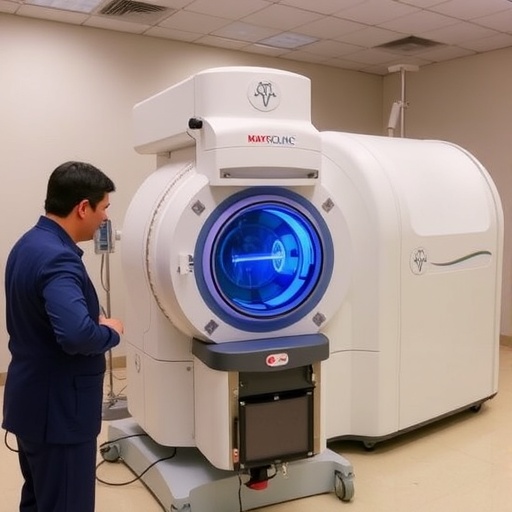
In a pioneering advancement for cancer research, Mayo Clinic in Rochester, Minnesota, has teamed up with New Phase Ltd., an Israeli deep-tech company, to introduce the first magnetic nanoparticle-mediated hyperthermia machine within the United States. This state-of-the-art investigational technology represents a promising frontier in oncological treatments, leveraging targeted heat delivery to selectively destroy cancer cells. Hyperthermia, the medical application of heat to damage malignant tissues, has long been recognized for its therapeutic potential. However, its conventional forms have been hindered by technological and practical limitations, restricting widespread usage. The new hyperthermia system, financed and developed through this collaboration, proposes to overcome these barriers by employing magnetic nanoparticles combined with electromagnetic induction, opening doors to novel therapeutic strategies against difficult-to-treat cancers.
The principle underlying this innovative approach is the use of iron oxide-based magnetic nanoparticles administered intravenously. These particles exhibit unique magnetic properties allowing them to be selectively retained within tumor tissues. Once localized, the patient is placed inside the electromagnetic induction apparatus—a sophisticated device comparable in function to an induction cooktop, but designed for medical applications. Alternating magnetic fields are then pulsed through the region harboring the nanoparticles; as these particles respond to the magnetic stimuli, they generate heat locally within the tumor microenvironment. This precision heating results in controlled hyperthermia, carefully maintained below 50 degrees Celsius, impairing and potentially killing cancer cells while minimizing damage to surrounding healthy tissue.
Dr. Scott Lester, a radiation oncologist at Mayo Clinic, highlights the transformative potential of this technology by emphasizing that temperature control has historically been cancer’s “Achilles’ heel.” Unlike traditional hyperthermia techniques, which suffered from imprecise heating capabilities and patient discomfort, this nanoparticle-mediated method allows clinicians to direct thermal energy exactly where needed. The induction mechanism functions similarly to cooking technology —the tumor effectively becomes the “pan” heated by the electromagnetic field, enabling unprecedented accuracy in treatment delivery. Additionally, external cooling measures, such as temperature-controlled blankets, ensure the patient’s core temperature remains stable during therapy, enhancing safety and tolerance.
The machine, installed in the Jacobson Building of Mayo Clinic’s Radiation Oncology Department, was operational by November 2025. Commencing in December 2025, the first patient in the United States underwent this novel hyperthermia treatment within a carefully designed clinical trial framework. This trial focuses on patients with metastatic solid tumors localized anywhere in the torso, excluding the brain. Remarkably, the therapy can concurrently target multiple tumors—even those situated deeply within the anatomical landscape—offering a significant advantage over other localized treatments. Researchers specifically selected patients who have failed multiple systemic therapies and more conventional modalities, including radiotherapy, underscoring the trial’s role as a potential last resort for advanced cancer cases.
This emerging hyperthermia approach could redefine the paradigms around combinatory cancer treatments. Dr. Sean Park, co-principal investigator of the trial and a Mayo Clinic radiation oncologist, explains that hyperthermia may act synergistically with existing therapies like radiation. By sensitizing tumor cells to radiation, hyperthermia could permit dose reductions while maintaining, or even improving, therapeutic outcomes. Furthermore, it shows promise in overcoming intrinsic or acquired radiation resistance—a formidable challenge in oncology. The biophysical rationale lies in heat’s ability to disrupt cellular repair mechanisms and augment immune response, making tumors more susceptible to concurrent therapies.
Historically, Mayo Clinic’s radiation oncologists engaged in hyperthermia through indirect means, such as heating water-filled bags placed externally on patients, predominantly as an adjunct to radiation for chest wall recurrences in breast cancer. While this method demonstrated some therapeutic benefit, it was plagued by inconsistent temperature regulation and patient discomfort, which ultimately led to its decline in clinical practice. Contemporary technological constraints hindered efficient heat delivery and made precise treatment planning difficult, limiting hyperthermia’s broader adoption despite early promising results.
The new system represents a quantum leap from earlier iterations, combining the precision of nanotechnology with the controlled delivery possible through electromagnetic induction. Dr. Nadia Laack, Chair of Radiation Oncology at Mayo Clinic, asserts that this refined method could finally fulfill hyperthermia’s long-suspected potential. Should clinical trials validate efficacy and safety, this technique may become a mainstream adjunct or stand-alone therapy. Being minimally invasive and potentially compatible with a range of systemic and local treatments, its incorporation could revolutionize oncological practice, particularly for patients with complex and resistant tumors.
New Phase Ltd.’s commitment to leveraging deep technology for healthcare is exemplified in this partnership. Its CEO, Ofer Shalev, stresses that the combined innovation aims to dramatically improve the quality of life for cancer patients who currently face limited options. The company’s specialized nanoparticles and electromagnetic systems demonstrate how cutting-edge engineering can translate into tangible therapeutic innovations. This marriage of physics, material science, and clinical medicine illustrates a growing trend toward multidisciplinary solutions in the fight against cancer.
Safety remains paramount in this investigational therapy. The nanoparticle coating is engineered to limit excessive heat generation, preventing tissue damage beyond the tumor. Continuous patient monitoring during sessions ensures immediate intervention if unintended thermal effects arise. The machine’s design focuses on patient comfort and clinical practicality, with treatment protocols refined to optimize tumor targeting while sparing healthy tissues. This cautious approach stems from an understanding that controlled hyperthermia, rather than indiscriminate heating, governs therapeutic success and tolerability.
Looking ahead, researchers plan to explore further applications and refinements of magnetic nanoparticle hyperthermia. Investigations into its integration with immunotherapy, chemotherapy, and cutting-edge biologics could expand its utility. Additionally, novel nanoparticle formulations may enhance tumor uptake or enable even more precise heating algorithms. These advancements underscore the potential for personalized hyperthermia treatment plans tailored to tumor biology and patient-specific variables. As research progresses, hyperthermia may join surgery, chemotherapy, and radiation as a foundational pillar of comprehensive cancer care.
The installation of this electromagnetic hyperthermia machine at Mayo Clinic marks a significant milestone, reviving a therapeutic concept that has long awaited technological maturity. With the convergence of clinical insight, engineering innovation, and rigorous scientific evaluation, this approach may usher in a new era where heat is harnessed not only as a weapon against cancer cells but as a strategic partner in multi-modality cancer treatment regimens. The oncology community and patients alike eagerly observe the outcomes of ongoing trials, hopeful that this advanced hyperthermia system could ultimately transform cancer management and offer renewed hope to those battling metastatic disease.
Subject of Research: Magnetic nanoparticle-mediated hyperthermia for cancer treatment
Article Title: Pioneering Magnetic Nanoparticle Hyperthermia: Unlocking Heat’s Potential in Cancer Therapy
News Publication Date: Not specified in the source content
Web References:
– https://www.mayoclinic.org/
– https://newphase.co.il/
– https://www.cancer.gov/about-cancer/treatment/types/hyperthermia
– https://www.mayoclinic.org/departments-centers/mayo-clinic-cancer-center
– https://www.cancer.gov/
Tags: advanced cancer treatment technologiescancer hyperthermia treatmentdeep-tech oncology innovationselectromagnetic induction cancer therapyinvestigational cancer therapies in the USiron oxide nanoparticles in oncologylocalized hyperthermia systemsmagnetic nanoparticle hyperthermiaMayo Clinic cancer researchnanoparticle-mediated tumor destructionNew Phase Ltd cancer collaborationtargeted heat cancer therapy