A mathematical modeling study has formulated and validated a system of coupled partial differential equations to describe the coupled transfer of heat and moisture through textile fabrics undergoing drying on heated cylinders inside a low-pressure chamber. Investigating thermal efficiency and product quality during industrial fabric processing, the research team developed a one-dimensional framework to predict local temperatures and moisture distributions across fabric thickness over time. The investigation establishes a computational foundation intended to support energy conservation, optimize production scheduling, avoid fabric over-drying, and assist in the future design of closed-loop industrial textile processing machinery operating with alternative processing fluids.
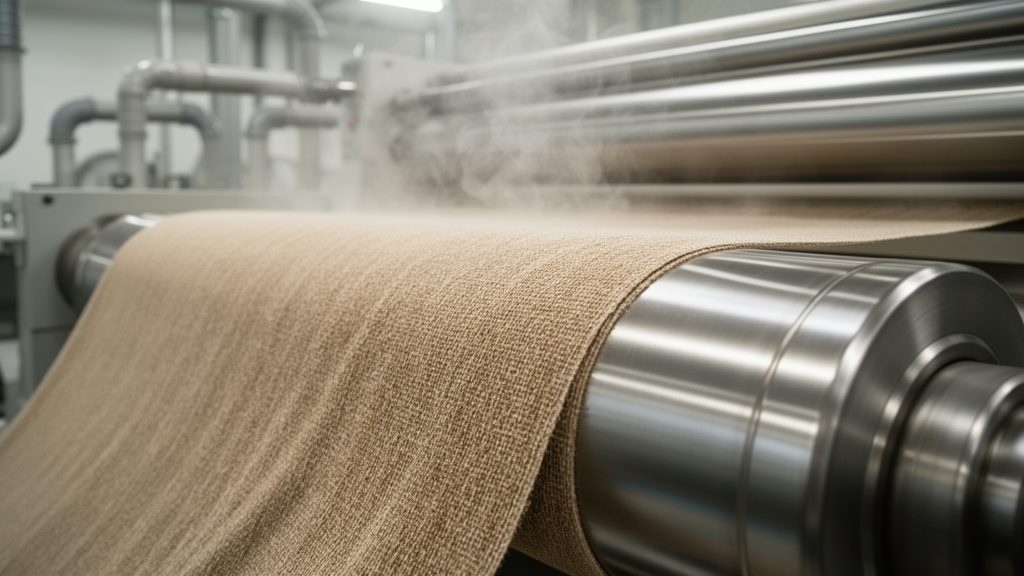
Industrial textile finishing historically demands substantial energy inputs and water resources during post-washing thermal drying operations. In the reviewed industrial configuration, the physical drying apparatus comprises a vacuum chamber maintained at a regulated sub-atmospheric pressure of 0.1 bar. Inside this chamber, fabric is conveyed continuously across three heated rollers alongside seven feed rollers that maintain steady mechanical tension and direct physical contact. Operating at 0.1 bar lowers the saturation evaporation temperature of water from standard atmospheric levels to approximately 45 degrees Celsius, or 318.15 Kelvin. Because the machine control system maintains the cylinder surfaces at a constant operating temperature of 150 degrees Celsius, or 423.15 Kelvin, while replenishing heat lost to the fabric, the system establishes a steep thermal gradient that drives rapid liquid evaporation across successive contact stages.
The mathematical formulation simplifies the physical system by focusing on the interaction between the moving fabric and an individual heated cylinder, treating the multidimensional problem as a one-dimensional spatial domain across the fabric thickness, denoted by the interval x from zero to L. The fabric is treated as a periodic porous structure formed by the weave of warp and weft yarns, allowing cross-sectional uniformity to be assumed along the normal direction to the cylinder surface. Under the formulated model assumptions, resistance to vapor transport through the internal pores is neglected because the liquid-to-vapor expansion ratio of water is approximately three orders of magnitude, and experimental observations showed no macroscopic fabric detachment from the roller surface. Furthermore, internal liquid redistribution resulting from capillary action or gravity is neglected, reflecting the brief duration of cylinder contact and the thinness of the fabric samples.
The governing mathematical structure consists of two coupled balance equations governing fabric temperature T(x,t) and dimensionless moisture concentration M(x,t), defined as the ratio of local liquid mass to the constant dry fiber mass. Heat transfer through the material thickness is governed by a non-homogeneous parabolic heat equation relating the product of wet fabric density and wet fabric specific heat capacity to spatial thermal conduction and an evaporative latent heat sink term. Because the thermodynamic parameters vary dynamically with local moisture, the model uses effective composite properties: the specific heat capacity represents a mass-weighted average of dry fabric and liquid, the density is derived from composite mass and volume balances, and the effective thermal conductivity increases linearly with moisture content up to a critical saturation threshold of Mc equals 2, beyond which the conductivity equals that of the permeating liquid.
Moisture depletion is represented by a first-order rate equation requiring that moisture concentration cannot increase over time. The model incorporates physical thresholds specifying that evaporation only initiates when the local fabric temperature reaches the low-pressure vaporization point, and the drying intensity decelerates as the remaining moisture approaches an unevaporable residual limit. To preserve differentiability in the continuous governing equations while preventing arithmetic overflow in numerical simulations, smooth logistic approximations are implemented. A temperature-activation logistic parameter beta is assigned a fixed value of 3 inverse Kelvin, which safely separates initial temperature deviations from standard IEEE double-precision floating-point limits, while the drying rate function incorporates an evaporation rate coefficient k, a residual moisture threshold Mb, and a transition slope parameter gamma.
Boundary conditions reflect the physical asymmetry between the contacting roller surface and the ambient chamber atmosphere. At the cylinder-fabric interface, represented by x equals zero, a Dirichlet condition fixes the temperature at the heated cylinder temperature, while instantaneous surface vaporization establishes an approximate Dirichlet boundary condition where moisture concentration approaches zero. At the opposite surface, represented by x equals L, a Robin-type boundary condition accounts for coupled convective and radiative heat losses into the surrounding chamber environment. The radiative heat exchange is evaluated assuming a cylindrical enclosure geometry using the Stefan-Boltzmann constant, while convective losses are computed from Nusselt, Reynolds, Prandtl, and Grashof dimensionless numbers tailored to low-pressure vapor flow.
Numerical approximation of the coupled initial boundary value problem was conducted using a finite element solver implemented in Python with the FEniCS library. The one-dimensional spatial thickness domain was discretized into a uniform mesh of 100 finite elements using mixed continuous piecewise-linear Lagrange elements, CG1 by CG1, for temperature and moisture variables. Temporal integration was carried out using a fully implicit backward Euler scheme with a constant time step of 0.1 seconds over the total process duration. To simulate the alternating physical routing across the three heated rollers, where the textile is exposed alternately on opposite faces, the finite element spatial fields for temperature and moisture were inverted across the spatial thickness domain between successive drying stages.
Model parameters were identified by minimizing the sum of squared residuals between experimental final average moisture content and model predictions across diverse fabric samples. The parameter optimization utilized the Trust Region Reflective algorithm from the SciPy library, executing bound-constrained nonlinear least squares. Bounds were set to k between 0.0001 and 0.001, Mb between 0.02 and 0.2, and gamma between 10 and 150. Evaluating the numerical gradient via finite differences required four initial boundary value problem evaluations per sample at each optimization iteration. Across the calibration dataset, optimal parameter values of k equals 9.99 times 10 to the minus 4, Mb equals 9.75 times 10 to the minus 2, and gamma equals 1.49 times 10 to the positive 2 yielded a Mean Squared Error of 0.000289 and a Mean Absolute Error of 0.0135.
Validation on three separate fabric test samples that were excluded from model parameter estimation demonstrated consistent accuracy, matching the overall error trends observed across the primary calibration dataset. Across all tested specimens, only two samples exhibited an absolute error exceeding 0.03 in residual moisture, with the majority falling within an absolute error tolerance of 0.015. Analysis of simulated internal profiles revealed that alternating cylinder exposure produces characteristic bell-shaped moisture curves across the fabric thickness, wherein both outer surfaces undergo intensive evaporation while the central core retains a higher residual moisture concentration.
The authors noted specific operational boundaries and physical limitations within the current single-cylinder framework. The model assumes isotropic materials and neglects two- or three-dimensional structural effects, such as tight yarn weaves or non-periodic textile constructions where internal vapor pressure or liquid capillarity might alter drying kinetics. Additionally, intermediate cooling effects occurring during fabric transit between successive rollers are not yet incorporated. Nevertheless, the validated one-dimensional contact model provides an accurate, computationally lightweight foundation for optimizing industrial drying parameters, and its generic fluid-property formulation allows future adaptation to waterless textile finishing machines employing pressurized carbon dioxide.
The research emerged from an industrial partnership uniting fabric producer S. Stefano S.p.A., textile machinery manufacturer Lafer S.p.A., and the Department of Industrial Engineering at the University of Florence. Their broader engineering goal targets a waterless finishing system utilizing pressurized carbon dioxide as the sole processing medium. Because that machine remains an uncharacterized prototype, experimental calibration utilized water-based drying data. Crucially, physical measurements recorded only bulk sample weights before and after drying, leaving internal spatial moisture distributions unobserved. In the finite element model, simulated average moisture was determined through the arithmetic mean of vertex values rather than numerical quadrature integration across the mesh.
Internal simulation profiles highlighted how processing duration and sample thickness govern drying uniformity. For Sample 3, with a thickness of 6.3 times 10 to the minus 4 meters and initial moisture of 0.63 dried over 30 seconds, moisture formed a pronounced bell-shaped curve with an elevated core. Conversely, Sample 14 had a thinner dimension of 4.2 times 10 to the minus 4 meters and similar initial moisture of 0.58 but underwent 60 seconds of drying. This extended duration and reduced thickness produced an almost linear temperature gradient and a substantially flatter moisture profile, confirming that longer exposure and thinner weaves yield more uniform moisture evacuation.
The investigators also tested model robustness across alternative parameter choices in addition to the primary calibrated set. Specifying an evaporation rate k of 5 times 10 to the minus 4, a moisture threshold Mb of 0.1, and a slope parameter gamma of 100 yielded a mean squared error of 0.000379 and a mean absolute error of 0.0151. Setting k to 0.001, Mb to 0.1, and gamma to 150 produced comparable errors of 0.000328 and 0.0144. Across all simulations, the FEniCS Newton solver relied on the MUMPS linear package, satisfying convergence criteria under absolute and relative tolerances of 10 to the minus 5 within 50 iterations.
Subject of Research: Mathematical modeling of heat and mass transfer in low-pressure textile contact drying
Article Title: Heat and mass transfer through fabric: a model for fabric drying with heated cylinders
Article References: Bellavia, S., Fiorini, N., Milazzo, A., & Papini, A. (2026). Heat and mass transfer through fabric: a model for fabric drying with heated cylinders. Journal of Computational Mathematics and Data Science, 21, Article 100139. https://doi.org/10.1016/j.jcmds.2026.100139
Image Credits: AI Generated
DOI: 10.1016/j.jcmds.2026.100139
Keywords: Textile drying, Heat transfer, Mass transfer, Mathematical modeling, Heated cylinders, Low pressure drying, Moisture concentration, FEniCS solver, Nonlinear least squares, Trust-region reflective, Energy efficiency, Industrial textiles, Latent heat of vaporization, Partial differential equations, Thermal conductivity, Residual moisture
News Source: Reid Dalton. (November 23, 2026). Mathematical Model Predicts Fabric Drying Dynamics on Heated Low-Pressure Cylinders. Scienmag.