A steep hormonal gradient maintaining intratesticular testosterone at levels fifty to one hundred times higher than circulating bloodstream concentrations is a fundamental physiological prerequisite for human sperm production, according to a narrative review published in the journal Reproductive Biology and Endocrinology. In healthy adult men, intratesticular testosterone concentrations range from 500 to 1000 nanomoles per liter, creating an extraordinary localized microenvironment compared to standard peripheral serum testosterone concentrations of only 10 to 30 nanomoles per liter. Although testosterone is recognized as the primary androgen driving human spermatogenesis, contemporary clinical practice continues to rely almost exclusively on peripheral serum measurements rather than evaluating the functionally critical testicular compartment. The authors report that this localized concentration gradient remains poorly understood in routine clinical practice, and validated non-invasive tools to assess intratesticular levels in ordinary diagnostic settings do not currently exist.
To clarify this localized hormonal gradient and evaluate practical strategies for non-invasive clinical assessment, the authors conducted a comprehensive narrative review of scientific literature published between 2000 and 2025 across the PubMed and Web of Science databases. Their literature synthesis encompassed both human clinical investigations and experimental animal or cellular models, focusing on quantitative intratesticular androgen levels, cellular mechanisms of androgen activity, findings from hormonal male contraception trials, and candidate surrogate biomarkers. Through this systematic evaluation, the review examined the physiological foundation, quantitative characteristics, and clinical significance of the intratesticular-to-serum testosterone ratio, while critically evaluating indirect derivation methods designed to eliminate the clinical necessity of invasive testicular biopsy or needle sampling procedures.
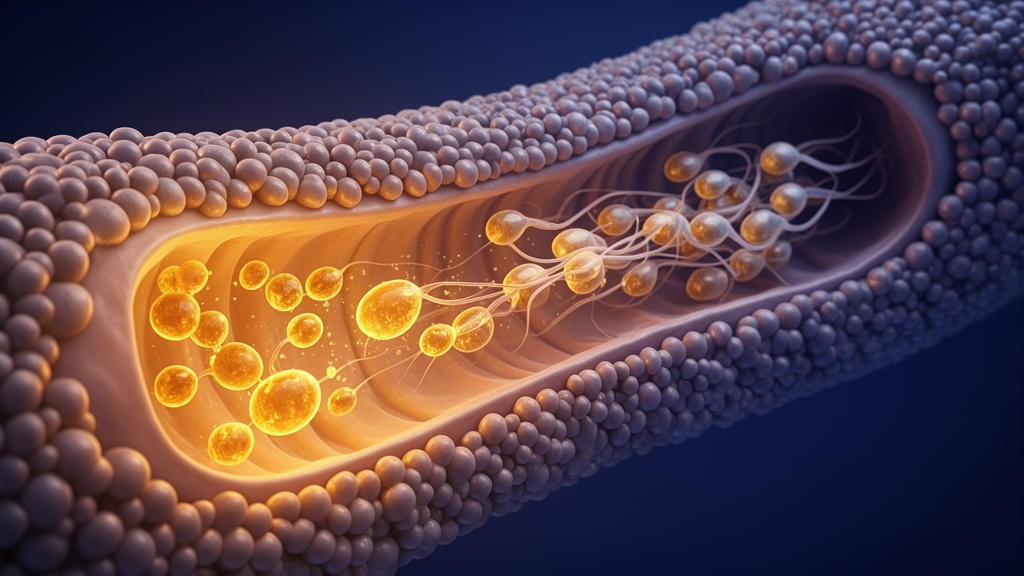
At the cellular level, the review details how testosterone governs sperm production through intermediary somatic structures rather than acting directly upon developing germ cells. Androgen signaling within the testis is mediated primarily through androgen receptors expressed on somatic support cells, specifically Sertoli cells and peritubular myoid cells situated around the seminiferous tubules. Genetic investigations using conditional androgen receptor knockout models confirm that intact androgen signaling within Sertoli cells is strictly indispensable for male germ cells to complete meiotic progression and spermiogenesis. Without functional androgen receptor activation within these supporting somatic cells, the complex cellular transformations required for normal sperm maturation cannot proceed, underscoring the critical biological function served by high localized androgen concentrations.
Experimental investigations highlighted in the review demonstrate that the high intratesticular testosterone gradient per se is required to maintain spermatogenesis. In experimental gonadotropin suppression studies where intratesticular testosterone concentrations were intentionally lowered to match serum-equivalent concentrations, sperm production was markedly impaired despite the maintenance of normal circulating serum testosterone levels. These experimental observations establish that peripheral androgen sufficiency cannot compensate for local intra-organ depletion. The authors emphasize that circulating serum testosterone concentrations correlate poorly with intratesticular androgen levels, with this diagnostic discrepancy becoming especially pronounced during exogenous hormonal manipulations and gonadotropin suppression protocols.
The review details the broader endocrine regulation governing this gradient and illustrates how exogenous therapeutic interventions can disrupt normal testicular function. Under normal physiological regulation, hypothalamic gonadotropin-releasing hormone stimulates pituitary secretion of luteinizing hormone and follicle-stimulating hormone. Luteinizing hormone acts directly on interstitial Leydig cells to stimulate testosterone biosynthesis, supporting active spermatogenesis within adjacent tubules while testosterone exerts negative feedback regulation on the hypothalamus and pituitary gland. When patients undergo exogenous testosterone replacement therapy, this negative feedback loop is disrupted, suppressing endogenous gonadotropins and halting Leydig cell production. This suppression severely depletes intratesticular testosterone and often leads to azoospermia or severe oligozoospermia, despite normal or elevated circulating serum testosterone readings.
Because direct testicular aspiration or tissue biopsy carries procedural risks and cannot be incorporated into routine clinical monitoring, researchers have investigated several circulating surrogate biomarkers to estimate intratesticular androgen status. Among these candidates, insulin-like factor 3, a peptide hormone constitutively secreted by interstitial Leydig cells, demonstrates the strongest correlation with intratesticular testosterone under experimental conditions. In addition, 17-hydroxyprogesterone reflects ongoing steroidogenic flux within testicular tissue, providing complementary diagnostic information regarding Leydig cell steroid biosynthetic activity. When measured in peripheral blood samples, these circulating biomarkers reflect local testicular endocrine function far more accurately than standard serum testosterone assays alone.
Integrating these novel biomarkers into multi-parameter clinical algorithms represents a promising strategy for non-invasive estimation. The authors propose combining serum measurements of luteinizing hormone, insulin-like factor 3, and 17-hydroxyprogesterone to derive reliable approximations of intratesticular testosterone concentrations. Such clinical algorithms hold immediate relevance for monitoring testosterone replacement therapy safety, preserving male fertility, and managing patients diagnosed with hypogonadotropic hypogonadism. However, the authors conclude that validated mathematical equations and standardized algorithms for routine clinical practice remain to be established, leaving the development of accurate non-invasive derivation models as a vital ongoing research objective in male reproductive endocrinology.
Subject of Research: Intratesticular testosterone gradient, human spermatogenesis, and non-invasive estimation biomarkers
Article Title: The serum-to-intratesticular testosterone ratio: physiological basis, clinical significance, and methods of derivation in the context of human spermatogenesis
Article References: Vignera, S. L., Calogero, A. E., Cannarella, R., Barbagallo, F., Crafa, A., & Condorelli, R. A. (2026). The serum-to-intratesticular testosterone ratio: physiological basis, clinical significance, and methods of derivation in the context of human spermatogenesis. Reproductive Biology and Endocrinology. https://doi.org/10.1186/s12958-026-01618-w
Image Credits: AI Generated
DOI: 10.1186/s12958-026-01618-w
Keywords: testosterone, intratesticular testosterone, spermatogenesis, sertoli cells, leydig cells, peritubular myoid cells, insulin-like factor 3, 17-hydroxyprogesterone, luteinizing hormone, follicle-stimulating hormone, gonadotropin-releasing hormone, androgen receptors, testosterone replacement therapy, male infertility, azoospermia, oligozoospermia, hypogonadotropic hypogonadism, fertility preservation
News Source: Drew Townsend. (November 24, 2026). High Testicular Testosterone Gradient Proves Essential for Human Sperm Production. Scienmag.