Higher lead levels in a mother’s blood can increase the chance of her bearing male offspring, according to new research led by Japanese scientists at the Tohoku University Graduate School of Medicine.
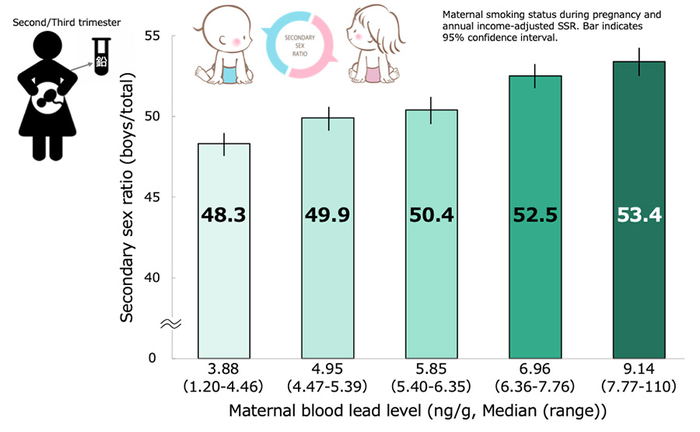
Credit: Nozomi Tatsuta
Higher lead levels in a mother’s blood can increase the chance of her bearing male offspring, according to new research led by Japanese scientists at the Tohoku University Graduate School of Medicine.
The research, published on January 4 in the Science of the Total Environment, aimed to help explain an observed decline in the proportion of male to female births in Japan and elsewhere. “Generally, for every 100 females, 104 -107 males are born, says associate professor of medicine and lead study author Nozomi Tatsuta. “In recent years, the sex ratio has been declining worldwide, and the number of male births has been decreasing.” Tatsuta cites data from a 2013 study of sex ratios at birth over six decades.
In demographic terms, the number of males per 100 females at birth is called the secondary sex ratio (SSR), which is known to be sensitive to certain environmental toxins. For example, “Previous studies have reported that the sex ratio is affected by exposure to chemical substances such as dioxins, as well as heavy metals such as methylmercury,” says study author Kunihiko Nakai, professor of Development and Environmental Medicine. Noting that lead can reduce female fertility as well as male sperm quality, the researchers hypothesized that it could play a role in the SSR.
The study recruited pregnant female participants from the ongoing Japan Environment and Children’s Study (JECS) sponsored by Japan’s Ministry of Environment. The study covers a broad geographic swathe of Japan. The participants were classified into five groups according to their blood lead levels. The analysis was adjusted for family income and smoking status during pregnancy, which could also affect the secondary sex ratio (SSR). Blood samples were collected from 85,171 female participants during middle-late pregnancy and analyzed for lead concentrations.
Several analyses were used to examine the relationship between maternal lead levels and SSR – a logistic regression, a sensitivity analysis, and a binomial distribution analysis – and all three indicated an increase in the proportion of male births with higher maternal lead concentrations. The correlation between maternal lead exposure and sex ratio was consistent even after adjusting for other potential variables like father’s age and exposure to lead on the job.
The findings may explain why the percentage of male births in Japan has been declining. The authors explain that, as restrictions in leaded gasoline and paint have been implemented, air lead levels have decreased, citing a 2021 study in Germany reporting a long-term trend of decreasing blood lead levels coincident with lower air lead levels. The similarly decreased air lead levels in Japan may explain the shift in sex ratio away from males.
This study has implications for public health. Guidelines for pregnant women are that blood lead levels should not exceed 50 nanograms per gram of blood. Yet, this study indicates that a maternal blood level of less than 1 nanogram per gram could affect the sex ratio of offspring.
The researchers call for further study of the correlation between lead and offspring sex ratio. “Since there are many factors other than lead exposure that are related to the sex ratio, it is still not fully understood to what extent maternal lead exposure affects the birth sex ratio,” says study author Shoji F. Nakayama, lead exposure scientist for the JECS. Other factors they hope to examine in the future include the effect of paternal blood lead levels on sex ratio and the impacts of lead on frequency of miscarriages and stillbirths.
The authors caution that because lead can have toxic effects on a developing human brain, it should never be used as a means of trying to control the sex of offspring.
Journal
Science of The Total Environment
DOI
10.1016/j.scitotenv.2021.152726
Article Title
Effects of maternal exposure to lead on secondary sex ratio in Japan: The Japan Environment and Children’s Study
Article Publication Date
4-Jan-2022