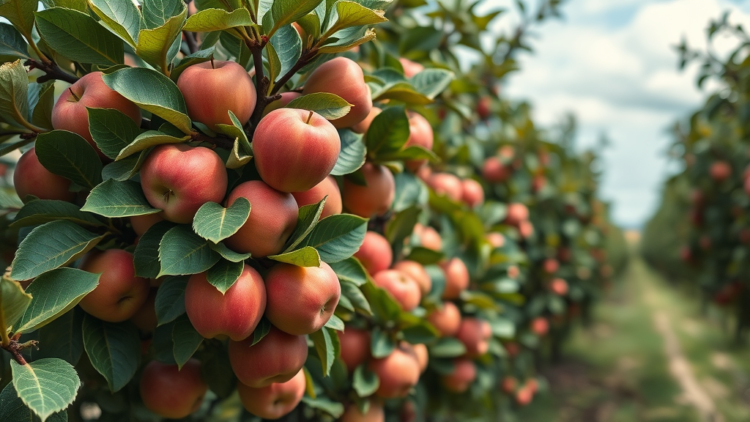
A team of European researchers has unveiled one of the most extensive annotated image collections ever assembled for apple tree phenology, offering the artificial intelligence community a rigorously curated resource for teaching computers to read the life cycle of an orchard. The dataset, called DeepPhenoTree-Apple Edition, documents apple trees across four contrasting European orchards and provides 48,320 time-stamped RGB images, from which a subset of 808 representative images was painstakingly annotated by hand. Together, these annotated images carry 241,600 expert annotations covering every major developmental stage, from the dormant bud of winter to the ripened fruit of autumn. The work, published in the journal Plant Methods, arrives at a moment when agriculture is racing to automate monitoring tasks that have depended for centuries on the trained eye of growers and scientists.
Phenology, the study of recurring biological events such as bud break, flowering, and fruit set, is central to virtually every decision a fruit grower makes. The timing of pruning, thinning, irrigation, fertilization, and pest control all hinge on knowing precisely where trees are in their developmental cycle. Historically, this knowledge has been gathered by human observers walking rows of trees and scoring buds and blossoms against standardized scales. It is labor-intensive, slow, and subject to observer variability. As climate change scrambles the traditional calendars of temperate fruit production, the need for fast, reliable, and scalable phenological observation has never been more urgent.
The new dataset addresses a well-recognized bottleneck in machine learning-driven plant phenotyping: the scarcity of well-annotated image data that captures genuine environmental variability. Deep learning models are only as robust as the diversity of the data they are trained on, and most existing plant image datasets come from a single location, a single variety, or tightly controlled conditions. When models trained under such narrow conditions are deployed in the real world, they often falter when confronted with unfamiliar lighting, different tree architectures, or genetic variation they have never seen.
DeepPhenoTree-Apple Edition was designed from the ground up to counter this fragility. The images were acquired across four European orchards belonging to the Apple REFPOP consortium, spanning sites in Spain, Belgium, Switzerland, and Italy. The choice of locations was deliberate: the orchards differ in genotype composition, orchard architecture, phenological development, and in the temperature and humidity conditions they experience. This multi-site, multi-variety design means that any model trained on the dataset must confront the full messiness of real-world agriculture rather than the tidy uniformity of a single experimental plot.
Technical standardization was equally central to the project. All images were captured using a tractor-mounted phenotyping platform equipped with active flash illumination. This seemingly simple engineering choice solves one of the most persistent problems in field imaging: uncontrolled sunlight. Natural illumination changes hour by hour and site by site, casting shifting shadows and altering color balance in ways that can confuse both algorithms and human annotators. By firing an active flash at each acquisition, the platform homogenizes exposure, tames shadows, and reduces illumination variability across sites, making images acquired in Catalonia directly comparable to those captured in the Swiss Alps or northern Italy.
Annotation followed the BBCH scale, the internationally recognized coding system that describes plant developmental stages in precise, numbered increments. Expert annotators labeled phenological structures in the curated subset of 808 images with bounding boxes, with the boxes adapted to the visibility of organs and to the developmental stage being labeled. This attention to annotation quality is what separates the resource from the thousands of raw image dumps floating around the machine learning ecosystem. A dormant bud, a swelling bud, an open flower, and a developing fruit each demand different labeling logic, and the researchers tailored their bounding boxes accordingly, ensuring that the ground truth embedded in the dataset reflects biological reality.
Beyond the dataset itself, the authors provide deep learning baseline experiments that illustrate object detection performance and, critically, how that performance holds up across locations. Baseline models serve as reference points that future researchers can benchmark against, sparing them the need to build evaluation pipelines from scratch. By testing detection across the four sites, the baselines also give the community an honest picture of where current algorithms succeed and where they still stumble when moving between orchards, climates, and tree forms.
The collaborative scale of the project is notable in itself. The team brought together researchers from Université d’Angers and INRAE in France, the Research Centre Laimburg in Italy, IRTA in Spain, Agroscope in Switzerland, Better3fruit in Belgium, and the phenotyping company Hiphen in Avignon. The effort was funded through the European Union’s Horizon Europe program under the PHENET project, along with French national investments in plant phenotyping infrastructure, and the computations were supported by French national high-performance computing resources. This blend of academic institutes, public research centers, and industry partners mirrors the interdisciplinary reality of modern digital agriculture.
The implications reach well beyond apples. Apple is one of the world’s most economically important temperate fruit crops, and methods proven on apple phenology can inform similar efforts in other tree crops, from vineyards to stone fruit orchards. The open availability of the dataset under a Creative Commons license means that research groups anywhere in the world, including those without tractor-mounted imaging platforms or multi-country orchard networks, can develop and test phenology-detecting algorithms on genuinely diverse data. That kind of democratization is essential if the benefits of digital agriculture are to extend beyond well-funded institutions.
As machine learning continues to seep into every corner of the food system, resources like DeepPhenoTree-Apple Edition represent the unglamorous but indispensable groundwork. Models that can automatically detect bud break, flowering, and fruit maturity could one day give growers real-time, orchard-wide phenological maps, sharpening the timing of field operations and helping breeders identify varieties that thrive under shifting climates. The 241,600 annotations compiled by this European consortium are, in effect, the raw material for that future, a bridge between the centuries-old practice of watching buds and the algorithms now learning to do the watching themselves.
Subject of Research: A multi-site annotated RGB image dataset for deep learning detection of apple tree phenological stages.
Article Title: DeepPhenoTree-Apple Edition: a multi-site apple phenology RGB annotated dataset with deep learning baseline models
Article References: Metuarea, H., Ousseini-Hamza, A.-D., Guerra, W., Zuffa, F., Panzeri, F., Patocchi, A., Lozano, L., Van Hoye, S., Laurens, F., Labrosse, J., Rasti, P., & Rousseau, D. (2026). DeepPhenoTree-Apple Edition: a multi-site apple phenology RGB annotated dataset with deep learning baseline models. Plant Methods. https://doi.org/10.1186/s13007-026-01591-w
Image Credits: AI Generated
DOI: 10.1186/s13007-026-01591-w
Keywords: apple phenology, DeepPhenoTree, deep learning, RGB imaging, BBCH scale, plant phenotyping, multi-site dataset, orchard monitoring, Apple REFPOP, computer vision, agriculture technology, growth stages
Cite Scienmag News
APA MLA Chicago
Alan Morgan. (September 20, 2026). Massive Apple Tree Image Dataset Aims to Teach AI How Orchards Grow. Scienmag. https://scienmag.com/massive-apple-tree-image-dataset-aims-to-teach-ai-how-orchards-grow/
Alan Morgan. “Massive Apple Tree Image Dataset Aims to Teach AI How Orchards Grow.” Scienmag, 20 September 2026, https://scienmag.com/massive-apple-tree-image-dataset-aims-to-teach-ai-how-orchards-grow/. Accessed 20 September 2026.
Alan Morgan. “Massive Apple Tree Image Dataset Aims to Teach AI How Orchards Grow.” Scienmag. September 20, 2026. https://scienmag.com/massive-apple-tree-image-dataset-aims-to-teach-ai-how-orchards-grow/
Copy citation Download RIS
Tags: agriculture technologyAI orchard monitoringannotated apple tree imagesapple phenologyApple REFPOPapple tree phenology datasetautomated agriculture technologyBBCH scalecomputer visioncrop monitoring with AIdeep learningDeepPhenoTreeEuropean apple orchards datasetfruit tree growth stagesgrowth stagesmachine learning in agriculturemulti-site datasetorchard development cycle analysisorchard monitoringplant phenological stagesplant phenotypingprecision agriculture data resourcesRGB imagingtemporal image dataset for horticulture