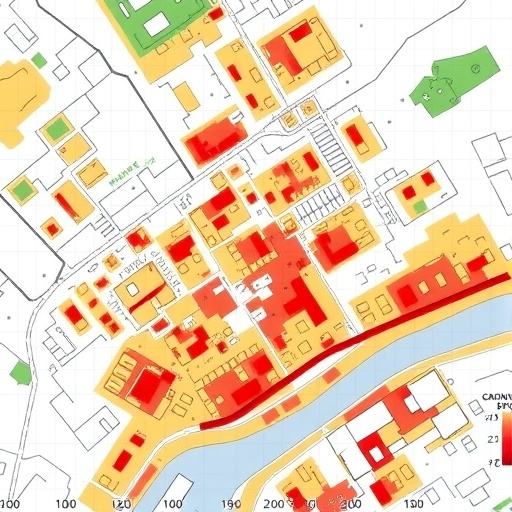
Urban Environments Reveal Predictable Climate Patterns Through Advanced Scaling Laws
In an age where cities are expanding at unprecedented rates and climate change poses severe challenges, understanding the intricate relationship between urbanization and microclimate variability is pivotal. A groundbreaking study recently published in Nature Cities provides a detailed analysis of how microclimate fluctuations within cities, including temperature and air quality variations, scale in a systematic manner across different urban environments worldwide. Moving beyond simplistic averages, this research leverages high-resolution spatial data and statistical physics frameworks to offer a nuanced, predictive perspective on urban climate dynamics.
Urban microclimates are complex phenomena shaped by myriad factors, including population density, infrastructure design, vegetation cover, and anthropogenic emissions. Traditionally, studies have largely relied on generalized metrics such as average monthly temperatures or annual pollutant concentrations to characterize urban climatic conditions. However, such metrics obscure the significant spatial variability found within cities, which is critical for targeted urban planning and public health interventions. The novel approach embraced in this study transcends these limitations by dissecting the marginal and joint probability distributions of temperature and pollutant concentration fields at extremely fine spatial resolutions.
Crucially, the researchers examined data from 142 cities dispersed globally, covering a broad spectrum of climatic zones, socio-economic contexts, and urban morphologies. Employing satellite remote sensing, street network overlays, and population density maps, they constructed an integrative dataset that captures the interplay between urban form and microclimate with granularity rarely seen before. What emerged from this comprehensive analysis was a striking finding: the distributions of temperature fluctuations and air pollution concentrations conform to universal scaling functions that resemble finite-size scaling concepts from statistical physics.
Finite-size scaling, a principle commonly applied in condensed matter physics to describe how system properties evolve with size, finds an unexpected but powerful analogy in urban climate studies. Here, the “size” corresponds to city-scale quantities such as population, while the “system” is the spatial layout of the urban environment. By mapping climatic variables onto these scaling laws, the study demonstrates that the variability within a city’s microclimate does not merely depend on its total population or area but hinges on deeper structural factors embedded in the street network and population distribution.
One of the most compelling aspects of this research is the discovery of logarithmic relationships linking urban spatial characteristics to climate fluctuations. In essence, the authors show that average street network properties—such as street length distributions, connectivity, and density—sufficiently encode the intricate spatial heterogeneity of temperature and pollution fields within cities. This insight overturns previous assumptions that complex climate behaviors require equally complex explanatory models, suggesting instead that key urban design metrics can serve as robust predictors.
Beyond its theoretical elegance, the practical implications of these findings are profound. Urban planners and policymakers can harness these scaling relations to forecast intra-urban climate variability without resorting to computationally intensive simulations. By integrating these generalizable functions into reduced-complexity models, city administrators can optimize infrastructure development, improve air quality management, and combat urban heat island effects more effectively. This has the potential to drastically improve urban resilience as climate challenges intensify globally.
Moreover, the approach adopted in this study facilitates cross-city comparisons, enabling the construction of generalized frameworks that transcend local idiosyncrasies. The universal scaling functions can be used to benchmark cities worldwide, assess their climate vulnerability, and identify priority zones for mitigation measures. Such an analytical lens is indispensable for shaping equitable and sustainable urban futures, particularly in rapidly urbanizing regions of the Global South where data scarcity has traditionally hampered detailed climate assessments.
At its core, this research exemplifies an interdisciplinary fusion, blending urban science, climatology, and statistical physics. The methodology leverages well-established physics concepts, adapting them cleverly to socio-environmental systems, thus broadening the theoretical toolkit available for urban climate research. By doing so, it opens pathways for further exploration, such as incorporating socio-economic variables and examining temporal dynamics of intra-urban climate fluctuations under different seasonal or developmental scenarios.
Further advancements in this vein could incorporate machine learning approaches to refine model precision and deepen understanding of causative mechanisms behind observed scaling laws. Additionally, expanding these analyses to include variables like humidity, wind patterns, and green infrastructure integration would embellish the current framework, providing a holistic climate model for urban environments. Such multidisciplinary enhancements promise to transform urban climate research into a predictive science with actionable insights.
This comprehensive study also casts light on the critical role of street networks as more than mere conduits for movement—they actively shape environmental conditions. By influencing airflow, shading patterns, and pollutant dispersion, street configurations emerge as pivotal determinants of microclimatic heterogeneity. This recognition empowers urban designers to rethink conventional street planning strategies with a climate-responsive lens, promoting healthier, more liveable cities.
Importantly, these findings resonate against the backdrop of escalating urban heat island intensity and worsening urban air pollution worldwide. Understanding how intra-urban climate fluctuations scale across diverse settings equips stakeholders with the tools to implement micro-targeted interventions—be it localized cooling strategies, traffic flow optimization, or strategic vegetation planting—that collectively modulate the urban climate at multiple scales.
The authors’ rigorous analytical framework and extensive dataset lay a solid foundation for subsequent research endeavors. Subsequent investigations may probe how socio-political factors influence urban climate variability and explore the implications of scaling laws in climate adaptation policy design. Likewise, assessing the interplay between urban microclimate variability and public health outcomes remains a fertile research frontier that could transform environmental epidemiology.
In sum, this pioneering study revolutionizes the understanding of urban climate variability by anchoring it in universal scaling principles derived from physical systems. It transcends traditional aggregate metrics to reveal intricate, predictable patterns embedded in the spatial fabric of cities. Its implications resonate across scientific disciplines and practical domains, heralding a new era where urban microclimates can be systematically quantified and managed with unprecedented precision.
Future urban planning, informed by these scaling functions, holds promise for crafting cities that are not only larger but smarter—cities better equipped to protect their inhabitants from the climate challenges of tomorrow. By integrating this knowledge, societies worldwide stand to foster more resilient, healthier urban environments, demonstrating that scientific innovation can pave the path to sustainable coexistence with nature, even within sprawling metropolitan landscapes.
As global urban populations continue to surge, the urgency of developing robust, scalable climate insights grows exponentially. This research represents a crucial step forward in that quest, highlighting how complex environmental phenomena can be unraveled through the lens of physics-inspired scaling laws. The universality discovered suggests that despite cultural, geographic, and infrastructural differences, urban microclimates abide by shared foundational principles—principles we can now harness for a better urban future.
Subject of Research: Intra-urban climate variability, focusing on temperature and air pollution fluctuations within cities and their relation to urban spatial structure.
Article Title: Scaling intra-urban climate fluctuations
Article References:
Duran-Sala, M., Hendrick, M. & Manoli, G. Scaling intra-urban climate fluctuations. Nat Cities (2026). https://doi.org/10.1038/s44284-026-00441-z
Image Credits: AI Generated
DOI: https://doi.org/10.1038/s44284-026-00441-z
Tags: high-resolution spatial climate dataimpact of urbanization on microclimatesintra-urban climate fluctuation patternsmicroclimate dynamics and urban planningpollutant concentration distribution in citiespredictive urban climate modelingscaling laws in urban environmentsspatial variability of urban temperaturestatistical physics in climate studiestemperature variability in citiesurban air quality fluctuationsurban microclimate variability