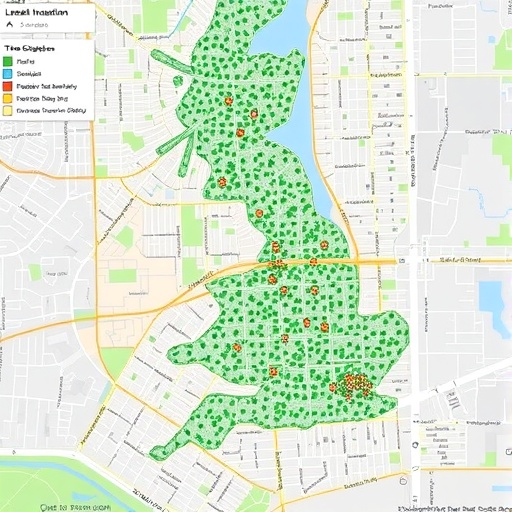
In the sprawling urban forests of the Pacific Northwest, the invasion of English Holly, scientifically known as Ilex aquifolium, is becoming increasingly concerning. Recent research has shed light on the alarming spatial dynamics of this invasive species, presenting new insights into its proliferation in these ecosystems. The study, led by esteemed researchers Lopez, Hicks, and Feola, delves into the mechanisms driving English Holly’s encroachment, providing vital information that could inform conservation strategies and ecosystem management efforts.
English Holly, a species originally hailing from Europe, has found a new home in the temperate regions of North America. Though admired for its ornamental value and festive associations, this species poses significant threats to local biodiversity. Its invasive nature competes with native flora, disrupting the delicate balance of urban forest ecosystems. Through their comprehensive examination, the researchers have highlighted the need to address the ecological impact of such invasions.
One notable revelation from the study is how the spatial dynamics of Ilex aquifolium vary within urban environments. The research employed advanced geographical information systems (GIS) to map the species’ spread and ascertain its patterns of growth. The intricate interplay between urban landscapes and biological invasions must be thoroughly understood, as urbanization can both hinder and facilitate the spread of invasive species, depending on specific environmental parameters.
The team’s findings suggest that microhabitats within urban forests significantly influence the invasion of English Holly. For instance, areas with greater sunlight exposure tend to harbor more considerable infestations. This observation raises questions about the role of forest management practices in either exacerbating or mitigating the spread of invasive species. Furthermore, the researchers have suggested that targeted management interventions can be devised, utilizing knowledge of spatial dynamics to curb the proliferation of English Holly.
Another key aspect of the study involves identifying the factors that contribute to Ilex aquifolium’s successful establishment in urban settings. The researchers have noted that soil composition, moisture levels, and competition with native species play crucial roles in facilitating its growth. By analyzing these variables, the study has provided a framework for predicting the areas most susceptible to invasion, enabling urban planners and ecologists to devise proactive measures against this invasive threat.
The implications of Ilex aquifolium’s spread extend beyond ecological concerns; they intertwine with social and economic dimensions. The cost of managing the invasive species can be substantial for municipalities. The researchers advocate for integrating ecological studies into urban planning to determine the most effective and cost-efficient measures for controlling non-native species like English Holly. Effective management strategies could not only preserve native biodiversity but also reduce the financial burden on urban centers.
In addition to their focus on spatial dynamics, the researchers have pointed out the importance of public awareness and community engagement in combating invasive species. Education initiatives can empower local communities to recognize the threat posed by English Holly and participate in eradication efforts. Public buy-in can often be a decisive factor in the success of invasive species management programs.
Through a series of field surveys combined with laboratory analysis, the team’s research has collected both qualitative and quantitative data, fostering a comprehensive understanding of English Holly’s ecological impact. The integrated approach they have employed is indeed groundbreaking; it serves as a model for future research on other invasive species in varying environments. By employing interdisciplinary methodologies, such studies can yield more robust insights into the complexities of biological invasions.
As urban centers continue to expand, the findings from Lopez, Hicks, and Feola’s work underscore a pressing need for adaptive management practices tailored to the dynamics of invasive species. Their research advocates for a collaborative approach, involving ecologists, urban planners, and the local community to address biodiversity loss effectively. Such collaboration is not just beneficial; it is essential for ensuring the resilience of urban ecosystems against invasive threats.
In conclusion, the insights derived from this pivotal study prompt a re-examination of how urban forests are managed in relation to invasive species. The ramifications of English Holly’s invasion extend beyond simple ecological metrics; they engage broader themes of biodiversity, ecosystem health, and community involvement. The continued study of this invasive species and its dynamics will be paramount as we seek to maintain and enhance the ecological integrity of urban landscapes.
The research on English Holly exemplifies how modern science can address urgent ecological issues. By continually updating our understanding of species invasions and their impacts, we can forge a path toward more sustainable urban environments. It stands as a compelling reminder of the critical intersection between ecology and urban planning, urging us to act swiftly and effectively to protect our planet’s diverse ecosystems.
With the urgency of urban biodiversity conservation ever-increasing, the research conducted by Lopez, Hicks, and Feola will undeniably serve as a cornerstone for future inquiries into the peculiarities of urban invasions. Their findings will resonate with ecologists and urban planners alike, carving a forward-thinking path for the conservation of our urban forests.
As we stand at the crossroads of development and environmental stewardship, it becomes imperative to heed the lessons provided through this significant research. Understanding the spatial dynamics of invasive species like English Holly is not merely an academic exercise but a pressing necessity in our ever-evolving urban landscapes.
By taking the findings from this study to heart, we can hope to foster healthier ecosystems that accommodate the intricate tapestry of life they harbor.
Subject of Research: Invasion dynamics of English Holly (Ilex aquifolium) in urban forests
Article Title: Novel insights into the spatial dynamics of English Holly (Ilex aquifolium) invasion in an urban forest ecosystem in the Pacific Northwest of the United States.
Article References:
Lopez, S., Hicks, N. & Feola, J. Novel insights into the spatial dynamics of English Holly (Ilex aquifolium) invasion in an urban forest ecosystem in the Pacific Northwest of the United States.
Discov. Plants 3, 7 (2026). https://doi.org/10.1007/s44372-026-00465-8
Image Credits: AI Generated
DOI: https://doi.org/10.1007/s44372-026-00465-8
Keywords: Ilex aquifolium, urban forests, invasive species, biodiversity, ecological impact, community engagement, environmental management.
Tags: conservation efforts for native plantsecological consequences of English HollyEnglish Holly invasion patternsGIS mapping of invasive speciesIlex aquifolium ecologyimpact of urbanization on florainvasive species management strategiesornamental plants and invasivenessPacific Northwest urban ecosystemsresearch on urban biodiversity.spatial dynamics of invasive speciesurban forest biodiversity threats