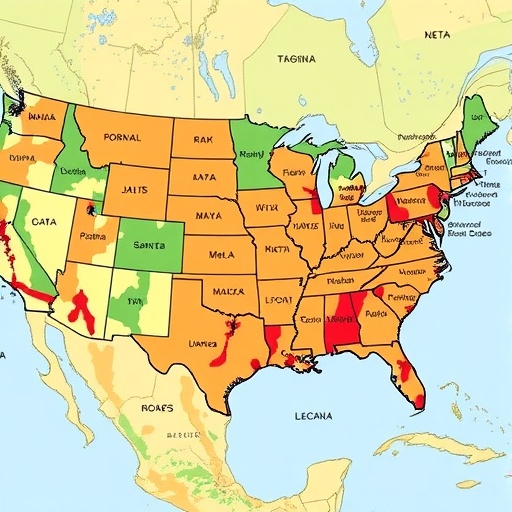
In an era where human mobility plays a decisive role in shaping socio-economic landscapes, understanding the intricate patterns of migration has become paramount for policymakers, urban planners, and social scientists alike. A groundbreaking study published in Nature Communications by Agostini, Young, Fitzpatrick, and colleagues in 2025 delves deep into the subtle, fine-grained migration trends throughout the United States. This work, representing the culmination of cutting-edge data analytics and geographical modeling, offers an unprecedented glance at the granular flows of people within the country, illuminating previously hidden dynamics in population shifts.
Migration in the United States is a subject deeply intertwined with economic opportunity, cultural shifts, and environmental challenges. Historically, studies of migration relied heavily on census data, surveys, and coarse-grained administrative records that, while informative, often masked dynamic and localized movements. Agostini et al. pivot from these traditional approaches by incorporating novel data streams, leveraging anonymized mobile phone tracking, detailed tax records, and digital footprint analysis to reconstruct migration flows at a much finer spatial and temporal resolution. This approach allows for the capture of day-to-day decisions and seasonal shifts, rendering a more vivid and accurate picture of the migratory landscape.
At the core of this study is a robust methodological framework that employs machine learning algorithms tailored to sift through enormous datasets. The researchers used clustering techniques to identify regions with similar migratory behaviors and temporal patterns, while also deploying network analysis to model the intricate connections linking different urban and rural localities. One of the remarkable outcomes of these methods is the generation of predictive maps displaying migration corridors that evolve dynamically, reflecting economic booms, natural disasters, or policy changes almost in real-time.
Technical advances in data privacy were also a cornerstone of the research, given the sensitivity of personal movement data. Agostini and colleagues implemented differential privacy protocols to ensure individual anonymity without sacrificing the granularity essential for robust modeling. This balance between privacy and precision represents a significant leap forward in migration studies, setting new ethical benchmarks for future research in this domain.
The implications of this fine-grained migration inference stretch far beyond academic curiosity. Urban planners can now harness these insights to design cities more resilient to influxes of population, optimizing infrastructure development and public services allocation. Economic development strategies become more targeted, identifying micro-regions poised for growth or decline. Furthermore, social services, health care provisioning, and educational resource distribution can be dynamically adjusted to meet the needs of communities experiencing rapid demographic changes.
Environmental scientists and disaster preparedness agencies also stand to benefit from this work. The detailed migration maps highlight patterns of movement triggered by climate events, such as hurricanes, wildfires, or prolonged droughts. This temporal precision enables authorities to anticipate evacuation needs and post-disaster recovery efforts with unparalleled accuracy, potentially saving lives and resources.
The study also reveals fascinating sociological trends. For example, there is a clear migration pattern linked to remote work adoption, with smaller towns and suburban areas witnessing significant inward migration, often from traditional metropolitan centers. This shift alters housing markets, community compositions, and even voting demographics, unfolding a complex web of societal transformation driven by very recent technological and cultural evolutions.
One of the more unexpected outcomes uncovered relates to intra-regional migration patterns, frequently overlooked in broader national analyses. The researchers uncovered micro-level movements within metropolitan agglomerations that suggest a nuanced relationship between affordability, employment opportunities, and lifestyle preferences. These insights emphasize that migration is no longer solely an inter-state or interstate phenomenon but also involves intricate intra-urban and peri-urban dynamics.
Additionally, the study’s predictive capabilities allow for scenario modeling under various policy frameworks. By simulating factors such as tax incentives, housing regulations, or changes in remote work policies, the researchers demonstrate how migration patterns can be influenced, providing a valuable tool for government bodies looking to steer demographic trends deliberately.
The research team also explored the impact of international migration on internal U.S. movements, studying how recent arrivals settle and subsequently relocate within the country. They discovered distinct settling patterns contingent on economic sectors and social networks, knowledge that could inform immigrant integration programs and labor market strategies.
Importantly, this research dispels some common myths about American migration — for instance, the idea that migration predominantly flows towards coastal urban centers. Instead, it reveals emergent migration “hotspots” in less traditionally recognized regions, driven by factors like industry shifts, cultural amenities, or lifestyle changes that appeal to particular demographic groups.
On a methodological note, the integration of real-time data processing pipelines marks a significant advancement. The researchers employed distributed computing environments to manage and analyze petabytes of data swiftly, enabling near-real-time tracking and updating of migratory trends. This real-time aspect paves the way for dynamic decision-making, something previously unattainable in population movement studies.
From a public engagement perspective, this kind of research also holds potential for empowering communities. Detailed migration trends can inform local economic development councils, neighborhood associations, and civic organizations about demographic shifts, allowing them to lobby for resources or adjust strategies in tune with their evolving constituencies.
Looking toward the future, Agostini and her colleagues argue for expanding this fine-grained migration monitoring framework to include other countries and eventually develop a global migration inference system. Such an international approach would be instrumental in addressing the challenges of global urbanization, climate-induced displacement, and international labor mobility on a worldwide scale.
The findings underscore the importance of interdisciplinarity, combining expertise in geography, computer science, sociology, economics, and environmental science to unravel the complexities of human mobility. This integrative approach sets a precedent for future research to harness diverse data sources and analytic techniques in service of understanding and addressing societal challenges.
In conclusion, this pioneering study redefines how migration patterns are understood, measured, and interpreted in the United States. Its use of sophisticated computational techniques, ethical data handling, and real-time analytics offers a blueprint for migration studies globally. The detailed migration insights emerging from this research carry profound implications for policy, planning, environmental management, and social cohesion as societies navigate a rapidly changing demographic landscape.
As the world grapples with new economic realities, environmental crises, and technological shifts, fine-grained migration analysis will likely become an indispensable tool for both governments and communities to adapt successfully. Agostini and her team’s work hence not only enriches academic understanding but also equips society with the knowledge necessary to anticipate and shape the future of human settlement and movement.
Subject of Research: Inferring fine-grained migration patterns and population mobility across the United States using advanced data analytics and machine learning techniques.
Article Title: Inferring fine-grained migration patterns across the United States.
Article References:
Agostini, G., Young, R., Fitzpatrick, M., et al. Inferring fine-grained migration patterns across the United States. Nat Commun (2025). https://doi.org/10.1038/s41467-025-68019-2
Image Credits: AI Generated
Tags: advanced data analytics in migration studiescultural implications of migration trendsdigital footprint analysis in migration researchenvironmental factors influencing migrationgeographical modeling of population shiftsgranular migration flow reconstructionlocalized migration dynamicsmobile phone tracking for migration datapolicymakers and urban planners migration strategiessocio-economic impact of migrationtraditional vs modern migration data sourcesU.S. migration patterns analysis