• HOME
  • NEWS
  • EXPLORE
    • CAREER
      • Companies
      • Jobs
    • EVENTS
    • iGEM
      • News
      • Team
    • PHOTOS
    • VIDEO
    • WIKI
  • BLOG
  • COMMUNITY
    • FACEBOOK
    • INSTAGRAM
    • TWITTER
Saturday, February 7, 2026
BIOENGINEER.ORG
No Result
View All Result
  • Login
  • HOME
  • NEWS
  • EXPLORE
    • CAREER
      • Companies
      • Jobs
        • Lecturer
        • PhD Studentship
        • Postdoc
        • Research Assistant
    • EVENTS
    • iGEM
      • News
      • Team
    • PHOTOS
    • VIDEO
    • WIKI
  • BLOG
  • COMMUNITY
    • FACEBOOK
    • INSTAGRAM
    • TWITTER
  • HOME
  • NEWS
  • EXPLORE
    • CAREER
      • Companies
      • Jobs
        • Lecturer
        • PhD Studentship
        • Postdoc
        • Research Assistant
    • EVENTS
    • iGEM
      • News
      • Team
    • PHOTOS
    • VIDEO
    • WIKI
  • BLOG
  • COMMUNITY
    • FACEBOOK
    • INSTAGRAM
    • TWITTER
No Result
View All Result
Bioengineer.org
No Result
View All Result
Home NEWS Science News Chemistry

Manipulating ligands

Bioengineer by Bioengineer
March 24, 2020
in Chemistry
Reading Time: 2 mins read
0
IMAGE
Share on FacebookShare on TwitterShare on LinkedinShare on RedditShare on Telegram

A new dimension for promoting electrocatalysis performance by noble metal aerogels
IMAGE

Credit: (c) Ran Du


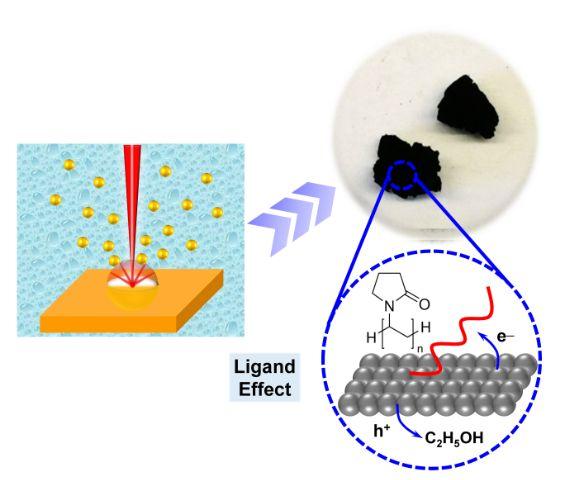
Noble metal aerogels (NMAs) are an emerging class of porous materials embracing nano-sized highly-active noble metals and porous structures, displaying unprecedented performance in diverse electrocatalytic processes. However, various impurities, particularly organic ligands, are often involved in the synthesis and remain in the corresponding products, hindering the investigation of the intrinsic electrocatalytic properties of NMAs. On the other hand, the presence of organic ligands is generally regarded detrimental to the catalytic process because they can block the active sites. However, the authenticity of this fact has not yet been verified in NMA systems because of the lack of way to impart ligands in clean NMAs via a controlled manner.

Ran Du from China is a Alexander von Humboldt research fellow working as postdoc in the physical chemistry group of Professor Alexander Eychmüller at TU Dresden since 2017. In collaboration with Prof. Stephan Barcikowski from the University of Duisburg-Essen, they recently created surface-clean noble metal aerogels by using laser-produced nanoparticles and thus, revealing a new dimension for enhancing electrocatalysis performance for electro-oxidation of ethanol (the anode reaction for direct ethanol fuel cells) by modulating ligand chemistry.

Ran Du and his team prepared various inorganic-salt-stabilized metal nanoparticles by laser ablation, which serve as organic-ligand-free precursors. In this way, they fabricated various impurity-free NMAs (gold (Au), palladium (Pd), and gold-palladium (Au-Pd) aerogels. In this light, the intrinsic electrocatalytic properties of NMAs were unveiled. In addition, these clean gels were used as a platform to deliberately graft specific ligands, by which the ligand-directed modulation of electrocatalytic properties was unambiguously demonstrated. The underlying mechanisms were found to be attributed to electron density modulations posed by different ligands, where the electrocatalytic activity of ethanol oxidation reaction (EOR) has been positively correlated with the oxidation state of the metals. In this regard, the polyvinylpyrrolidone (PVP)-modified Au-Pd bimetallic aerogel delivered a prominent current density of 5.3 times higher than commercial Pd/C (palladium/carbon) and 1.7 times higher than Au-Pd pristine aerogels.

“With this work, we not only provide a strategy to fabricate impurity-free NMAs for probing their intrinsic properties, but also offer a new dimension for devising high-performance electrocatalysts by revisiting the effects of the ligands”, assumes Ran Du.

###

Original Publication:

Fan, X.; Zerebecki, S.; Du, R.*; Hübner, R.; Marzum, G.; Jiang, G.; Hu, Y.; Barcikowki, S.; Reichenberger, S.; Eychmüller, A.*, Promoting the Electrocatalytic Performance of Noble Metal Aerogels by Ligand-Directed Modulation. Angew. Chem. Int. Ed. 2020, DOI: 10.1002/anie.201913079.

Media Contact
Ran DU
[email protected]

Related Journal Article

http://dx.doi.org/10.1002/anie.201913079

Tags: Chemistry/Physics/Materials Sciences
Share12Tweet8Share2ShareShareShare2

Related Posts

blank

Breakthrough in Environmental Cleanup: Scientists Develop Solar-Activated Biochar for Faster Remediation

February 7, 2026
blank

Cutting Costs: Making Hydrogen Fuel Cells More Affordable

February 6, 2026

Scientists Develop Hand-Held “Levitating” Time Crystals

February 6, 2026

Observing a Key Green-Energy Catalyst Dissolve Atom by Atom

February 6, 2026
Please login to join discussion

POPULAR NEWS

  • Robotic Ureteral Reconstruction: A Novel Approach

    Robotic Ureteral Reconstruction: A Novel Approach

    82 shares
    Share 33 Tweet 21
  • Digital Privacy: Health Data Control in Incarceration

    63 shares
    Share 25 Tweet 16
  • Study Reveals Lipid Accumulation in ME/CFS Cells

    57 shares
    Share 23 Tweet 14
  • Breakthrough in RNA Research Accelerates Medical Innovations Timeline

    53 shares
    Share 21 Tweet 13

About

We bring you the latest biotechnology news from best research centers and universities around the world. Check our website.

Follow us

Recent News

Florida Cane Toad: Complex Spread and Selective Evolution

Exploring Decision-Making in Dementia Caregivers’ Mobility

Succinate Receptor 1 Limits Blood Cell Formation, Leukemia

Subscribe to Blog via Email

Enter your email address to subscribe to this blog and receive notifications of new posts by email.

Join 73 other subscribers
  • Contact Us

Bioengineer.org © Copyright 2023 All Rights Reserved.

Welcome Back!

Login to your account below

Forgotten Password?

Retrieve your password

Please enter your username or email address to reset your password.

Log In
No Result
View All Result
  • Homepages
    • Home Page 1
    • Home Page 2
  • News
  • National
  • Business
  • Health
  • Lifestyle
  • Science

Bioengineer.org © Copyright 2023 All Rights Reserved.